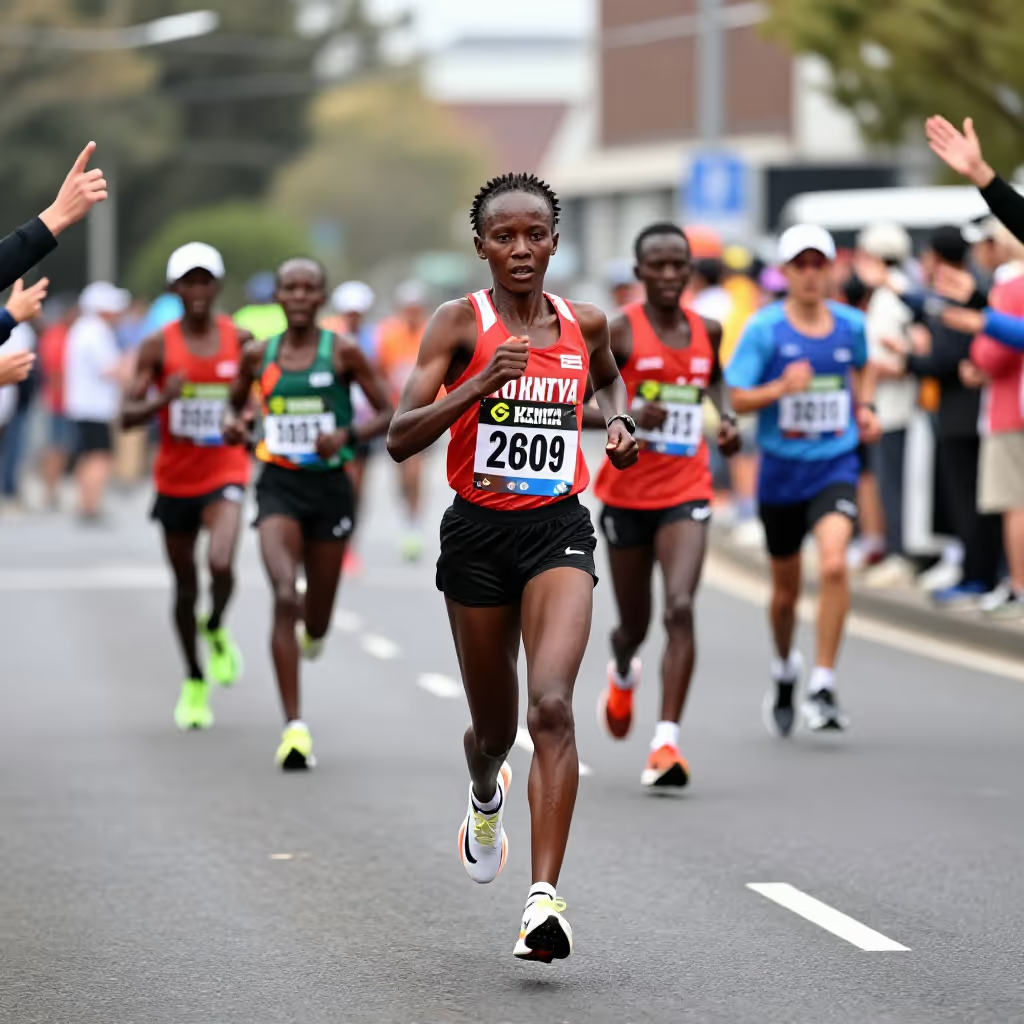
Dominating thematically, in terms of content, or atmospherically, and being the most important.
example
Die Frage der Nachhaltigkeit war das beherrschende Thema der Konferenz.
The question of sustainability was the dominant topic of the conference.

Usage tips
Participle as adjective
'Beherrschend' is the present participle of the verb 'beherrschen' (to dominate/control). Like many participles ending in '-end', it is used as an adjective to describe an active, ongoing quality.
EXAMPLE
Der Turm hat eine beherrschende Position über der Stadt.
The tower has a commanding position over the city.
Context clue
You can recognize the meaning from the noun. In connection with abstract terms like 'Thema' (topic) or 'Eindruck' (impression), it refers to dominance in terms of content. With geographical nouns like 'Felsen' (rock) or 'Position' (position), it is about physical superiority.
EXAMPLE
Die Digitalisierung ist das beherrschende Thema unserer Zeit.
Digitalization is the dominant topic of our time.
Typical combinations
In the figurative sense, 'beherrschend' (dominant) is often combined with abstract nouns. Common expressions are 'das beherrschende Thema sein' (to be the dominant topic) or 'eine beherrschende Rolle spielen' (to play a dominant role).
EXAMPLE
Die Frage nach der Sicherheit spielte eine beherrschende Rolle in der Debatte.
The question of safety played a dominant role in the debate.
Strategic position
In the literal sense, the word often describes a strategically advantageous, elevated position. Typical combinations are 'ein beherrschender Hügel' (a commanding hill), 'eine beherrschende Stellung' (a commanding position), or 'ein beherrschender Blick' (a commanding view).
EXAMPLE
Die Festung hatte eine beherrschende Stellung über dem gesamten Tal.
The fortress had a commanding position over the entire valley.
Compare with
near_synonym
beherrschend vs zentral
central
'zentral' and 'beherrschend' can both say that something is very important within a topic. 'zentral' means that something is essential and at the center. 'beherrschend' is stronger: it means that a topic, mood, or impression dominates everything else. If something is important but other things still have room alongside it, 'zentral' fits. If something determines the whole situation, 'beherrschend' is more suitable.
beherrschend
Nach dem Unfall war die Angst das beherrschende Gefühl in der ganzen Gruppe.
After the accident, fear was the dominant feeling in the whole group.
zentral
Die Frage nach der Ursache ist zentral für die Behandlung.
The question of the cause is central to the treatment.