

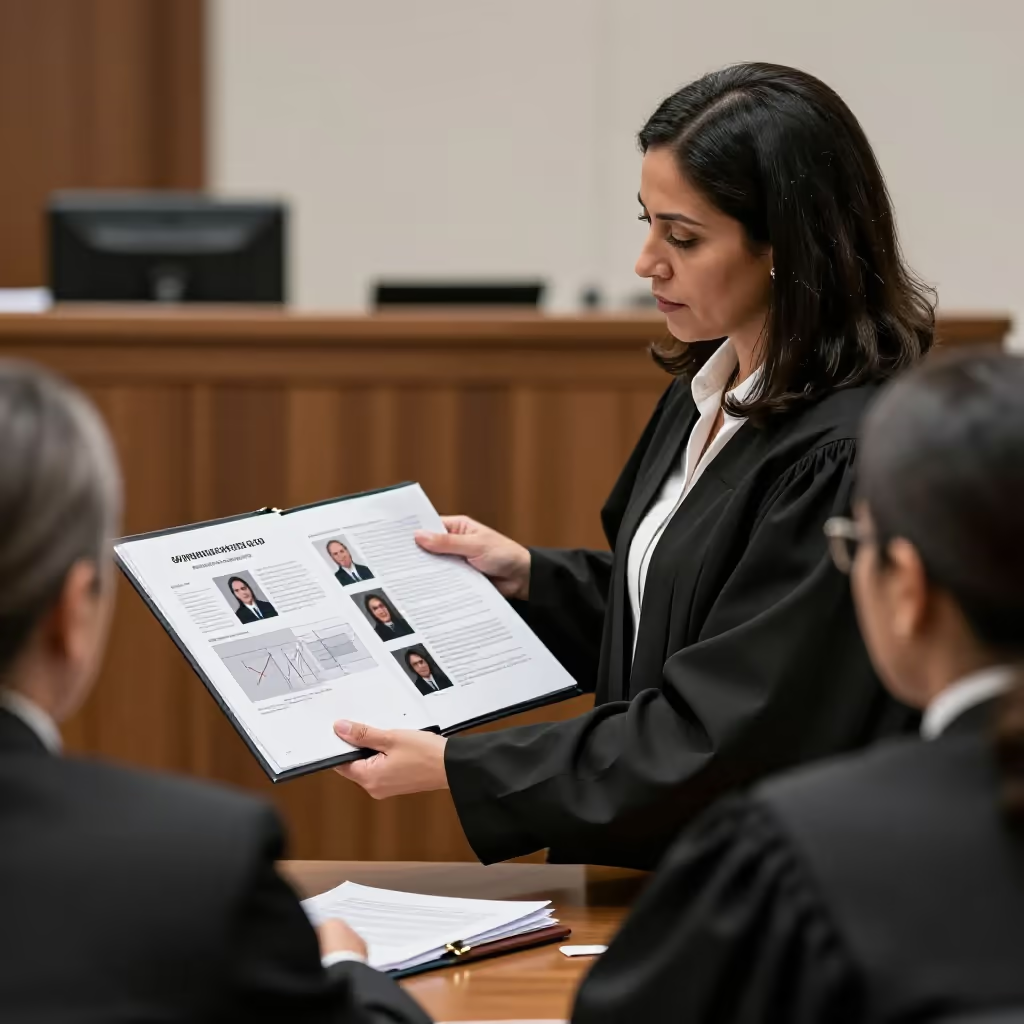
The legal obligation in a court proceeding to prove the facts on which one relies to support one's claim or defense.
example
Im Strafrecht liegt die Beweislast grundsätzlich bei der Staatsanwaltschaft, die dem Angeklagten die Schuld nachweisen muss.
In criminal law, the burden of proof generally lies with the prosecution, which must prove the defendant's guilt.
Usage tips
Compound word
The word is made up of 'der Beweis' (proof/evidence) and 'die Last' (burden). So it literally means the 'burden of proving something' or the 'proof burden'.
EXAMPLE
Die Beweislast für den Schaden liegt beim Kläger.
The burden of proof for the damage lies with the plaintiff.
Use with dative
A very common construction is 'die Beweislast liegt bei' (the burden of proof lies with), followed by a person or institution in the dative. This expresses who has responsibility for the proof.
EXAMPLE
In diesem Fall liegt die Beweislast beim Verkäufer.
In this case, the burden of proof lies with the seller.
Register: technical language
'Beweislast' (burden of proof) is a term from legal language. It is rarely used in everyday speech unless people are talking about legal topics.
EXAMPLE
Der Anwalt erklärte seinem Mandanten das Prinzip der Beweislast.
The lawyer explained the principle of the burden of proof to his client.
Typical collocations
Common verbs used with 'Beweislast' (burden of proof) are 'tragen' (to bear), 'haben' (to have), and 'umkehren' (to reverse). 'Die Umkehr der Beweislast' (the reversal of the burden of proof) is a fixed legal term.
EXAMPLE
Der Angeklagte muss die Beweislast nicht tragen.
The defendant does not have to bear the burden of proof.
Compare with
confusable
Beweislast vs Beweis
proof / evidence
'der Beweis' and 'die Beweislast' both belong to the topic of proving something, especially in court. A 'Beweis' is the fact, document, or argument that shows something. 'Beweislast', on the other hand, does not mean the proof or evidence itself, but the obligation to prove something. The words can be confused because both begin with 'Beweis' and often appear in legal contexts. The simple distinction is important: you present the 'Beweis'; the 'Beweislast' says who has to provide that proof or evidence.
Beweislast
In diesem Fall liegt die Beweislast bei der Firma.
In this case, the burden of proof lies with the company.
Beweis
Ohne einen Beweis kann der Richter die Aussage nicht sicher beurteilen.
Without evidence, the judge cannot assess the statement with certainty.