

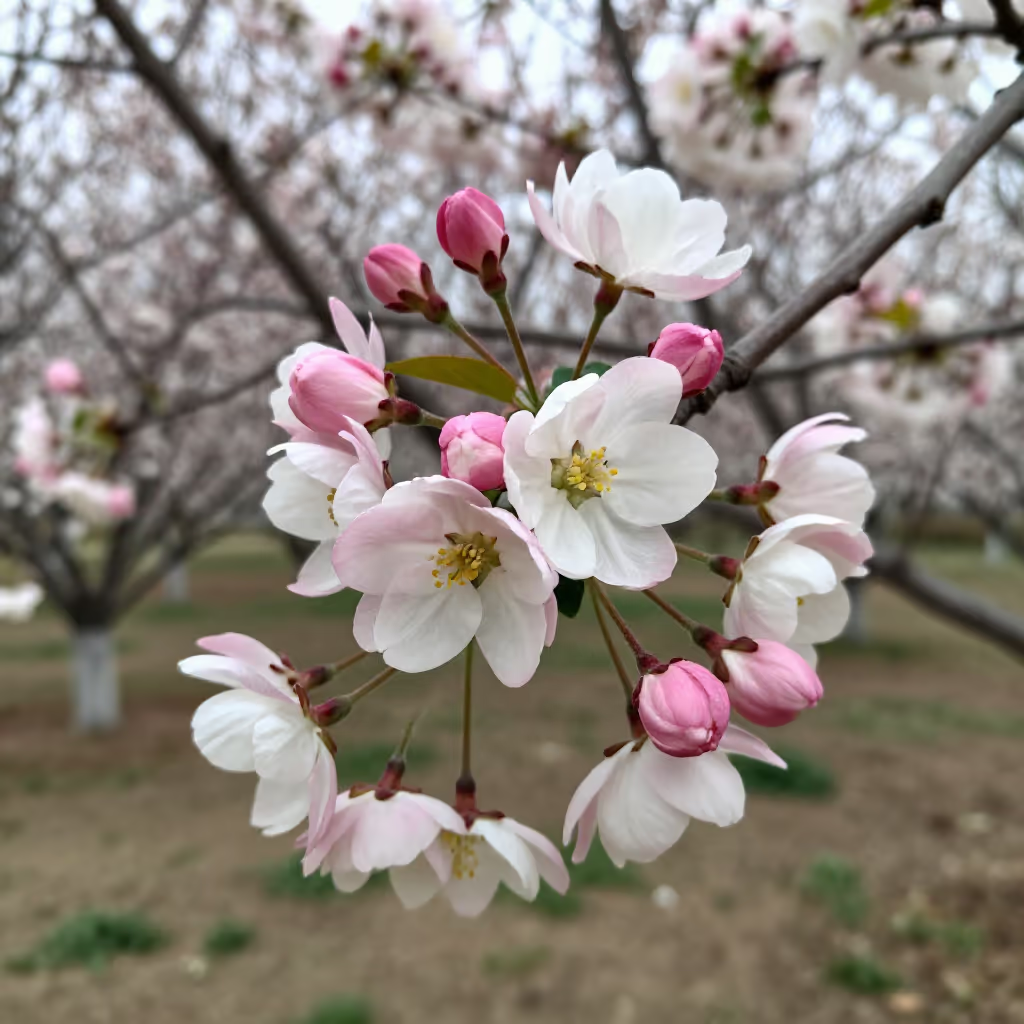
blühen
to bloom
The process in which a plant produces blossoms.
EXAMPLE
Im Frühling blühen die Kirschbäume in den schönsten Farben.
In spring, the cherry trees bloom in the most beautiful colors.
to bloom / flourish
Loading your saved state.
to bloom
The process in which a plant produces blossoms.
Im Frühling blühen die Kirschbäume in den schönsten Farben.
In spring, the cherry trees bloom in the most beautiful colors.

to flourish
To develop splendidly, flourish, or thrive. Often used figuratively for businesses, the imagination, or life.
Seit der neuen Geschäftsführerin blüht das Geschäft regelrecht auf.
Since the new managing director arrived, the business has really begun to flourish.

to be in store for someone
A usually unpleasant consequence or unwanted event that awaits someone in the future.
Wenn du deine Hausaufgaben nicht machst, blüht dir am Wochenende Hausarrest.
If you don't do your homework, a weekend of being grounded is in store for you.
You can recognize the figurative meaning 'florieren' (to flourish) from the context. If the subject is not a plant, but something abstract like 'das Geschäft' (the business), 'die Kunst' (art), or 'die Fantasie' (the imagination), this metaphorical meaning is intended.
Im Mittelalter blühte der Handel zwischen den Städten.
In the Middle Ages, trade between the cities flourished.
The separable verb 'aufblühen' (to blossom/flourish) is also often used in this figurative meaning. It often emphasizes the beginning or the process of thriving.
Nach dem Umzug in die neue Stadt ist sie richtig aufgeblüht.
After moving to the new city, she really blossomed.
This meaning has a fixed grammatical structure: the unpleasant event is in the nominative as the subject, while the person affected by it is in the dative. The structure is: Etwas (Nom.) blüht jemandem (Dat.) (something is in store for someone).
Wenn du jetzt nicht gehst, blüht dir eine Menge Ärger.
If you don't leave now, a lot of trouble is in store for you.
Although 'blühen' (to bloom) sounds positive, this construction is always used for something unpleasant that awaits someone. It is often a warning or an ironic observation.
Wer ohne Ticket fährt, dem blüht eine hohe Geldstrafe.
Anyone who travels without a ticket has a heavy fine in store for them.
to expect
Both verbs can name a consequence that is about to happen to someone. „Erwarten“ remains matter-of-fact and usually takes the consequence as an accusative object, while „jemandem blühen“ marks a usually unpleasant prospect with the dative. „Blühen“ is often a better choice for an impending punishment.

Dem Angeklagten blüht nach dem Prozess eine hohe Strafe.
The defendant has a severe sentence in store after the trial.
Der Angeklagte erwartet nach dem Prozess eine hohe Strafe.
The defendant expects a severe sentence after the trial.