

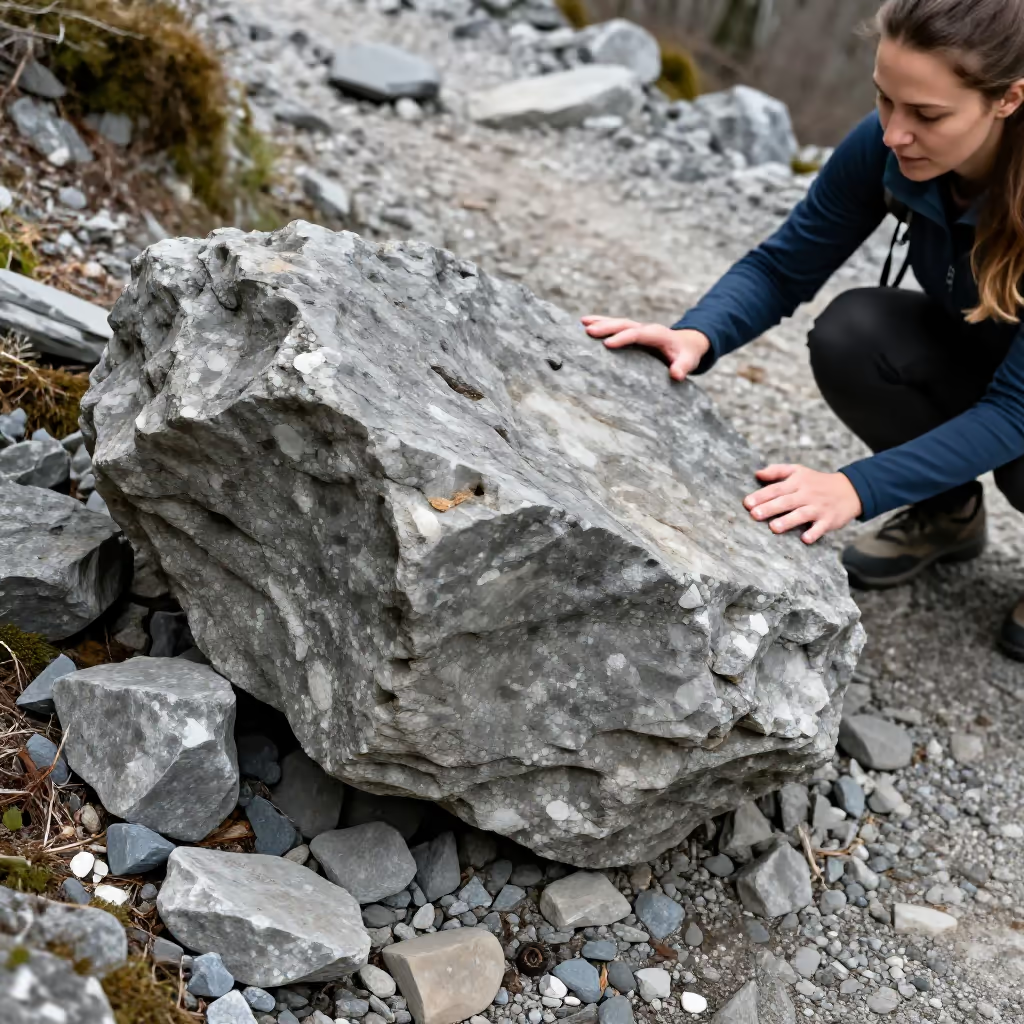
der Brocken
chunk
A large, irregular piece of something solid, for example rock, bread, or ice.
EXAMPLE
Er brach einen großen Brocken vom Brotlaib ab.
He broke off a large chunk from the loaf of bread.
chunk
Loading your saved state.
chunk
A large, irregular piece of something solid, for example rock, bread, or ice.
Er brach einen großen Brocken vom Brotlaib ab.
He broke off a large chunk from the loaf of bread.

tough challenge
Colloquial for a very difficult task, a big problem, or information that is hard to digest.
Die Abschlussprüfung in Physik war ein ganz schöner Brocken.
The final exam in physics was quite a tough challenge.

Brocken
The name of the highest mountain in the Harz region in northern Germany.
Wir sind letztes Wochenende auf den Brocken gewandert.
We hiked up the Brocken last weekend.

hulk / big lump
Colloquial for a large, heavy, or impressive person, animal, or object.
Der neue Türsteher ist ein echter Brocken von einem Mann.
The new bouncer is a real hulk of a man.
'Brocken' (chunk) is closely related to the verb 'brechen' (to break). A 'Brocken' is literally a piece that has been broken off from something larger. This origin helps you understand the basic meaning.
Ein Steinbrocken löste sich von der Felswand.
A chunk of rock came loose from the cliff face.
When 'Brocken' (chunk) refers to a piece of something, the noun naming the material often follows directly without an article. Typical patterns are 'ein Brocken Brot' (a chunk of bread), 'ein Brocken Käse' (a chunk of cheese), or 'ein Brocken Gestein' (a chunk of rock).
Zum Wein reichte er einen Brocken Käse.
He served a chunk of cheese with the wine.
In the meaning of 'schwierige Aufgabe' (difficult task), 'Brocken' is colloquial. You often hear it in combinations like 'ein harter Brocken' (a tough nut/a hard challenge) or 'ein dicker Brocken' (a big challenge).
Diese Aufgabe ist ein wirklich harter Brocken, ich weiß nicht, wo ich anfangen soll.
This task is a really tough challenge; I don't know where to start.
To describe a person or thing as big and heavy, the structure 'ein Brocken von einem/einer ...' (a hulk/lump of a ...) is often used. This emphasizes the impressive size.
Der neue Schrank ist ein riesiger Brocken von einem Möbelstück.
The new cabinet is a huge lump of a piece of furniture.
When 'der Brocken' is used as the name of the mountain in the Harz region, it almost always appears with the definite article 'der'. The context is usually geography, hiking, or weather.
Die Aussicht vom Brocken war fantastisch.
The view from the Brocken was fantastic.
piece
Stück and Brocken can both refer to a separated part of something solid. Stück remains neutral, while Brocken additionally emphasizes a relatively large and irregular shape. Stück fits an ordinary piece, while Brocken is more suitable for a noticeably large or misshapen piece.

Sie brach einen großen Brocken Brot ab und legte ihn auf den Teller.
She broke off a large chunk of bread and put it on the plate.
Sie schnitt ein Stück Brot ab und legte es auf den Teller.
She cut off a piece of bread and put it on the plate.