to print
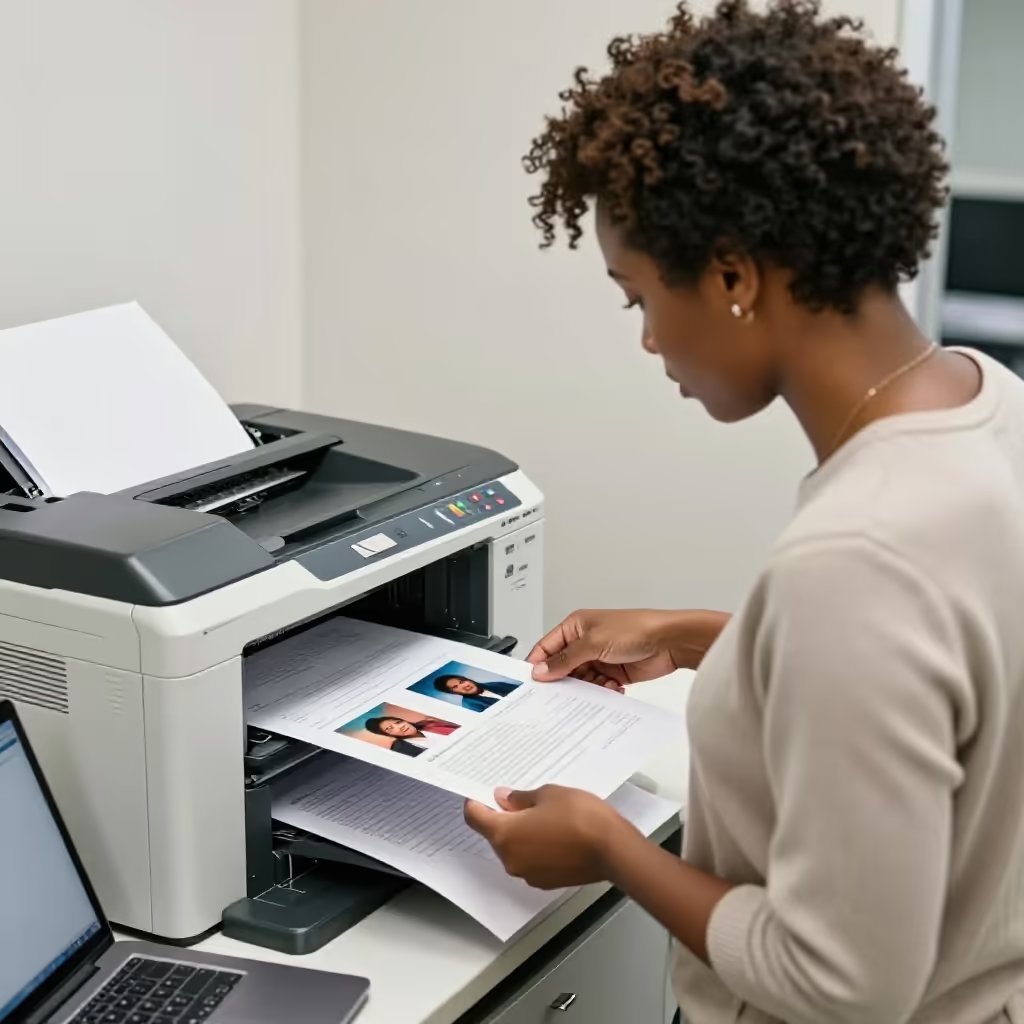
To transfer text or images onto paper or another material using a printer, printing press, or similar device.
Ich muss dieses Dokument noch schnell für das Meeting drucken.
I still need to quickly print this document for the meeting.


to print / shirk
Loading your saved state.
to print
To transfer text or images onto paper or another material using a printer, printing press, or similar device.
Ich muss dieses Dokument noch schnell für das Meeting drucken.
I still need to quickly print this document for the meeting.

The verb 'drucken' (to print) is closely related to the noun 'der Druck' (pressure). The basic meaning of printing is to put ink onto paper with pressure. The reflexive meanings too, such as 'sich vor etwas drücken' (to shirk something), contain the idea of avoiding a (metaphorical) pressure.
Der hohe Erwartungsdruck in der Arbeit ist kaum auszuhalten.
The high pressure of expectations at work is almost unbearable.
It is important to distinguish the non-reflexive and reflexive forms. 'Drucken' (to print) means to put something onto paper (e.g. a document). 'Sich drücken' means that a person moves themself or avoids a task.
Kannst du mir bitte diese E-Mail drucken?
Could you please print this email for me?
The expression 'sich drücken vor' (to shirk/avoid) is always used with the preposition 'vor' and the dative. It describes what one is shirking. This phrasing is somewhat colloquial.
Die Kinder versuchen, sich vor den Hausaufgaben zu drücken.
The children try to shirk their homework.
In the technical sense, 'drucken' (to print) is often used with objects such as 'ein Dokument' (a document), 'ein Foto' (a photo), 'ein Plakat' (a poster), or 'ein Ticket' (a ticket). You can also specify how something is printed, for example 'in Farbe' (in color) or 'schwarz-weiß' (black and white).
Ich habe die Fotos vom Urlaub auf speziellem Fotopapier gedruckt.
I printed the vacation photos on special photo paper.
When 'sich drücken' means to duck or crouch, it is often followed by a preposition with a location. Typical formulations are 'sich hinter etwas drücken' (to crouch behind something), 'sich an die Wand drücken' (to press oneself against the wall), or 'sich in eine Ecke drücken' (to squeeze into a corner).
Das Kind drückte sich ängstlich hinter seine Mutter.
The child crouched anxiously behind his mother.
to publish
'veröffentlichen' and 'drucken' can both have to do with texts, books, or articles. 'veröffentlichen' means that a work or piece of information is made available to the public, for example online or in a newspaper. 'drucken' often refers only to the technical process: text or images are put onto paper. In newspapers, however, 'drucken' can also mean something similar to 'veröffentlichen'. That is why the words can be confused. The important point is: not everything that is printed with 'drucken' is also published with 'veröffentlichen'; and not everything that is published with 'veröffentlichen' is printed with 'drucken'.

Für den Unterricht druckt Lena die Arbeitsblätter zu Hause aus.
Lena prints the worksheets at home for class.
Die Redaktion veröffentlicht den Artikel heute Abend auf ihrer Webseite.
The editorial team is publishing the article on its website this evening.