


drücken
to press
To apply pressure deliberately to something with your fingers or hand, for example to a button or switch.
EXAMPLE
Du musst den roten Knopf drücken, um die Maschine zu starten.
You have to press the red button to start the machine.
to press / hug
Loading your saved state.
to press
To apply pressure deliberately to something with your fingers or hand, for example to a button or switch.
Du musst den roten Knopf drücken, um die Maschine zu starten.
You have to press the red button to start the machine.

to hug
To hold someone tightly in your arms as a sign of affection or comfort; to embrace.
Zum Abschied drückte sie ihre Freundin ganz fest.
When saying goodbye, she hugged her friend very tightly.
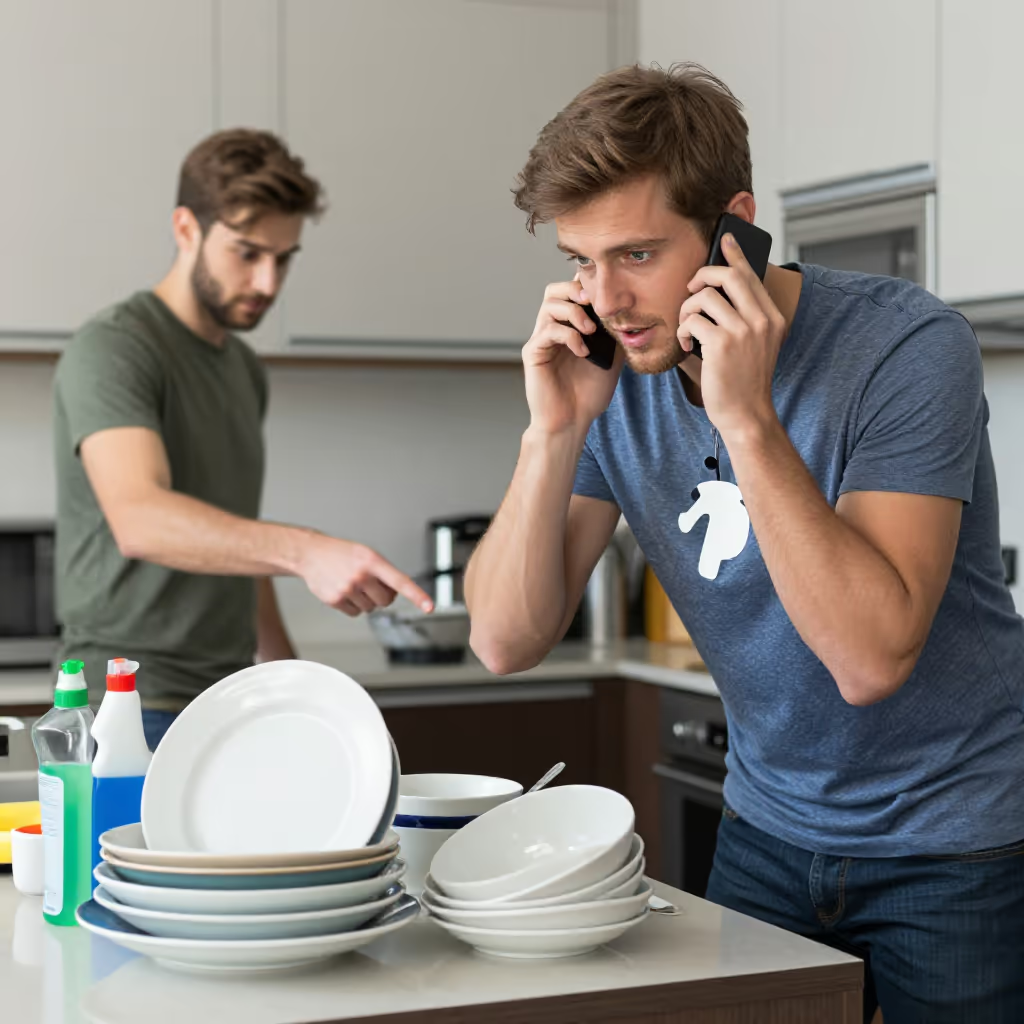
to shirk
To deliberately avoid an unpleasant task, duty, or responsibility.
Er versucht immer, sich vor dem Abwasch zu drücken.
He always tries to shirk doing the dishes.

to keep fingers crossed
To symbolically wish someone luck for an upcoming challenge.
Ich drücke dir für dein Vorstellungsgespräch ganz fest die Daumen!
I'll keep my fingers crossed for your job interview!

to push down
To move something downward or lower it, for example prices or costs.
Der Discounter versucht, die Preise für Lebensmittel weiter zu drücken.
The discount retailer is trying to push food prices down further.

to press / weigh on
A burden or worry that weighs on someone mentally or physically.
Die neuen Schuhe drücken mich am kleinen Zeh.
The new shoes are pressing on my little toe.
The expression 'sich vor etwas drücken' (to shirk something) is reflexive and always uses the preposition 'vor' with the dative. It means to avoid an unpleasant task.
Er drückt sich immer vor der Hausarbeit.
He always shirks the housework.
The idiom is 'jemandem die Daumen drücken' (to keep one's fingers crossed for someone). The person you are wishing luck to is in the dative.
Ich drücke dir die Daumen für deine Prüfung morgen!
I'll keep my fingers crossed for your exam tomorrow!
In the meaning of 'pressen' (to press), the verb is often used with objects such as 'einen Knopf' (a button), 'eine Taste' (a key/button), 'einen Schalter' (a switch), or 'eine Türklinke' (a door handle).
Um den Computer zu starten, musst du den Power-Knopf drücken.
To start the computer, you have to press the power button.
This meaning can be literal, for example when clothing is too tight. But it can also be used figuratively for worries or problems that weigh on a person.
Diese Jacke drückt mich an den Schultern.
This jacket is pressing on my shoulders.
When 'drücken' (to hug) means 'umarmen' (to embrace), it is often described more precisely with adverbs such as 'fest' (tightly), 'herzlich' (warmly), or 'lange' (for a long time).
Zur Begrüßung drückte er seinen alten Freund herzlich.
In greeting, he hugged his old friend warmly.
In the meaning of 'senken' (to lower), 'drücken' (to push down) is used almost exclusively in a business context. Typical objects are 'Preise' (prices), 'Kosten' (costs), 'Löhne' (wages), or 'Margen' (margins).
Die Konkurrenz versucht, die Preise zu drücken.
The competition is trying to push prices down.
to avoid
Both words can express avoiding an unpleasant duty. „Vermeiden“ is neutral and generally describes keeping away from something unwanted, while „sich vor etwas drücken“ is colloquial and usually criticizes avoiding a duty or responsibility. „Vermeiden“ is suitable in neutral texts, while „sich drücken vor“ is used in reproachful everyday speech.

Tom drückt sich vor der schwierigen Aufgabe und lässt seine Kollegin damit allein.
Tom is shirking the difficult task and leaving his colleague to deal with it alone.
Um Streit zu vermeiden, übernahm Lena die schwierige Aufgabe selbst.
To avoid an argument, Lena took on the difficult task herself.