

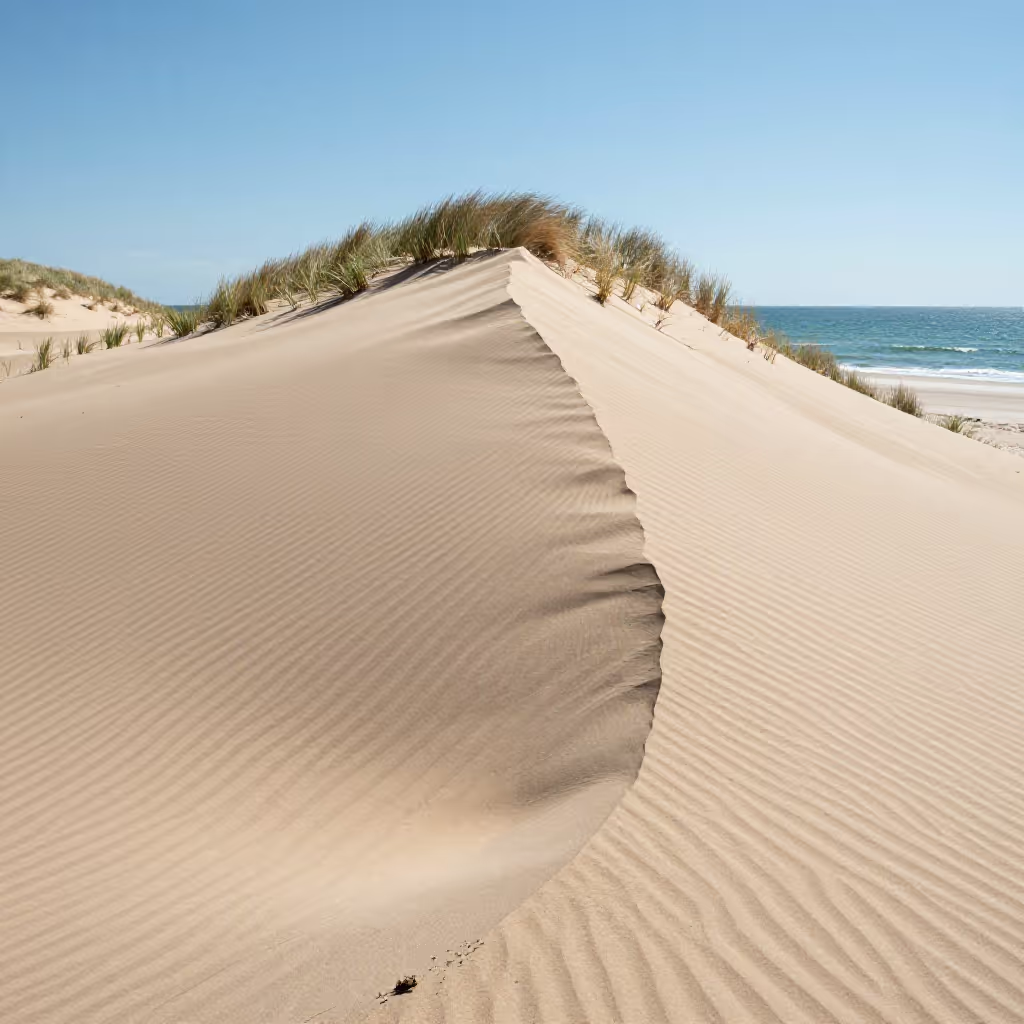
die Düne
dune
A hill of sand piled up by the wind, typically found on coasts or in deserts.
EXAMPLE
Wir sind barfuß über die hohen Dünen zum Strand gelaufen.
We walked barefoot over the high dunes to the beach.
dune
die Düne, die Dünen
Loading your saved state.
dune
A hill of sand piled up by the wind, typically found on coasts or in deserts.
Wir sind barfuß über die hohen Dünen zum Strand gelaufen.
We walked barefoot over the high dunes to the beach.
| gender | feminine die |
|---|---|
| plural | die Dünen |
| genitive | der Düne |
| singular | plural | |
|---|---|---|
| nominative | die Düne | die Dünen |
| accusative | die Düne | die Dünen |
| dative | der Düne | den Dünen |
| genitive | der Düne | der Dünen |
The article changes with the case; it is shown in colour.
With places like 'Düne' (dune), the correct preposition is important. Movement up onto the hill is expressed with 'auf die Düne' (onto the dune, accusative). If you are already there, it is 'auf der Düne' (on the dune, dative).
Die Kinder rannten auf die höchste Düne.
The children ran onto the highest dune.
Wir saßen auf der Düne und schauten aufs Meer.
We sat on the dune and looked out at the sea.
'Düne' (dune) is often combined with verbs of movement or staying in a place. Typical phrases are 'durch die Dünen wandern' (to hike through the dunes), 'in den Dünen spazieren gehen' (to go for a walk in the dunes), or 'auf einer Düne sitzen' (to sit on a dune).
Im Urlaub sind wir jeden Tag durch die Dünen gewandert.
On vacation, we hiked through the dunes every day.
Man darf in den Dünen kein Feuer machen.
You are not allowed to make a fire in the dunes.
The word 'Düne' (dune) is a common component of compound nouns that describe landscapes. Examples include 'die Sanddüne' (sand dune), 'die Wanderdüne' (shifting dune), and 'die Dünenlandschaft' (dune landscape).
Die Küste ist für ihre beeindruckende Dünenlandschaft bekannt.
The coast is known for its impressive dune landscape.