

einfassen
to frame / set
To surround something with a border, edge, or frame in order to stabilize, protect, or decorate it.
EXAMPLE
Der Juwelier wird den Diamanten in Platin einfassen.
The jeweler will set the diamond in platinum.
to frame / set
Loading your saved state.
to frame / set
To surround something with a border, edge, or frame in order to stabilize, protect, or decorate it.
Der Juwelier wird den Diamanten in Platin einfassen.
The jeweler will set the diamond in platinum.
'Einfassen' (to frame / set) is a separable verb. The prefix 'ein-' comes at the end in a main clause. In a subordinate clause, the verb stays together.
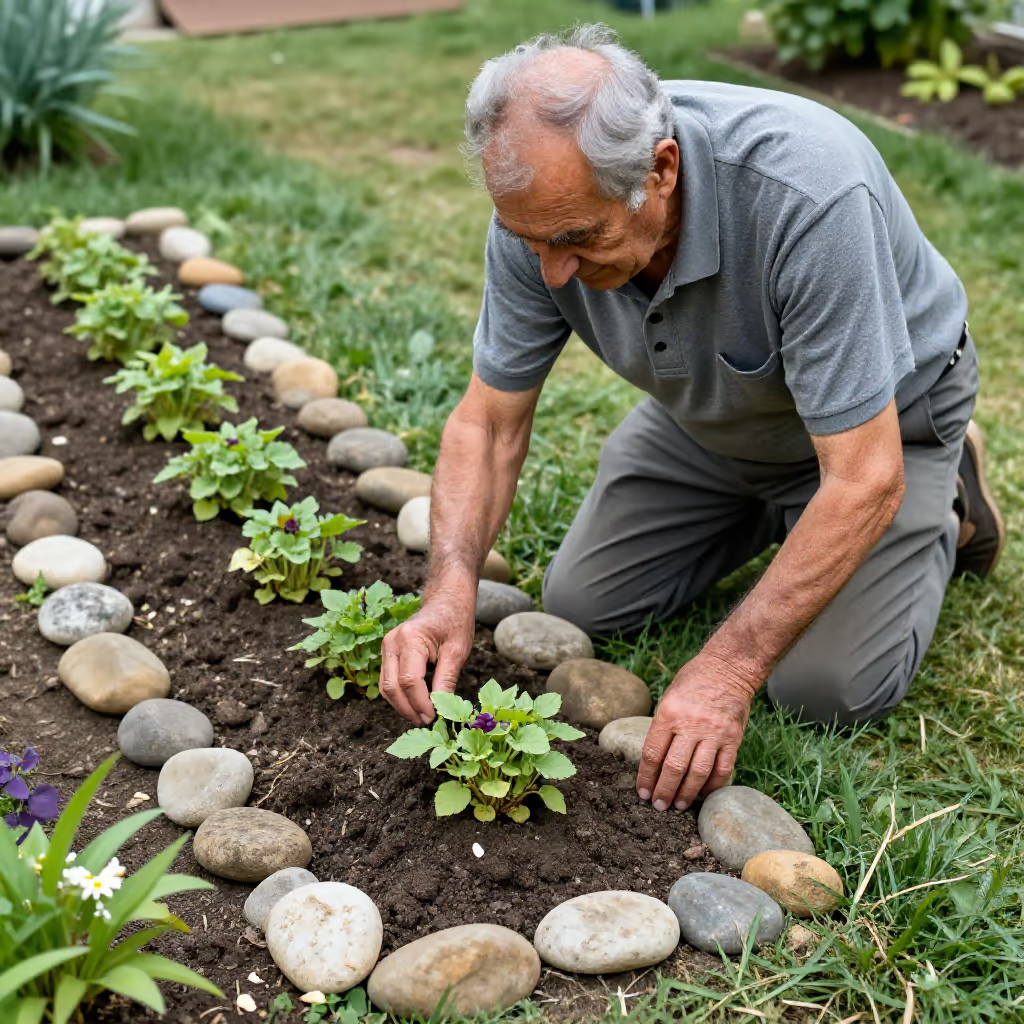
Der Gärtner fasst das Beet mit Steinen ein.
The gardener frames the flower bed with stones.
The verb consists of 'ein-' and 'fassen' (to hold, to grasp). The literal idea is to 'hold' something into a frame or boundary and thus fix it in place.
Sie wollte den Spiegel mit einem Holzrahmen einfassen lassen.
She wanted to have the mirror framed with a wooden frame.
To name the material of the frame or border, the prepositions 'in' (with dative) or 'mit' are used. The construction is: etwas (accusative) in/mit etwas (dative) einfassen.
Der Ring war mit kleinen Diamanten eingefasst.
The ring was set with small diamonds.
to remodel / surround
Both verbs can express enclosing something with a built structure. Umbauen describes a place being completely surrounded by buildings, while einfassen emphasizes a border or frame that limits, protects, or decorates something. Use umbauen for an enclosed setting, and einfassen for a frame-like boundary.

Eine niedrige Mauer fasst den kleinen Innenhof ein.
A low wall borders the small courtyard.
Der kleine Innenhof ist von hohen Wohnhäusern umbaut.
The small courtyard is surrounded by tall apartment buildings.