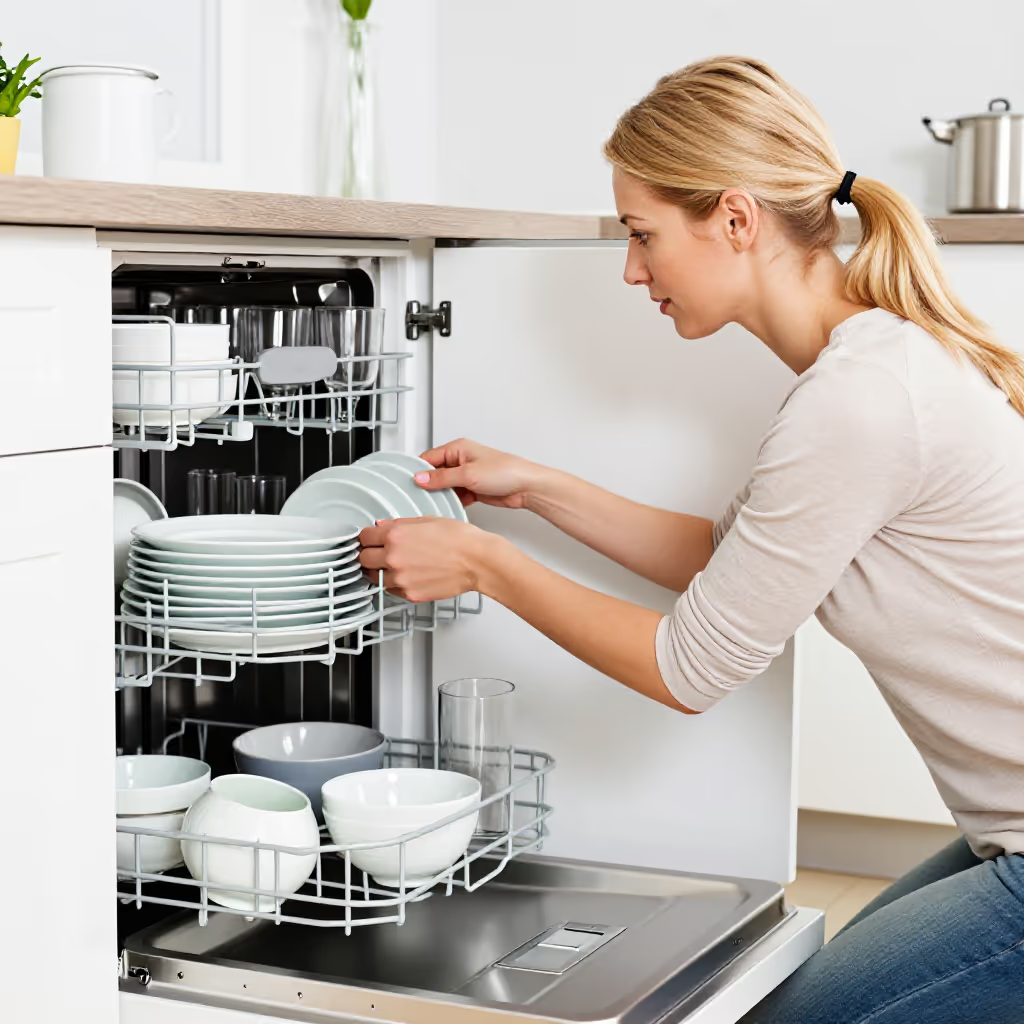
To put, place, or sort objects into their designated place, for example into a cupboard, a shelf, or the refrigerator. This is a separable verb.
example
Kannst du mir bitte helfen, die Einkäufe in die Schränke einzuräumen?
Can you please help me put the groceries away in the cupboards?

Usage tips
Separable verb
'Einräumen' (to put away / to admit / to grant) is a separable verb. The prefix 'ein-' comes at the end in main clauses. In subordinate clauses or in the infinitive with 'zu', the verb stays together.
EXAMPLE
Ich räume später die Spülmaschine ein.
I'll load the dishwasher later.
Dative construction
When granting someone an opportunity or a right, the structure 'jemandem (Dative) etwas (Accusative) einräumen' (to grant someone something) is used. The person who receives the advantage is in the dative.
EXAMPLE
Die Firma räumte ihren Mitarbeitern flexible Arbeitszeiten ein.
The company granted its employees flexible working hours.
Sentence structure with 'dass'
In the meaning 'to admit', the object can be a noun ('einen Fehler einräumen' — to admit a mistake) or an entire subordinate clause with 'dass' (that). This is very common in formal language or reports.
EXAMPLE
Der Politiker musste einräumen, dass er nicht die Wahrheit gesagt hatte.
The politician had to admit that he had not told the truth.
Typical collocations
In the literal meaning, 'einräumen' (to put away) is often combined with household items. Typical objects are: groceries, dishes, laundry, or books.
EXAMPLE
Nach dem Waschen muss ich noch die saubere Wäsche einräumen.
After washing, I still have to put away the clean laundry.
Compare with
near_synonym · confusable
einräumen vs anerkennen
to recognize / acknowledge
'anerkennen' and 'einräumen' can both mean that you admit something is true. The difference lies in the tone and the context. 'einräumen' is often used when someone admits a mistake, a problem, or an unpleasant fact, usually reluctantly. 'anerkennen' sounds somewhat broader and can also mean that you accept a fact or agree with it. Learners may confuse the words because both fit in discussions or criticism. As a simple guide: you are more likely to 'einräumen' your own mistake; you are more likely to 'anerkennen' a fact or a result.
einräumen
Mein Kollege räumt ein, dass er die E-Mail zu spät beantwortet hat.
My colleague admits that he answered the email too late.
anerkennen
Nach der Besprechung erkannte Mara an, dass der Plan noch Lücken hatte.
After the meeting, Mara acknowledged that the plan still had gaps.