
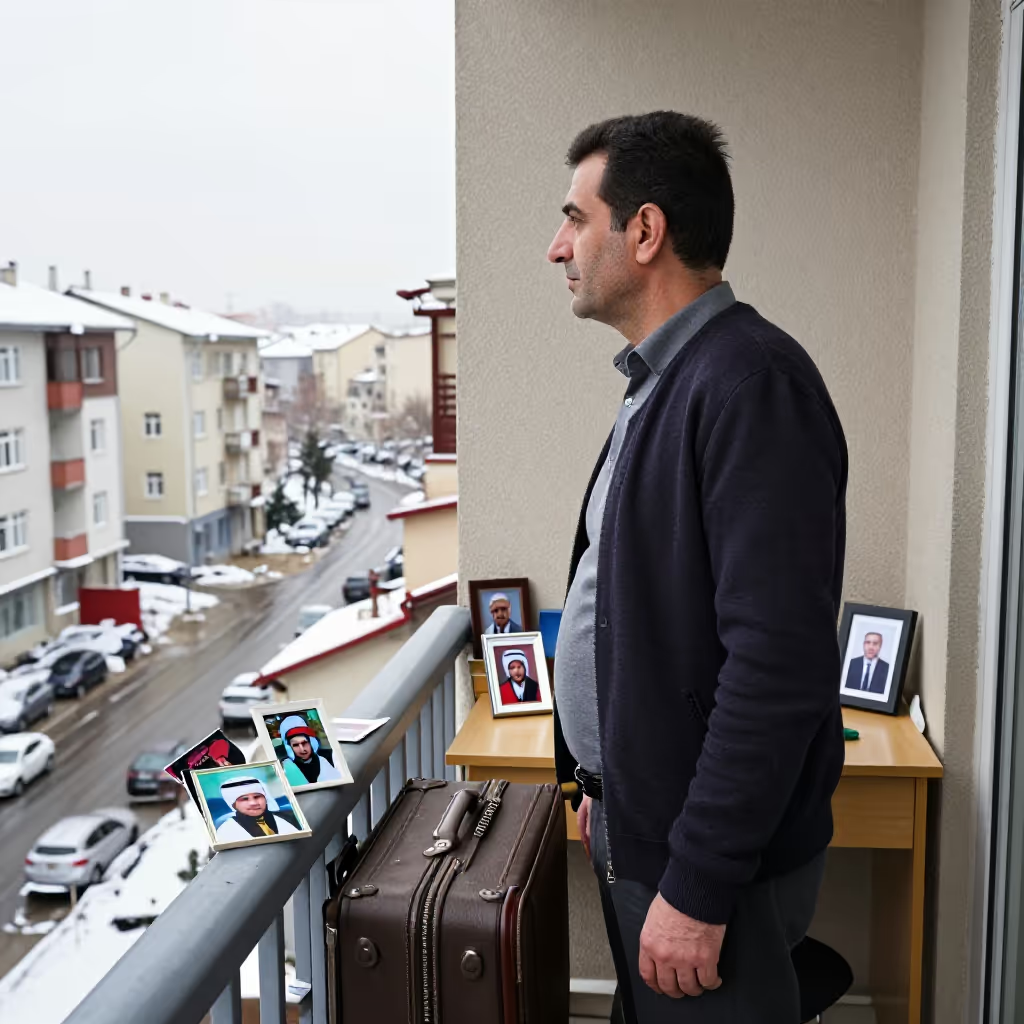
The state of living outside one's home country, either involuntarily or voluntarily, usually for political, religious, or racial reasons.
example
Viele Künstler und Intellektuelle gingen während der Diktatur ins Exil.
Many artists and intellectuals went into exile during the dictatorship.
Usage tips
Important prepositions
The use of 'Exil' (exile) is strongly tied to fixed prepositions. Movement is expressed with 'ins Exil gehen' (to go into exile; accusative), while a state is expressed with 'im Exil leben' (to live in exile; dative).
EXAMPLE
Der Autor musste 1933 ins Exil gehen.
The author had to go into exile in 1933.
Typical verbs
In connection with the state of exile, verbs that describe the beginning are often used. These include 'ins Exil gehen' (to go into exile), 'ins Exil fliehen' (to flee into exile), or also 'jemanden ins Exil zwingen' (to force someone into exile).
EXAMPLE
Die politische Lage zwang viele Oppositionelle ins Exil.
The political situation forced many opposition members into exile.
Political context
The word 'Exil' (exile) is very strongly associated with contexts of political, religious, or artistic persecution. It is frequently used in historical discussions about people who had to flee their home country.
EXAMPLE
Die Ausstellung widmet sich dem Leben von Schriftstellern im Exil.
The exhibition is devoted to the lives of writers in exile.
Context clue
When 'Exil' (exile) refers to a concrete place, it is often accompanied by an adjective or appears as the object of verbs like 'finden' (to find) or 'suchen' (to seek). This shows that it does not only mean the state.
EXAMPLE
Für viele Verfolgte wurde das Land zu einem neuen Exil.
For many persecuted people, the country became a new exile.
Compare with
antonym
Exil vs Heimat
homeland / home
'die Heimat' and 'das Exil' stand in clear contrast. 'Heimat' is the place or country to which you are connected through origin and feeling. 'Exil' means that someone lives outside this homeland, often because he or she cannot freely return or had to leave for political, religious, or similar reasons. 'Heimat' emphasizes closeness and belonging; 'Exil' emphasizes distance and separation from that place.
Exil
Der Schriftsteller lebte viele Jahre im Exil und schrieb über sein verlorenes Land.
The writer lived in exile for many years and wrote about his lost country.
Heimat
Für viele Menschen ist die Heimat mehr als nur ein Ort auf der Karte.
For many people, their homeland is more than just a place on the map.