


fallen
to fall
To move from top to bottom due to gravity; to fall to the ground.
EXAMPLE
Vorsicht, die Blätter fallen von den Bäumen und der Weg ist rutschig.
Careful, the leaves are falling from the trees and the path is slippery.
to fall
Loading your saved state.
to fall
To move from top to bottom due to gravity; to fall to the ground.
Vorsicht, die Blätter fallen von den Bäumen und der Weg ist rutschig.
Careful, the leaves are falling from the trees and the path is slippery.

to fall
To decrease in value, quantity, or level; to decline.
Die Temperaturen sollen in der Nacht unter null Grad fallen.
Temperatures are expected to fall below zero degrees during the night.

to be hard/easy
To be difficult or easy for someone to do something.
Es fällt mir leicht, neue Sprachen zu lernen.
It is easy for me to learn new languages.
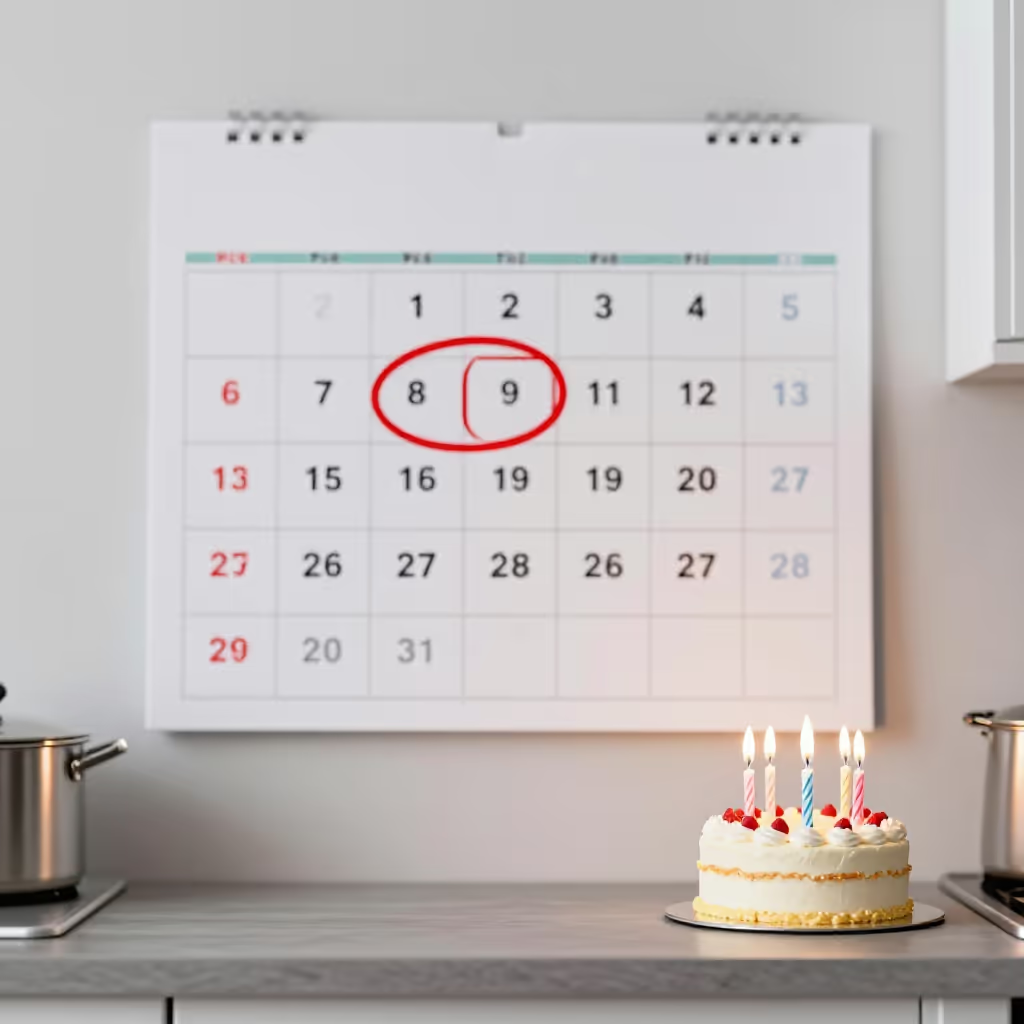
to fall on
To occur on a particular day or date in the calendar.
Mein Geburtstag fällt dieses Jahr auf einen Samstag.
My birthday falls on a Saturday this year.

to fall
To be killed in a battle or war.
Sein Großvater ist im Zweiten Weltkrieg gefallen.
His grandfather fell in the Second World War.

to be made / said
To be pronounced or mentioned (e.g. a word, a decision).
Bei der Sitzung ist endlich eine Entscheidung gefallen.
At the meeting, a decision was finally made.
The verb 'fallen' (to fall) always forms compound tenses (such as the perfect tense) with the auxiliary verb 'sein' (to be). This is because it describes movement or a change of state.
Der teure Teller ist mir aus der Hand gefallen.
The expensive plate fell out of my hand.
The past participle of 'fallen' (to fall) is 'gefallen' (fallen). This word is identical to the infinitive of the verb 'gefallen' (to please). You distinguish them by the auxiliary verb: 'Der Apfel ist gefallen' (The apple has fallen; fallen, with 'sein'), but 'Das Geschenk hat gefallen' (The gift was pleasing; gefallen, with 'haben').
Der Schnee ist leise gefallen.
The snow fell quietly.
Whether 'fallen' (to fall) is meant literally (to fall down) or figuratively (to decrease) can be recognized from the subject of the sentence. If it involves abstract values like 'Preise' (prices), 'Temperaturen' (temperatures), or 'Kurse' (rates/share prices), 'fallen' always means 'sinken' (to sink/decrease) or 'abnehmen' (to decline).
Der Aktienkurs der Firma ist plötzlich gefallen.
The company's share price suddenly fell.
In the expression 'jemandem schwer/leicht fallen' (to be hard/easy for someone), the person who experiences something as difficult or easy is always in the dative. The subject is often the impersonal 'es' (it).
Es fällt ihm schwer, früh aufzustehen.
It is hard for him to get up early.
The meaning 'to be killed in war' is very specific. The word 'gefallen' (fallen) is used in this context as a formal, almost euphemistic expression for the death of soldiers.
An dem Denkmal stehen die Namen der gefallenen Soldaten.
The names of the fallen soldiers are written on the memorial.
In a passive-like meaning, 'fallen' (to be made/said) is used with impersonal subjects like 'Entscheidung' (decision), 'Urteil' (judgment), or 'Wort' (word). It means that something is decided or said.
In der Besprechung ist noch keine Entscheidung gefallen.
No decision has been made in the meeting yet.
to lie / be located
When talking about appointments, liegen and fallen both indicate a position in time. With liegen, you say that the appointment lies on Monday; with fallen, you say that it falls on Monday. The key difference is therefore how each verb combines with the time expression.

Der nächste Beratungstermin fällt auf Montag.
The next consultation appointment falls on Monday.
Der nächste Beratungstermin liegt am Montag.
The next consultation appointment is on Monday.