


sinken
to fall
To decrease in value, amount, level, or intensity; to become less.
EXAMPLE
Die Temperaturen sollen in der Nacht unter null Grad sinken.
Temperatures are expected to fall below zero degrees during the night.
to sink / fall
Loading your saved state.
to fall
To decrease in value, amount, level, or intensity; to become less.
Die Temperaturen sollen in der Nacht unter null Grad sinken.
Temperatures are expected to fall below zero degrees during the night.
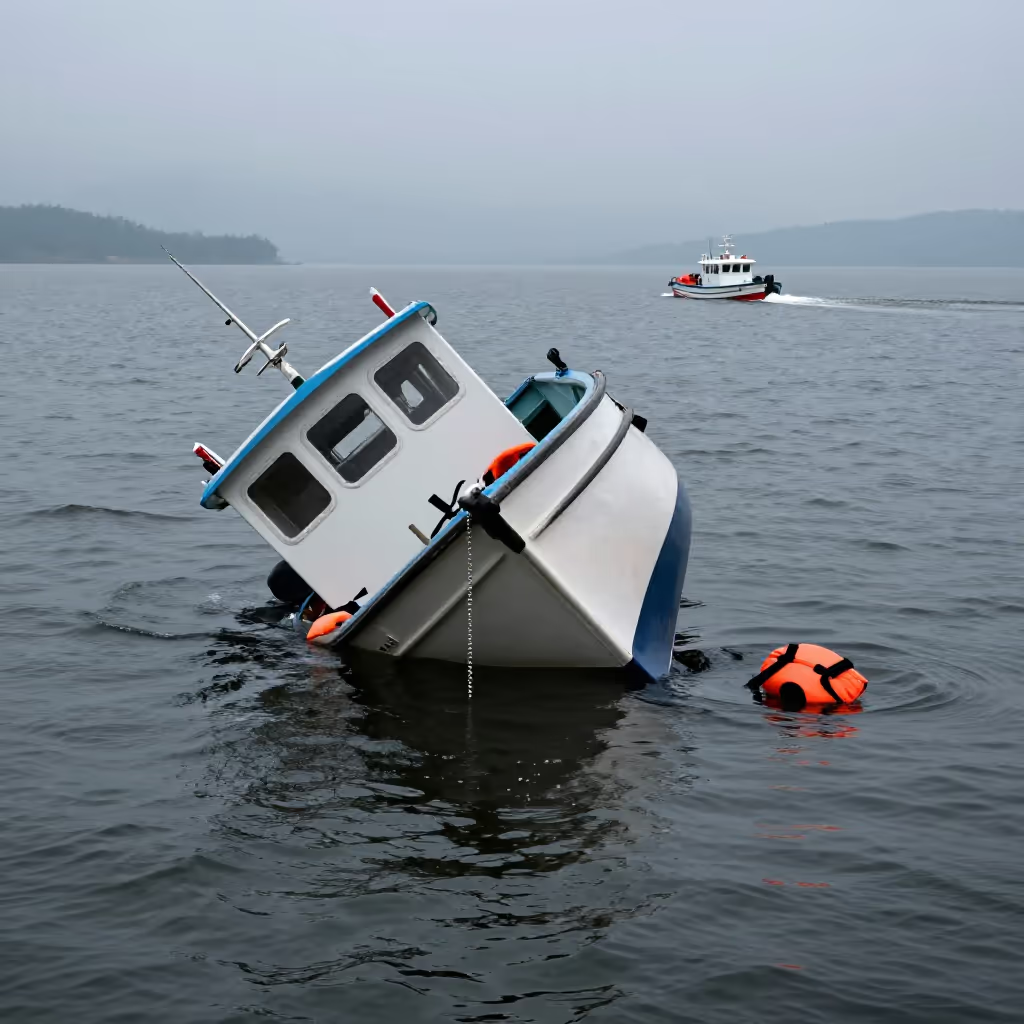
to sink
To move downward in a liquid or in the air and go under.
Das Schiff traf einen Eisberg und sank innerhalb weniger Stunden.
The ship hit an iceberg and sank within a few hours.

to sink down
To move downward slowly, often because of weakness or exhaustion, or to let oneself fall.
Nach der langen Wanderung sank sie erschöpft auf das Sofa.
After the long hike, she sank down exhausted onto the sofa.

to decline
To lose quality, reputation, or moral level; to deteriorate.
Seit dem Skandal ist sein Ansehen in der Öffentlichkeit stark gesunken.
Since the scandal, his reputation among the public has declined sharply.
'Sinken' (to sink/fall) describes a change of state or a downward movement. Therefore, the perfect tense is always formed with the auxiliary verb 'sein' (to be).
Die Preise für Benzin sind letzte Woche stark gesunken.
Gas prices fell sharply last week.
'Sinken' (to sink/fall) is an intransitive verb, which means it does not take an accusative object. The subject of the sentence is the thing or person that goes downward or becomes less on its own.
Die Sonne sinkt langsam am Horizont.
The sun is slowly sinking on the horizon.
In this meaning, 'sinken' (to fall) is often used with abstract values or levels. Typical examples are: die Preise sinken (prices fall), die Temperaturen sinken (temperatures fall), die Arbeitslosigkeit sinkt (unemployment falls), or die Stimmung sinkt (the mood falls).
Im Winter sinken die Temperaturen oft unter den Gefrierpunkt.
In winter, temperatures often fall below freezing.
In its literal meaning, 'sinken' (to sink) is usually used for objects in a liquid, for example 'ein Schiff sinkt' (a ship is sinking). It can also be used figuratively, as in the idiom 'vor Scham im Boden sinken' (to want to sink into the ground from shame).
Der Stein sank sofort auf den Grund des Sees.
The stone immediately sank to the bottom of the lake.
When referring to deterioration, 'sinken' (to decline) is often combined with the reputation, morals, or quality of something.
Das Niveau der Fernsehsendung ist in den letzten Jahren gesunken.
The quality of the TV show has declined in recent years.
to fall
Fallen and sinken can both express a decrease in values, amounts, or levels. The usual collocation often determines the choice: prices and temperatures can use either fallen or sinken, whereas sinken is especially natural with a water level or gauge reading.

Nach den trockenen Wochen sinkt der Pegel des Flusses.
The river level is falling after the dry weeks.
Nach der guten Ernte fallen die Preise für Äpfel.
Apple prices are falling after the good harvest.