


bleiben
to stay
To remain in a place and not leave.
EXAMPLE
Wegen des Regens bleiben wir heute zu Hause.
Because of the rain, we're staying at home today.
to stay / remain
Loading your saved state.
to stay
To remain in a place and not leave.
Wegen des Regens bleiben wir heute zu Hause.
Because of the rain, we're staying at home today.

to remain
To remain in a certain state or condition.
Bitte bleiben Sie ruhig und geraten Sie nicht in Panik.
Please remain calm and don't panic.
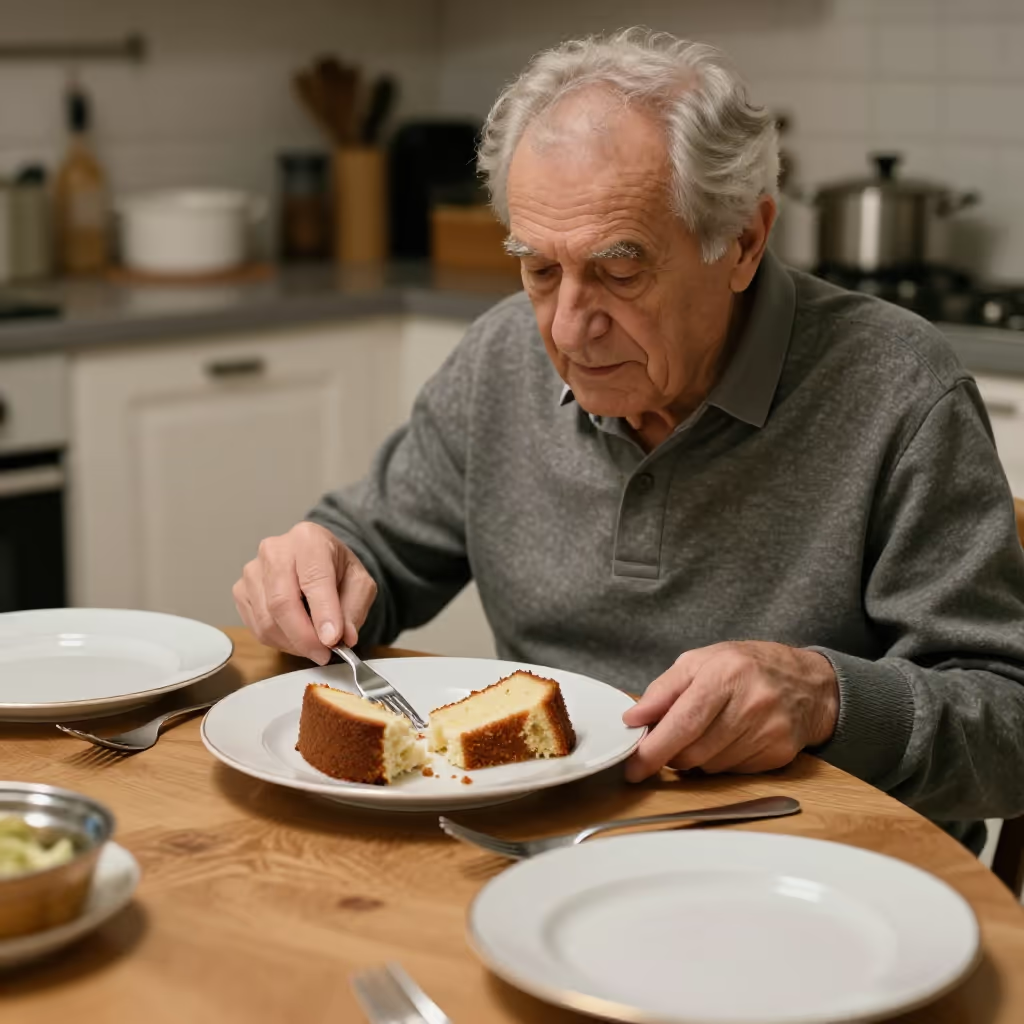
to remain
To be left over or remain as a leftover.
Vom Kuchen ist nur noch ein kleines Stück geblieben.
Only a small piece of the cake remained.

to stick with
To hold on to a decision, opinion, or statement once made.
Ich bleibe bei meiner Meinung, auch wenn du anderer Ansicht bist.
I'm sticking with my opinion, even if you see it differently.

to fall / die
As a euphemism for dying, especially in the context of war or accidents.
Sein Großvater ist im Krieg auf dem Feld geblieben.
His grandfather fell in the field during the war.
Although 'bleiben' (to stay/remain) does not describe movement, it always forms the perfect tense with the auxiliary verb 'sein' (to be). This is an important exception that must be learned by heart.
Ich bin gestern länger im Büro geblieben.
I stayed at the office longer yesterday.
To express that a state does not change, you combine 'bleiben' (to remain) directly with an adjective. The adjective is not declined.
Auch in der schwierigen Situation blieb er ganz entspannt.
Even in the difficult situation, he remained completely relaxed.
When you hold on to an opinion or decision, you use the fixed preposition 'bei' with the dative: 'bei etwas bleiben' (to stick with something).
Er bleibt bei seinem Plan, nächstes Jahr umzuziehen.
He is sticking with his plan to move next year.
Common expressions with 'bleiben' (to stay/remain) are 'in Kontakt bleiben' (to stay in touch), 'am Ball bleiben' (to keep at it / stay on the ball), and 'gesund bleiben' (to stay healthy, as a wish).
Lass uns auch nach deinem Umzug in Kontakt bleiben.
Let's stay in touch even after you move.
In the meaning 'übrig sein' (to be left over), 'bleiben' (to remain) often appears with quantities. The sentences often begin with 'Es ist/sind ...' (There is/are ...).
Nach der Party sind noch viele Getränke geblieben.
After the party, many drinks were still left over.
In a very formal or literary context, especially when it is about war, 'bleiben' (to remain) can mean 'sterben' (to die). This usage is very rare in everyday language.
Viele Soldaten sind auf dem Schlachtfeld geblieben.
Many soldiers fell on the battlefield.
to fall
Bleiben and fallen can refer to a person's death in the context of war. Bleiben is an indirect, euphemistic expression, while fallen is the usual term associated with war. Use bleiben in more cautious or euphemistic language and fallen in a direct description.

Viele Soldaten blieben im Krieg, und ihre Familien erhielten später Nachricht.
Many soldiers were lost in the war, and their families received word later.
Viele Soldaten fielen im Krieg, und ihre Familien erhielten später Nachricht.
Many soldiers were killed in the war, and their families received word later.