

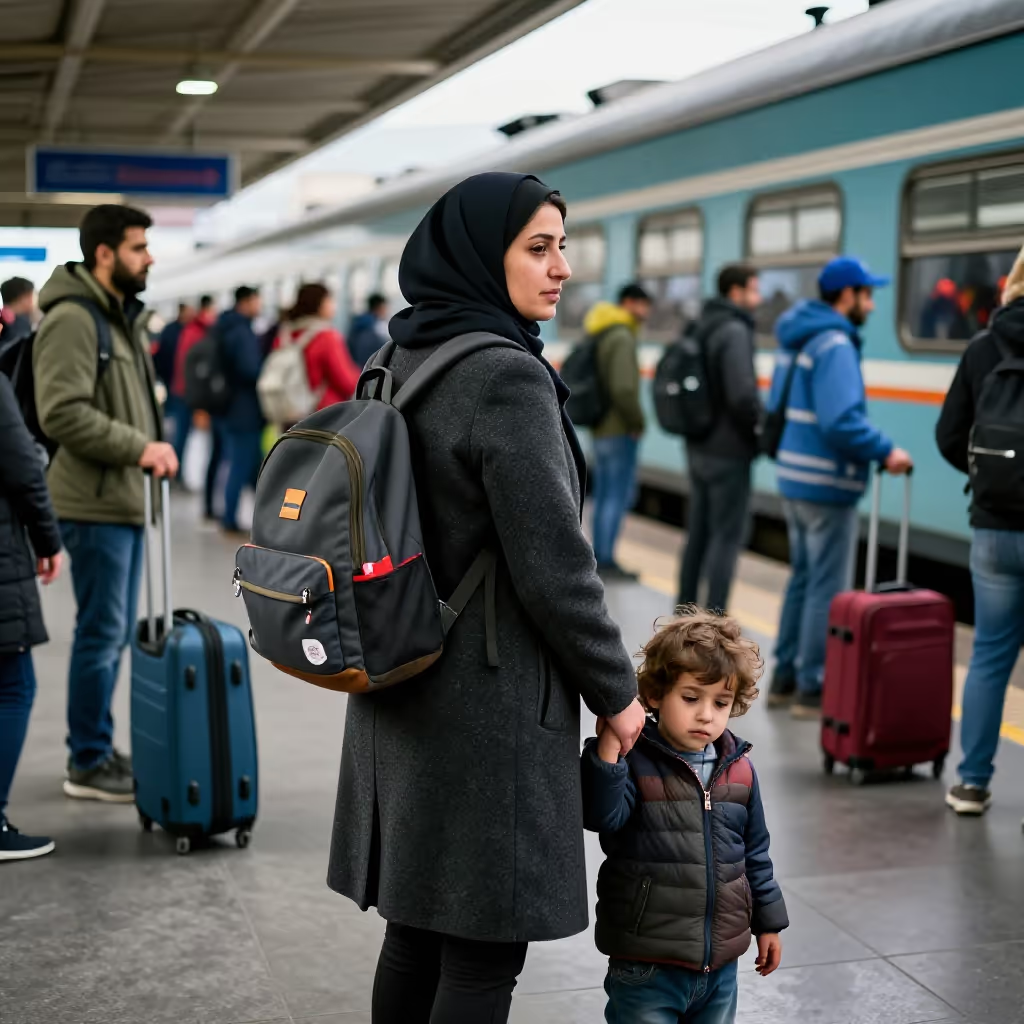
A person who is forced to leave their home country in order to escape war, persecution, or natural disasters.
example
Das Lager wurde für Flüchtlinge aus dem benachbarten Kriegsgebiet errichtet.
The camp was set up for refugees from the neighboring war zone.

Usage tips
Word structure
The word 'Flüchtling' (refugee) is derived from the verb 'flüchten' (to flee). The ending '-ling' is often used in German to refer to a person characterized by a particular trait or action.
EXAMPLE
Ein Flüchtling ist jemand, der flüchten musste.
A refugee is someone who had to flee.
Reason for fleeing
To indicate the reason for fleeing, the preposition 'vor' with the dative is used. So you flee 'vor' (from) a danger.
EXAMPLE
Viele Menschen sind vor dem Krieg geflohen.
Many people fled from the war.
Typical collocations
In connection with 'Flüchtling' (refugee), certain verbs are often used, for example 'Flüchtlinge aufnehmen' (to take in refugees), 'Flüchtlinge versorgen' (to provide for refugees), or 'Flüchtlingen Asyl gewähren' (to grant refugees asylum).
EXAMPLE
Viele freiwillige Helfer versorgen die ankommenden Flüchtlinge mit Essen und Kleidung.
Many volunteer helpers provide the arriving refugees with food and clothing.
Typical compounds
'Flüchtling' (refugee) is often used as the base word for more precise terms that name the reason for fleeing. Common examples are 'Kriegsflüchtling' (war refugee), 'Wirtschaftsflüchtling' (economic migrant/refugee), or 'Klimaflüchtling' (climate refugee).
EXAMPLE
Als Kriegsflüchtling erhielt er besonderen Schutz.
As a war refugee, he received special protection.
Compare with
confusable
Flüchtling vs Migrant
migrant
'Flüchtling' and 'Migrant' both refer to people who have left their homeland and live somewhere else. The important difference lies in the reason. A refugee leaves their homeland because they need protection, for example because of war, persecution, or a disaster. A migrant moves to another country or another region, often because of work, family, education, or better living conditions. The words are easy to confuse because both have to do with movement to another country. When coercion and danger are the focus, 'Flüchtling' is more precise. When it is more generally about living in a new place, 'Migrant' is more appropriate.
Flüchtling
Beim Termin beraten wir einen Flüchtling, der wegen des Krieges seine Heimat verlassen musste.
At the appointment, we advise a refugee who had to leave his homeland because of the war.
Migrant
Als Migrant lernt er zu Hause Deutsch, damit er morgen im Kurs besser mitkommt.
As a migrant, he studies German at home so that he can follow along better in the course tomorrow.