

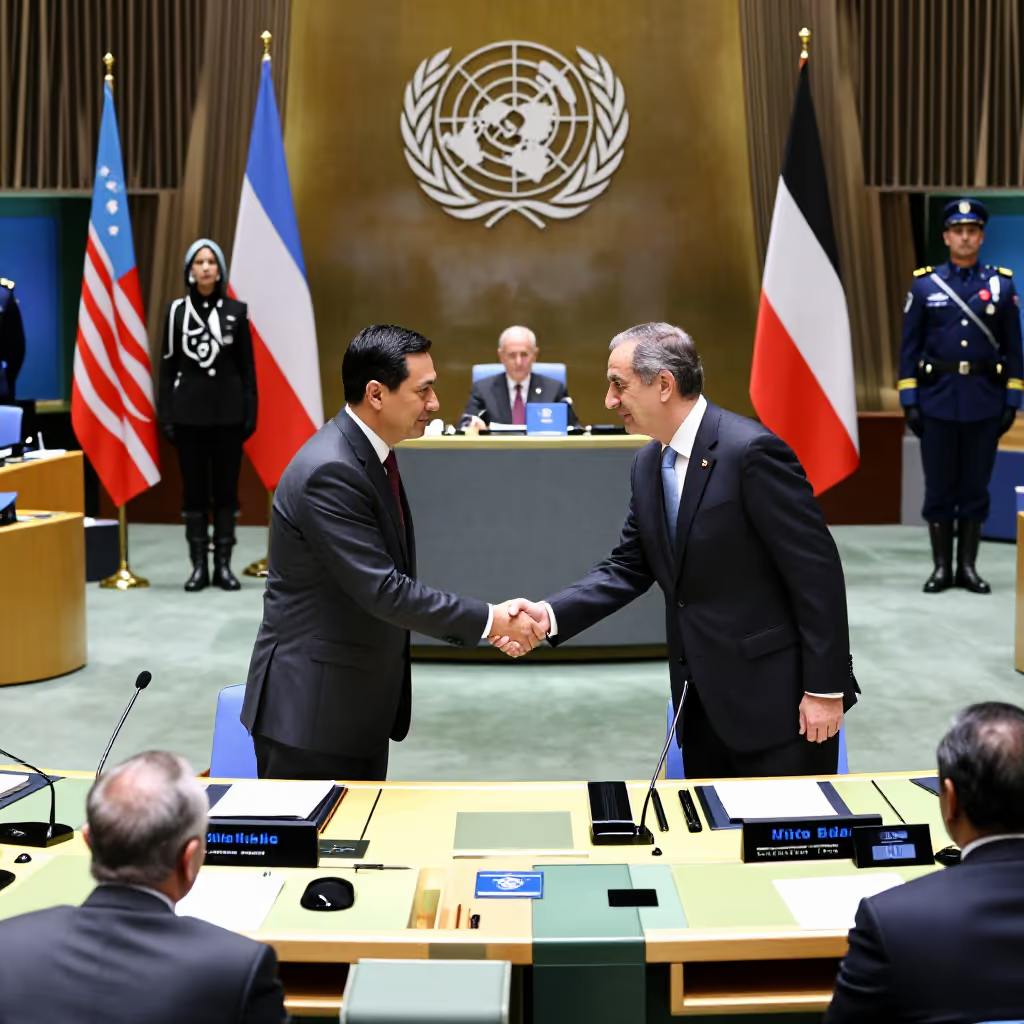
der Frieden
peace
A state in which there is no war or armed conflict between countries, peoples, or groups.
EXAMPLE
Nach langen Verhandlungen wurde endlich Frieden geschlossen.
After long negotiations, peace was finally made.
peace
Loading your saved state.
peace
A state in which there is no war or armed conflict between countries, peoples, or groups.
Nach langen Verhandlungen wurde endlich Frieden geschlossen.
After long negotiations, peace was finally made.

peace
A state of inner calm, quiet, and harmony; the absence of disturbance, conflict, or worries.
Nach einem langen Spaziergang im Wald fand er seinen inneren Frieden wieder.
After a long walk in the forest, he found his inner peace again.

peace
Harmonious coexistence in a community, family, or group without arguments and conflicts. Often used in the expression 'um des lieben Friedens willen' (for the sake of peace).
Um des lieben Friedens willen gab sie in der Diskussion nach.
For the sake of peace, she gave in during the discussion.

to leave someone in peace
To not disturb or bother someone.
Lass mich bitte in Frieden, ich muss mich konzentrieren.
Please leave me in peace; I need to concentrate.
The noun 'der Frieden' (peace) is the root of the adjective 'friedlich' (peaceful). When a situation or person is 'friedlich', it is characterized by calm and harmony.
Die Demonstration verlief friedlich und ohne Gewalt.
The demonstration was peaceful and without violence.
'Frieden' (peace) is an abstract noun and is used almost exclusively in the singular. Even when talking about different peace processes, the word usually remains singular.
Alle hoffen auf Frieden in der Region.
Everyone is hoping for peace in the region.
In a political context, 'Frieden' (peace) is often combined with certain verbs. Typical expressions are 'Frieden schließen' (to make peace), 'Frieden stiften' (to create peace / act as a peacemaker), or 'den Frieden sichern' (to secure peace).
Die beiden Länder haben nach jahrelangen Konflikten endlich Frieden geschlossen.
After years of conflict, the two countries finally made peace.
When it is about inner calm, 'Frieden' (peace) is often used with the verb 'finden' (to find) or in the expression 'mit sich selbst im Frieden sein' (to be at peace with oneself). Another fixed expression is 'mit etwas Frieden schließen' (to make peace with something), which means to accept a difficult situation.
Er hat lange gebraucht, um mit seiner Vergangenheit Frieden zu schließen.
It took him a long time to make peace with his past.
The expression 'um des lieben Friedens willen' (for the sake of peace) means that you avoid an argument by giving in. Pay attention to the genitive 'des lieben Friedens' in this fixed idiom.
Ich habe nichts mehr gesagt, einfach um des lieben Friedens willen.
I didn't say anything more, simply for the sake of peace.
The idiom 'jemanden in Frieden lassen' (to leave someone in peace) always requires an accusative object. It is a direct request not to bother a person any further.
Kannst du mich bitte in Frieden lassen? Ich habe viel zu tun.
Can you please leave me in peace? I have a lot to do.
quiet / calm
Both Ruhe and Frieden can refer to a balanced inner state. Ruhe emphasizes that stress and excitement are subsiding; Frieden places more emphasis on having overcome conflict, worries, or inner struggles.

Nach der Versöhnung findet sie wieder inneren Frieden.
After they reconciled, she found inner peace again.
Nach dem anstrengenden Gespräch braucht sie Ruhe, damit ihre Aufregung nachlässt.
After the difficult conversation, she needs some peace and quiet so that her agitation can subside.