


die Ruhe
quiet
The state in which there are no disturbing sounds or noise; silence.
EXAMPLE
Ich gehe in den Wald, weil ich die Ruhe der Natur liebe.
I go into the forest because I love the quiet of nature.
quiet / calm
Loading your saved state.
quiet
The state in which there are no disturbing sounds or noise; silence.
Ich gehe in den Wald, weil ich die Ruhe der Natur liebe.
I go into the forest because I love the quiet of nature.

calm
A state of inner composure, relaxation, and peace, without stress or excitement.
Nach einem langen Arbeitstag finde ich beim Lesen meine Ruhe.
After a long workday, I find my calm by reading.

to leave someone alone
To not disturb or bother someone.
Bitte lass mich in Ruhe, ich muss diese E-Mail fertig schreiben.
Please leave me alone; I have to finish writing this email.

to keep calm
To remain calm and level-headed in a stressful, hectic, or dangerous situation.
Auch als der Feueralarm losging, bewahrte die Lehrerin die Ruhe und führte alle sicher nach draußen.
Even when the fire alarm went off, the teacher kept calm and led everyone safely outside.

rest
A break from an activity in order to recover.
Gönn dir mal eine kleine Ruhe, du hast genug gearbeitet.
Treat yourself to a little rest; you've worked enough.
The noun 'die Ruhe' (quiet/calm) belongs to a word family with the adjective 'ruhig' (quiet/calm) and the verb 'ruhen' (to rest). All of these words refer to a state without movement, noise, or hectic activity.
Hier ist es angenehm ruhig.
It's pleasantly quiet here.
The context makes clear whether external quiet (no noise) or inner calm (no stress) is meant. Words like 'Natur' (nature) or 'Nacht' (night) point to silence, while 'Stress' (stress) or 'Meditation' (meditation) point to composure.
Ich brauche absolute Ruhe, um mich zu konzentrieren.
I need absolute quiet in order to concentrate.
The fixed expression 'jemanden in Ruhe lassen' (to leave someone alone) means not to disturb a person. The person who should not be disturbed is always in the accusative.
Kannst du bitte meinen kleinen Bruder in Ruhe lassen?
Can you please leave my little brother alone?
The phrase 'die Ruhe bewahren' (to keep calm) is a fixed collocation and means to remain calm and controlled in a difficult situation. Here, 'Ruhe' always appears with the definite article 'die'.
Versuchen Sie, in jeder Situation die Ruhe zu bewahren.
Try to keep calm in every situation.
In connection with inner composure, 'Ruhe' is often combined with verbs like 'finden' (to find), 'verlieren' (to lose), or 'ausstrahlen' (to radiate). The adjective 'innere' (inner) is also a typical collocation.
Durch Yoga hat er seine innere Ruhe gefunden.
Through yoga, he found his inner calm.
When referring to silence, 'Ruhe' is often intensified with adjectives like 'himmlisch' (heavenly), 'absolut' (absolute), or 'tief' (deep). The opposite is when someone 'die Ruhe stört' (disturbs the peace/quiet).
Am Sonntagmorgen herrscht hier eine himmlische Ruhe.
On Sunday mornings, there is a heavenly quiet here.
peace
Both Ruhe and Frieden can refer to a balanced inner state. Ruhe emphasizes that stress and excitement are subsiding; Frieden places more emphasis on having overcome conflict, worries, or inner struggles.
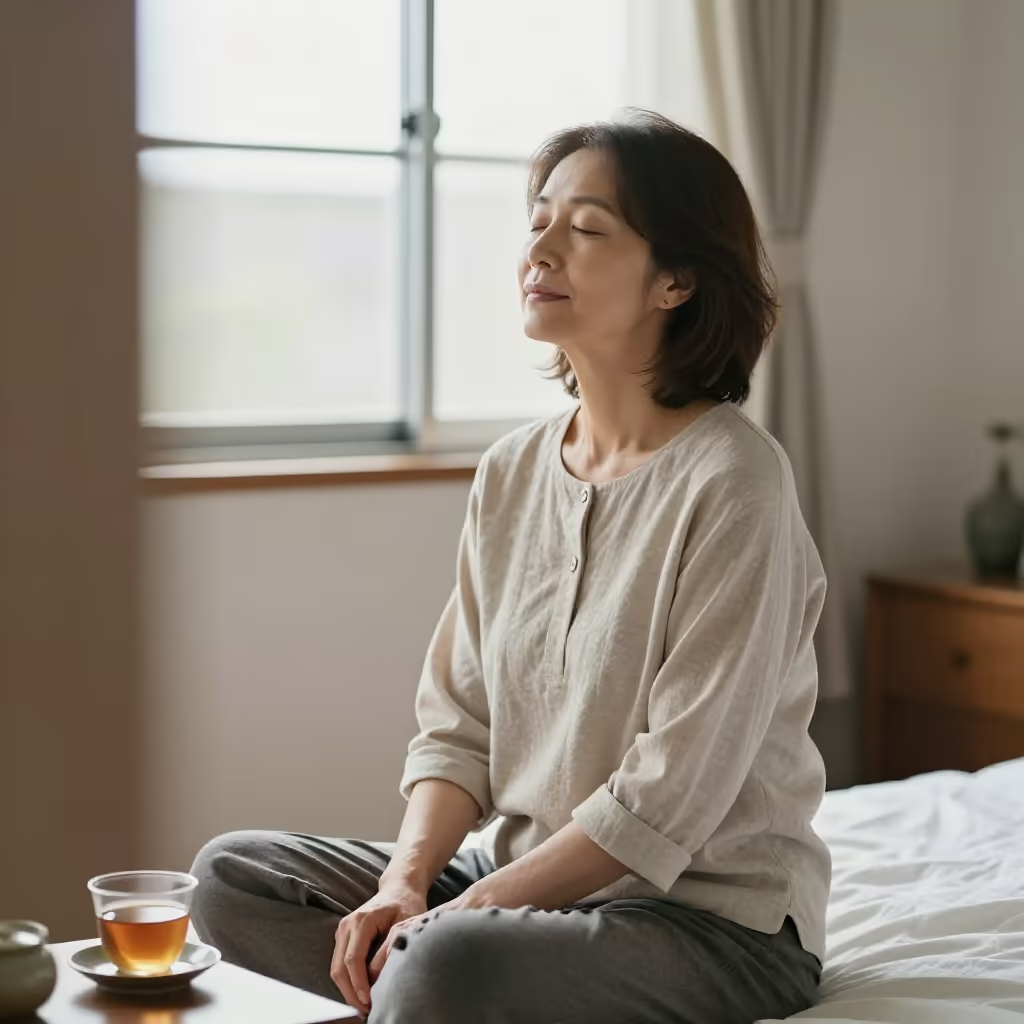
Nach dem anstrengenden Gespräch braucht sie Ruhe, damit ihre Aufregung nachlässt.
After the difficult conversation, she needs some peace and quiet so that her agitation can subside.
Nach der Versöhnung findet sie wieder inneren Frieden.
After they reconciled, she found inner peace again.