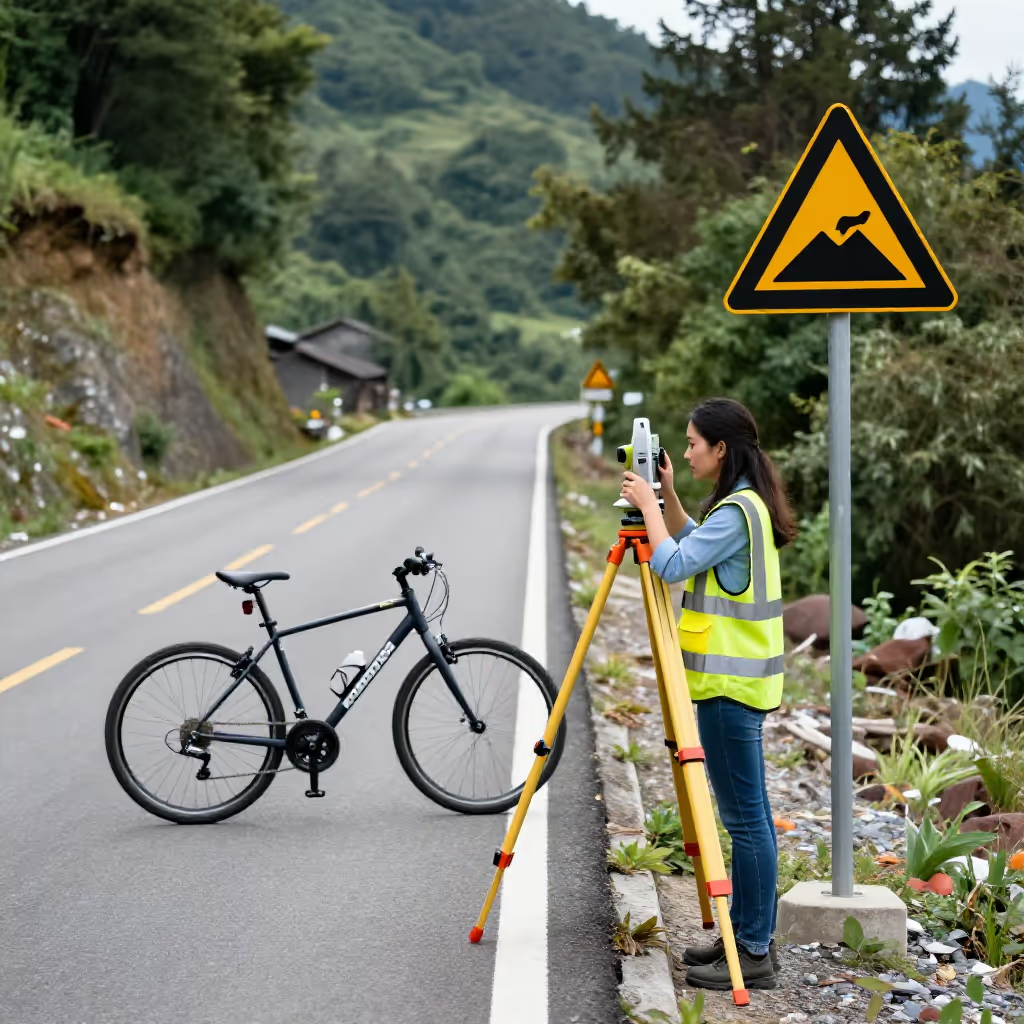
The slope of a surface, that is, the difference in height over a certain horizontal distance. It is often used for roads, railway lines, or rivers and is given in percent or degrees.
example
Wegen des starken Gefälles müssen LKW hier einen niedrigen Gang einlegen.
Because of the steep gradient, trucks have to shift into a low gear here.
Usage tips
Word structure
The word 'Gefälle' (gradient/disparity) is derived from the verb 'fallen' (to fall). The prefix 'Ge-' forms a noun here that describes the result or state of falling — that is, a slope on which something falls or flows downward.
EXAMPLE
Der Bach fließt wegen des natürlichen Gefälles in Richtung Tal.
The stream flows toward the valley because of the natural gradient.
Context clue
You can recognize the meaning from the context. If people are talking about roads or rivers, or if there are figures in percent, it means a slope or gradient. In social or economic contexts (e.g., with words like 'Lohn' (wage) or 'Bildung' (education)), it refers to a difference or inequality.
EXAMPLE
Die Straße hat ein Gefälle von 12 Prozent.
The road has a gradient of 12 percent.
Typical collocations
When referring to a slope, 'Gefälle' (gradient) is often combined with adjectives such as 'stark' (strong/steep), 'leicht' (slight), or 'steil' (steep). You also say that a stretch or route 'ein Gefälle hat' (has a gradient).
EXAMPLE
Vorsicht, die Einfahrt hat ein starkes Gefälle!
Careful, the driveway has a steep gradient!
Typical collocations
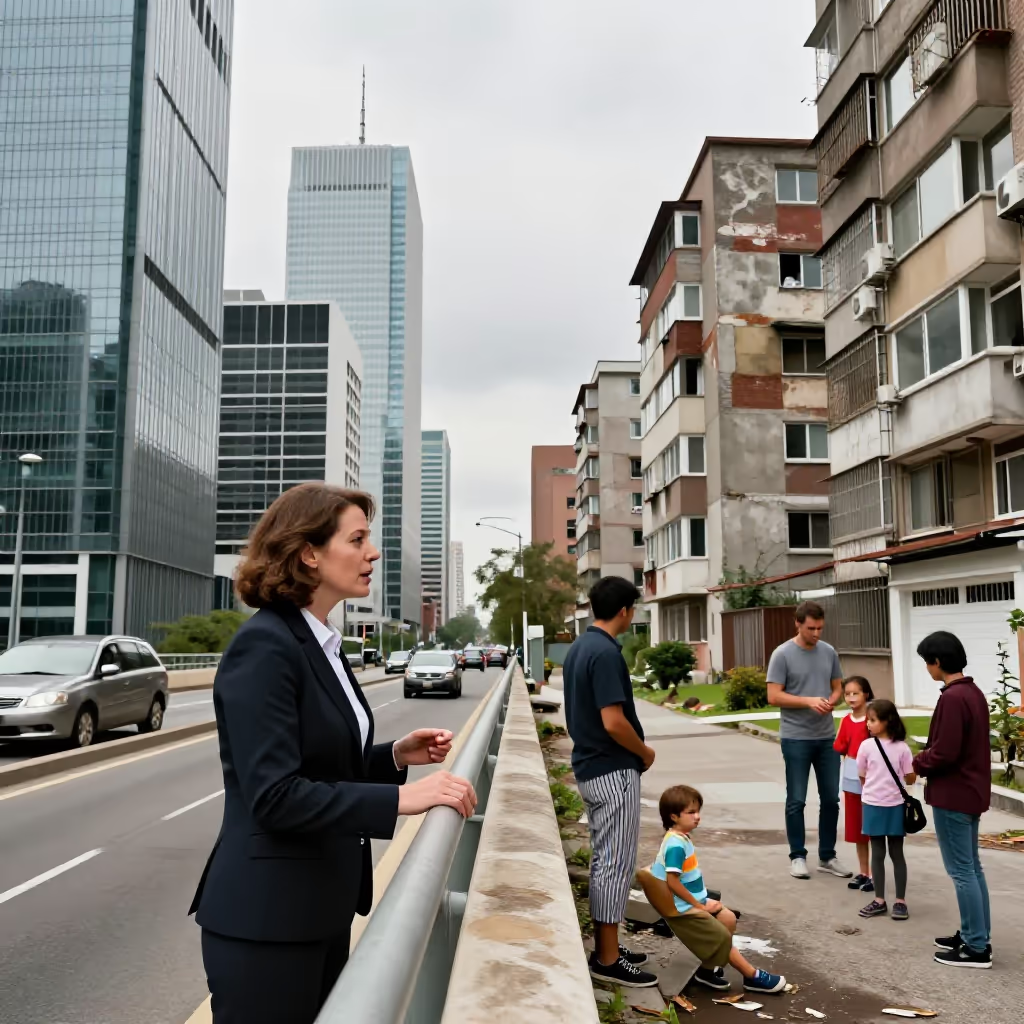
In the figurative meaning, 'Gefälle' (disparity) is often used in fixed combinations, for example 'Lohngefälle' (wage disparity), 'Bildungsgefälle' (educational disparity), 'soziales Gefälle' (social disparity), or 'Nord-Süd-Gefälle' (north-south divide).
EXAMPLE
Die Politik diskutiert Maßnahmen gegen das Stadt-Land-Gefälle.
Politicians are discussing measures against the urban-rural divide.
Historical context
This meaning is outdated and is used only in historical texts. If you are reading about the Middle Ages or the early modern period, 'Gefälle' can mean dues or taxes paid to a ruler.
EXAMPLE
Der Bauer musste sein Gefälle an den Grundherrn entrichten.
The farmer had to pay his dues to the feudal lord.
Compare with
near_synonym · confusable
Gefälle vs Unterschied
difference
'der Unterschied' and 'das Gefälle' can both describe that two groups, places, or conditions are not the same. 'Unterschied' is general and neutral: it can refer to small or large, simple or important differences. 'Gefälle' is used when the difference is clear and often shows an inequality, for example between city and countryside, rich and poor, or different educational groups. Learners may confuse the words because 'Gefälle' in such cases also means a difference. But 'Gefälle' sounds more specific and stronger; it fits especially when one side is clearly better, stronger, or richer than the other.
Gefälle
Zwischen den Löhnen in der Stadt und auf dem Land gibt es ein deutliches Gefälle.
There is a clear disparity between wages in the city and in the countryside.
Unterschied
Bei der Arbeit merkt die Kundin den Unterschied zwischen den beiden Angeboten sofort.
At work, the customer immediately notices the difference between the two offers.