


der Gegner
opponent
A person or team that you compete against in a game, contest, or debate.
EXAMPLE
Im Finale traf sie auf eine starke Gegnerin.
In the final, she faced a strong opponent.
opponent
Loading your saved state.
opponent
A person or team that you compete against in a game, contest, or debate.
Im Finale traf sie auf eine starke Gegnerin.
In the final, she faced a strong opponent.
opponent / adversary
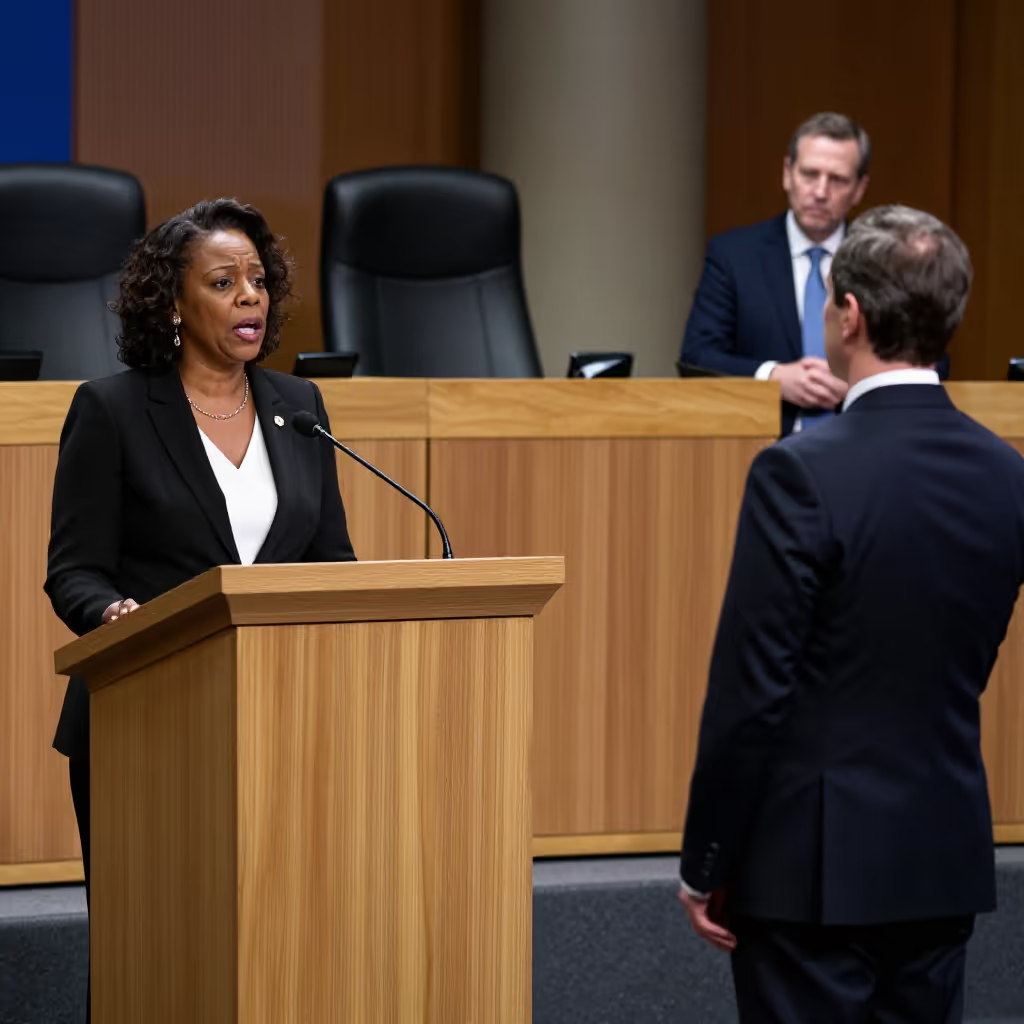
A person or group that holds different views and actively works against someone or something; an enemy or adversary.
Die politischen Gegner kritisierten den Gesetzesentwurf scharf.
The political opponents sharply criticized the draft law.
The word 'Gegner' (opponent) is derived from the preposition 'gegen' (against). An opponent is therefore literally a person who is 'gegen' (against) someone or something.
Sie kämpft gegen eine starke Gegnerin.
She is fighting against a strong opponent.
The context makes the difference: in the areas of sports, games, or competition, a 'Gegner' (opponent) is a competitor. In politics or serious conflicts, a 'Gegner' (opponent/adversary) is an adversary with opposing goals.
Der Schachspieler analysierte die Züge seines Gegners.
The chess player analyzed his opponent's moves.
In sports and game contexts, 'Gegner' (opponent) is often combined with adjectives such as 'stark' (strong), 'schwach' (weak), 'fair' (fair), or 'gefährlich' (dangerous).
Obwohl es ein harter Wettkampf war, blieb sein Gegner immer fair.
Although it was a tough competition, his opponent always remained fair.
enemy
A Gegner works against your goals or takes a different position without necessarily wanting to cause harm. A Feind is more strongly negative: they feel hatred or strong rejection and want to harm the other person. For matter-of-fact or political opposition, Gegner is therefore usually the better choice.

Im Wahlkampf ist Paul mein Gegner, weil er ein anderes politisches Programm vertritt.
During the election campaign, Paul is my opponent because he supports a different political platform.
Nach seinen schweren Drohungen sehe ich Paul als Feind, weil er mir bewusst schaden will.
After his serious threats, I see Paul as an enemy because he deliberately wants to harm me.