


geordnet
ordered / orderly
In a clear structure or sequence; tidy and easy to understand. The opposite of chaotic.
EXAMPLE
Seine Bücher standen geordnet nach Autoren im Regal.
His books were arranged in order by author on the shelf.
ordered / orderly
Loading your saved state.
ordered / orderly
In a clear structure or sequence; tidy and easy to understand. The opposite of chaotic.
Seine Bücher standen geordnet nach Autoren im Regal.
His books were arranged in order by author on the shelf.

stable / orderly
Refers to living circumstances or finances and means that they are stable, secure, and without major problems.
Nach der Ausbildung freut er sich auf ein geordnetes Leben mit festem Einkommen.
After his training, he is looking forward to a stable life with a regular income.
'Geordnet' (ordered/orderly) is the past participle of the verb 'ordnen' (to order/arrange). It is used like a normal adjective to describe a state that is the result of an organizing process.
Ich fand die geordneten Akten schnell auf dem Schreibtisch.
I quickly found the orderly files on the desk.
You can recognize the meaning from the noun: If 'geordnet' (ordered/orderly) refers to things or information, such as papers or thoughts, it means 'tidy/organized'. If it refers to life or finances, such as circumstances or income, it means 'stable and secure'.
Ihre Gedanken waren klar und geordnet.
Her thoughts were clear and orderly.
When something is sorted according to a specific criterion, the structure 'geordnet nach' (ordered by/according to) + dative is used. This is a very common and useful construction.
Die Kleidung im Schrank ist nach Farben geordnet.
The clothes in the closet are ordered by color.
In the meaning of 'stable', 'geordnet' (stable/orderly) is often used with fixed expressions such as 'ein geordnetes Leben führen' (to lead an orderly life) or 'in geordneten Verhältnissen leben' (to live in stable circumstances).
Er führt ein sehr geordnetes Leben mit festen Routinen.
He leads a very orderly life with fixed routines.
neat / proper
„Ordentlich“ and „geordnet“ (ordered) can both describe a tidy room. „Ordentlich“ emphasizes cleanliness and a good condition, while „geordnet“ highlights a clear structure or sequence. Choose „ordentlich“ when something looks clean, and „geordnet“ when things are arranged in a clear and orderly way.
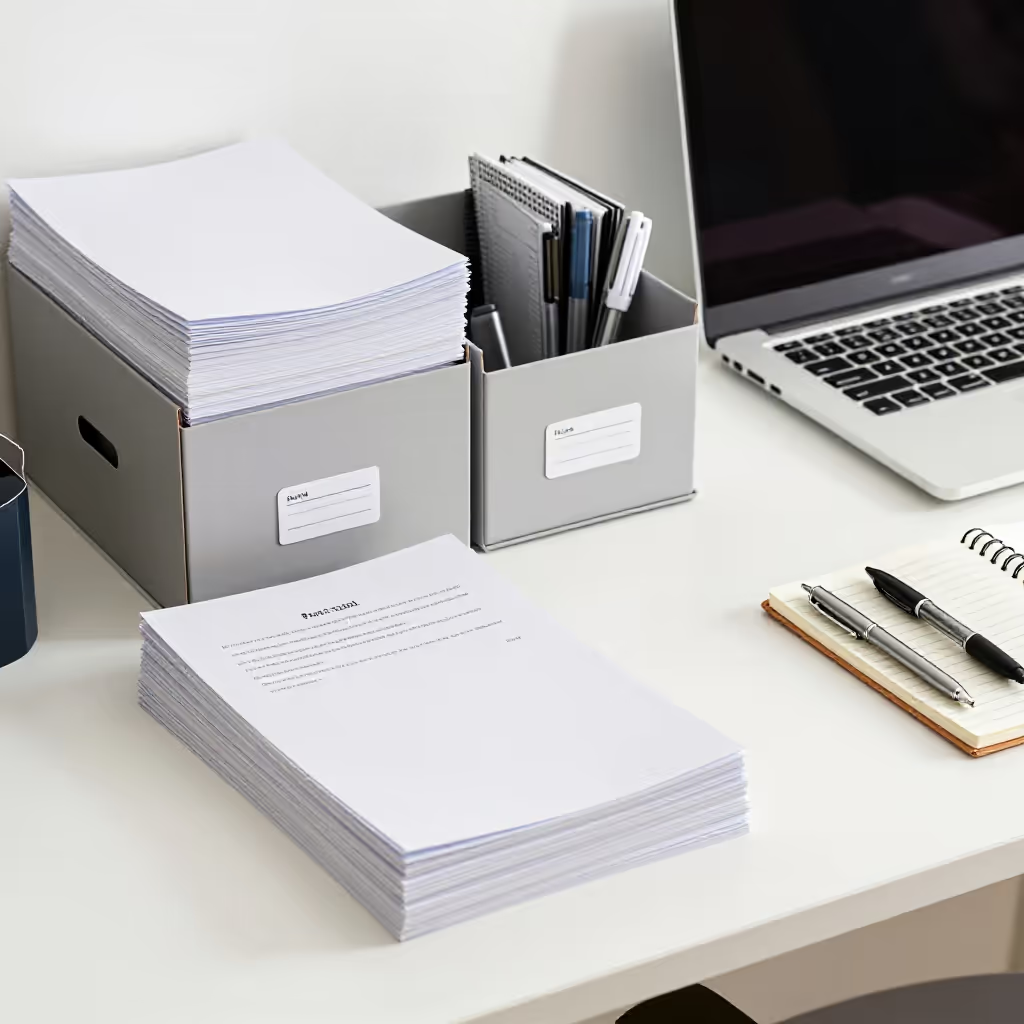
Nach dem Aufräumen stehen die Bücher im Regal nach Themen geordnet.
After tidying up, the books on the shelf are arranged by subject.
Nach dem Aufräumen ist das Wohnzimmer wieder ordentlich und sauber.
After tidying up, the living room is neat and clean again.