


ordentlich
neat
Tidy, clean, and well organized. The opposite of messy or chaotic.
EXAMPLE
Sein Schreibtisch ist immer sehr ordentlich.
His desk is always very neat.
neat / proper
Loading your saved state.
neat
Tidy, clean, and well organized. The opposite of messy or chaotic.
Sein Schreibtisch ist immer sehr ordentlich.
His desk is always very neat.

quite a lot
Colloquial for 'very' or 'quite a lot'. Used as an intensifier to express a large amount or high intensity.
Wir hatten gestern Abend ordentlich Spaß auf der Party.
We had quite a lot of fun at the party last night.

proper
In accordance with rules or norms; correct and decent. Refers to behavior or formal processes.
Bitte reichen Sie einen ordentlichen Antrag mit allen Unterlagen ein.
Please submit a proper application with all the documents.

regular
Regular or scheduled in an official or legal sense. Often used in fixed terms such as 'ordentliches Mitglied' (full member) or 'ordentliches Gericht' (ordinary court).
Nach ihrer Probezeit wurde sie zum ordentlichen Mitglied des Vereins ernannt.
After her probationary period, she was appointed a full member of the club.
The adjective 'ordentlich' (neat/proper) is derived from the noun 'die Ordnung' (order). Everything that is 'ordentlich' has some form of order or structure.
Nachdem sie aufgeräumt hatte, war ihr Zimmer wieder ordentlich.
After she had tidied up, her room was neat again.
The meaning of 'ordentlich' depends strongly on the context. If it refers to a room, it means 'aufgeräumt' (tidy). If it comes before a noun like 'Spaß' (fun) or 'Hunger' (hunger), it means 'viel' (a lot). In formal documents, it often means 'regelkonform' (compliant with the rules).
Bitte füllen Sie das Formular ordentlich aus.
Please fill out the form properly.
In colloquial speech, 'ordentlich' is often used as an adverb to intensify an amount or degree. It then means 'sehr' (very) or 'viel' (a lot) and is not declined.
Das hat ordentlich Geld gekostet.
That cost quite a lot of money.
In formal or legal contexts, 'ordentlich' is part of fixed terms. Examples are 'ordentliches Mitglied' (full member) or 'ordentlicher Professor' (full professor/chair holder).
Er wurde zum ordentlichen Professor an der Universität berufen.
He was appointed full professor at the university.
clean
A room can be both ordentlich and sauber, but the words emphasize different things. Sauber mainly means free of dirt, while ordentlich highlights the arrangement and the tidy overall impression. Use sauber for dirt or stains and ordentlich for messiness.
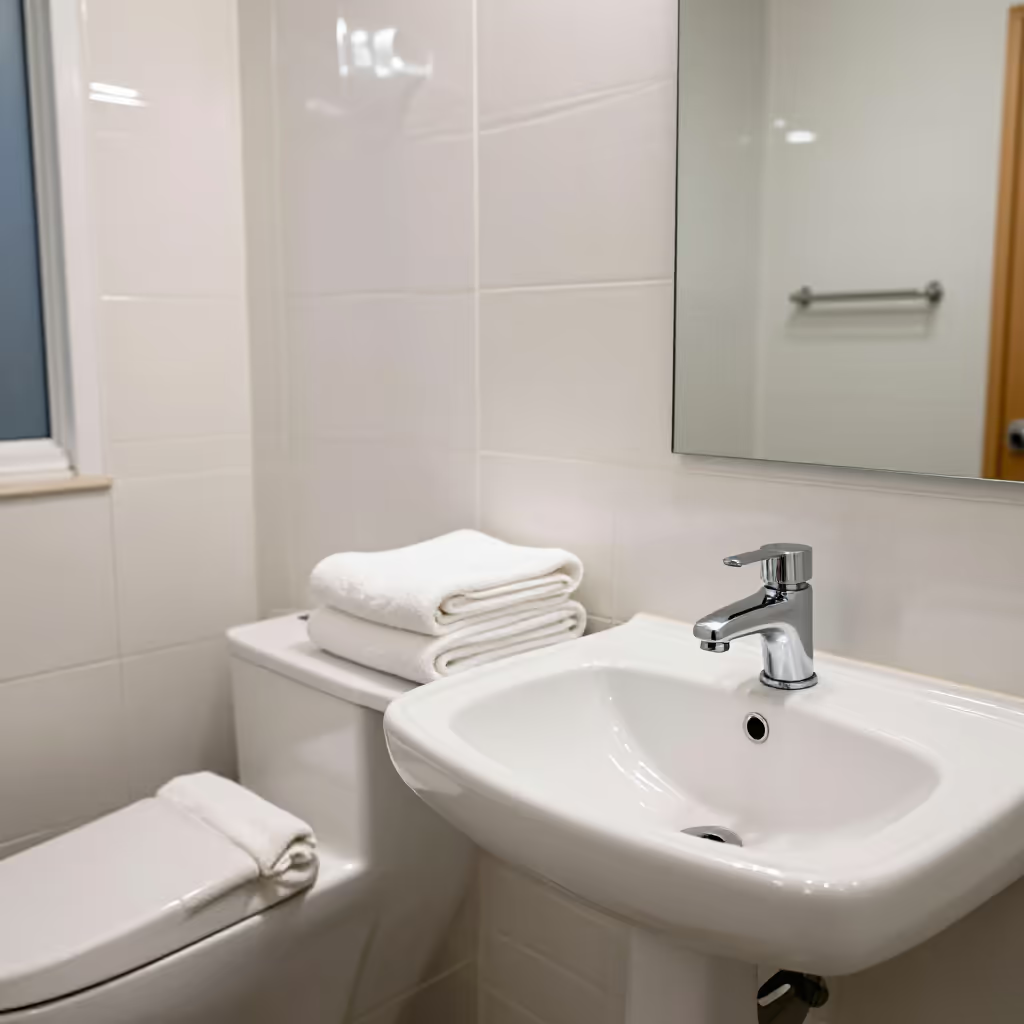
Das Zimmer ist ordentlich, weil alle Bücher im Regal stehen.
The room is neat because all the books are on the shelf.
Das Zimmer ist sauber, weil der Boden gründlich gewischt wurde.
The room is clean because the floor was thoroughly mopped.