


das Glück
happiness
A state of intense joy and contentment.
EXAMPLE
Für sie bedeutet das größte Glück, Zeit mit ihren Enkelkindern zu verbringen.
For her, the greatest happiness means spending time with her grandchildren.
happiness / luck
Loading your saved state.
happiness
A state of intense joy and contentment.
Für sie bedeutet das größte Glück, Zeit mit ihren Enkelkindern zu verbringen.
For her, the greatest happiness means spending time with her grandchildren.
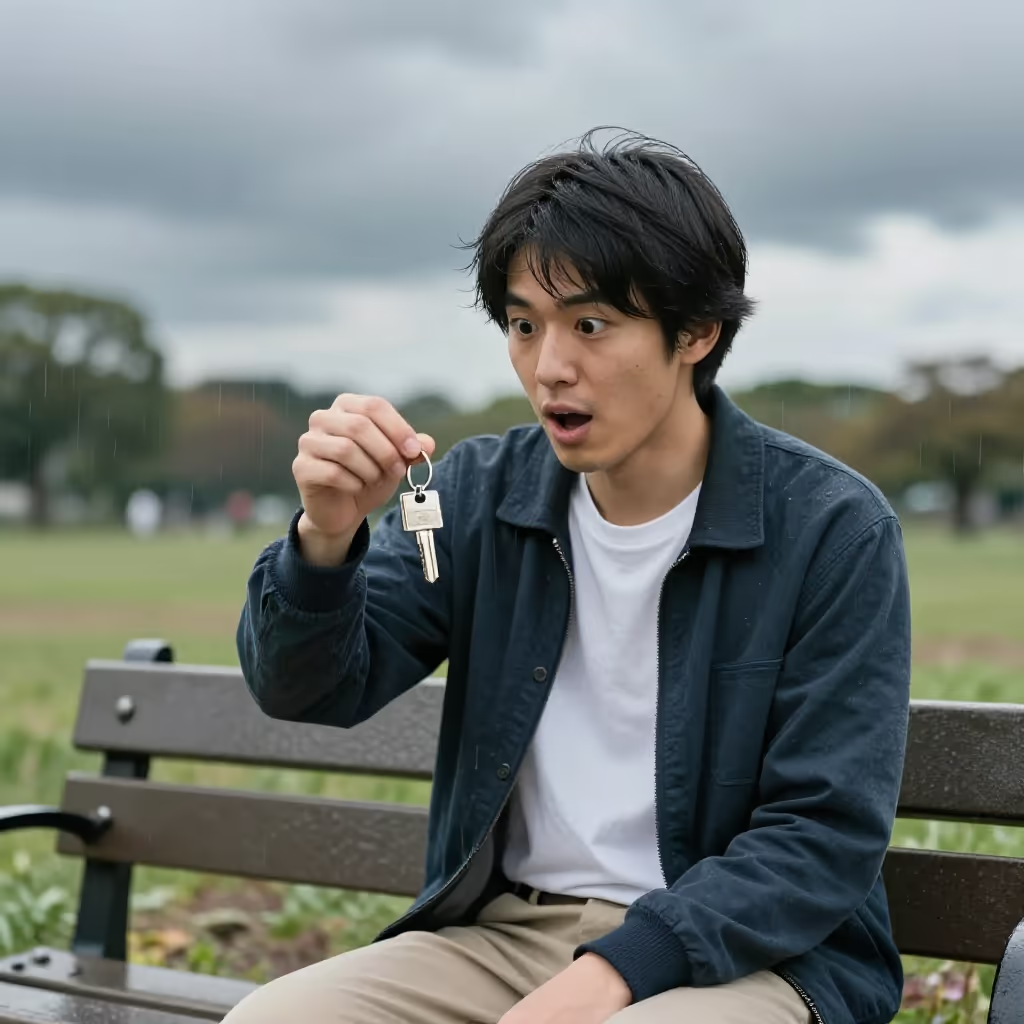
luck
A fortunate coincidence or a positive turn of fate.
Er hatte Glück und fand auf der Straße einen 50-Euro-Schein.
He had luck and found a 50-euro note on the street.

to be lucky
The fixed expression for having a fortunate coincidence happen to you.
Du hast wirklich Glück gehabt, dass du den Zug noch erwischt hast.
You were really lucky that you still caught the train.

fortunately
A fixed expression that expresses relief that something unpleasant did not happen or that something good happened; synonymous with 'glücklicherweise' (fortunately).
Ich hatte meinen Schirm vergessen, aber zum Glück hat es nicht geregnet.
I had forgotten my umbrella, but fortunately it didn't rain.
'Glück' has two central meanings: an inner feeling of joy and contentment (happiness) or a positive coincidence (luck). The context makes clear which meaning is intended.
Er fand sein Glück in der Musik.
He found his happiness in music.
To express that someone experiences a fortunate coincidence, you use the fixed expression 'Glück haben' (to be lucky). You cannot say 'Glück sein'.
Wow, du hast aber Glück gehabt!
Wow, you really were lucky!
The expression 'zum Glück' functions like an adverb and means 'fortunately'. If it stands at the beginning of a sentence, the verb follows directly after it in position 2.
Ich dachte, ich hätte meinen Schlüssel verloren. Zum Glück war er in meiner anderen Jacke.
I thought I had lost my key. Fortunately, it was in my other jacket.
The wish 'Viel Glück!' almost always means 'Good luck!', that is, the wish for a positive coincidence. It is used before exams or challenges, not to wish someone general joy in life.
Du hast morgen dein Vorstellungsgespräch? Viel Glück!
You have your job interview tomorrow? Good luck!
joy
Freude is usually a positive reaction to a specific, pleasing occasion. Glück generally refers more to an all-encompassing state of intense joy and contentment. A good piece of news therefore often calls for Freude, while the positive experience of life as a whole is more likely to be described as Glück.

Im Kreis seiner Familie empfindet Paul tiefes Glück.
Paul feels profound happiness surrounded by his family.
Über die gute Nachricht empfindet Paul große Freude.
Paul feels great joy at the good news.