


der Herr
Mr.
A formal form of address for a man, often used together with the last name.
EXAMPLE
Guten Tag, Herr Müller, wie kann ich Ihnen helfen?
Good afternoon, Mr. Müller, how can I help you?
gentleman / Mr.
Loading your saved state.
Mr.
A formal form of address for a man, often used together with the last name.
Guten Tag, Herr Müller, wie kann ich Ihnen helfen?
Good afternoon, Mr. Müller, how can I help you?

gentleman
A general, often somewhat formal or old-fashioned term for a man.
Ein älterer Herr mit Hut fragte mich nach dem Weg.
An older gentleman with a hat asked me for directions.

master
A person who has power or control over other people, animals, or an area; a ruler or master.
Der Hund gehorcht seinem Herrn aufs Wort.
The dog obeys his master without question.
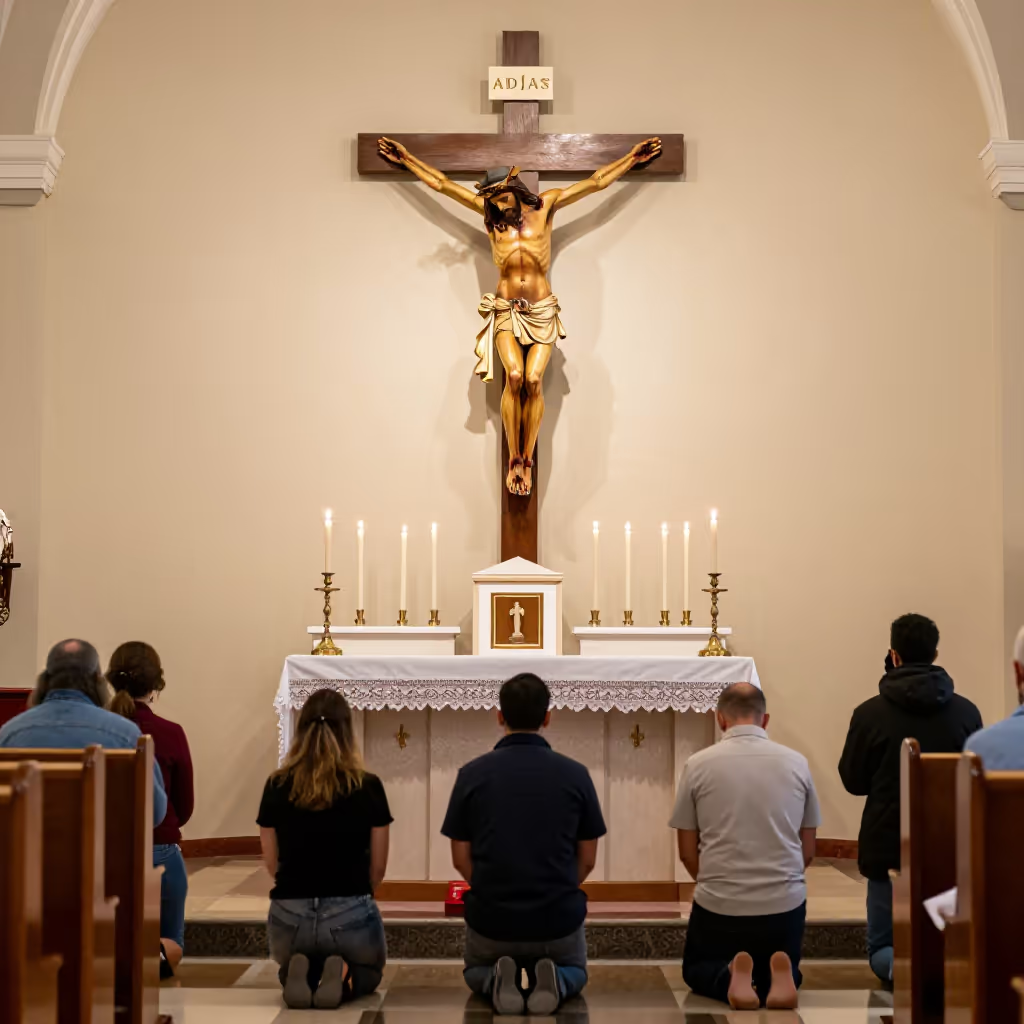
Lord
In a Christian religious context, a term for God or Jesus Christ.
Viele Gläubige beten täglich zum Herrn.
Many believers pray to the Lord every day.
'Herr' belongs to the N-declension. This means it takes the ending '-n' or '-en' in all cases except the nominative singular. A common mistake is forgetting this ending.
Ich spreche mit dem Herrn dort drüben.
I am speaking with the gentleman over there.
The word 'Herr' (gentleman / master / lord) is the root of other words related to power or control. These include the verb 'herrschen' (to rule) and the noun 'der Herrscher' (the ruler).
Der König herrschte über ein großes Reich.
The king ruled over a large empire.
When 'Herr' (Mr.) is used as a direct form of address with a last name, it appears without an article. In letters and emails, the formal salutation 'Sehr geehrter Herr...' (Dear Mr...) is common.
Sehr geehrter Herr Schmidt, anbei sende ich Ihnen die Dokumente.
Dear Mr. Schmidt, I am sending you the documents attached.
In the meaning of 'Gebieter' (ruler) or 'Meister' (master), 'Herr' appears in fixed expressions. Examples are 'sein eigener Herr sein' (to be one's own master) or 'Herr der Lage sein' (to be in control of the situation).
Nach dem Umzug in die eigene Wohnung war er endlich sein eigener Herr.
After moving into his own apartment, he was finally his own master.
You can recognize the religious meaning by the fact that 'Herr' (Lord) is often used with the definite article 'der' and without a name. In this context, the word is often capitalized even when it is not at the beginning of a sentence.
Sie vertrauen auf die Hilfe des Herrn.
They trust in the help of the Lord.
man
Mann and Herr can both refer to an unknown adult man. Mann is the neutral term; Herr sounds more polite and formal, especially when referring to customers or speaking about someone in a more distant way. Choose Herr when respect or formal distance is important.

Der Herr vor der Kasse wartet schon seit zehn Minuten.
The gentleman in front of the checkout has already been waiting for ten minutes.
Der Mann vor der Kasse wartet schon seit zehn Minuten.
The man in front of the checkout has already been waiting for ten minutes.