
The general, prevailing, and often longer-lasting emotional state of a person or group. It forms the basis for more current, short-term moods.
example
Trotz des kleinen Erfolgs war die Grundstimmung im Team weiterhin pessimistisch.
Despite the small success, the underlying mood in the team remained pessimistic.
Usage tips
Word composition
'Grundstimmung' (underlying mood/atmosphere) consists of 'Grund' (ground/basis) and 'Stimmung' (mood/atmosphere). It therefore describes the basic, deep-seated mood that serves as the basis for shorter-term feelings or impressions.
EXAMPLE
Nach der langen Regenperiode war die Grundstimmung in der Stadt gedrückt.
After the long period of rain, the underlying mood in the city was depressed.
Context clue
You can recognize the meaning from the context: if the word refers to people or groups, it means their emotional state. If it refers to works of art, places, or events, it means the general atmosphere.
EXAMPLE
Die Grundstimmung der Mitarbeiter war nach der Ankündigung sehr positiv.
The underlying mood among the employees was very positive after the announcement.
Typical adjectives
When it refers to the emotional state, 'Grundstimmung' (underlying mood) is often combined with adjectives such as 'optimistisch' (optimistic), 'pessimistisch' (pessimistic), 'positiv' (positive), or 'negativ' (negative).
EXAMPLE
Trotz der Schwierigkeiten herrschte eine optimistische Grundstimmung.
Despite the difficulties, there was an optimistic underlying mood.
Typical collocations
In the context of art or places, 'Grundstimmung' (atmosphere) is often used with verbs such as 'erzeugen' (to create), 'vermitteln' (to convey), or 'haben' (to have) to describe the atmosphere.
EXAMPLE
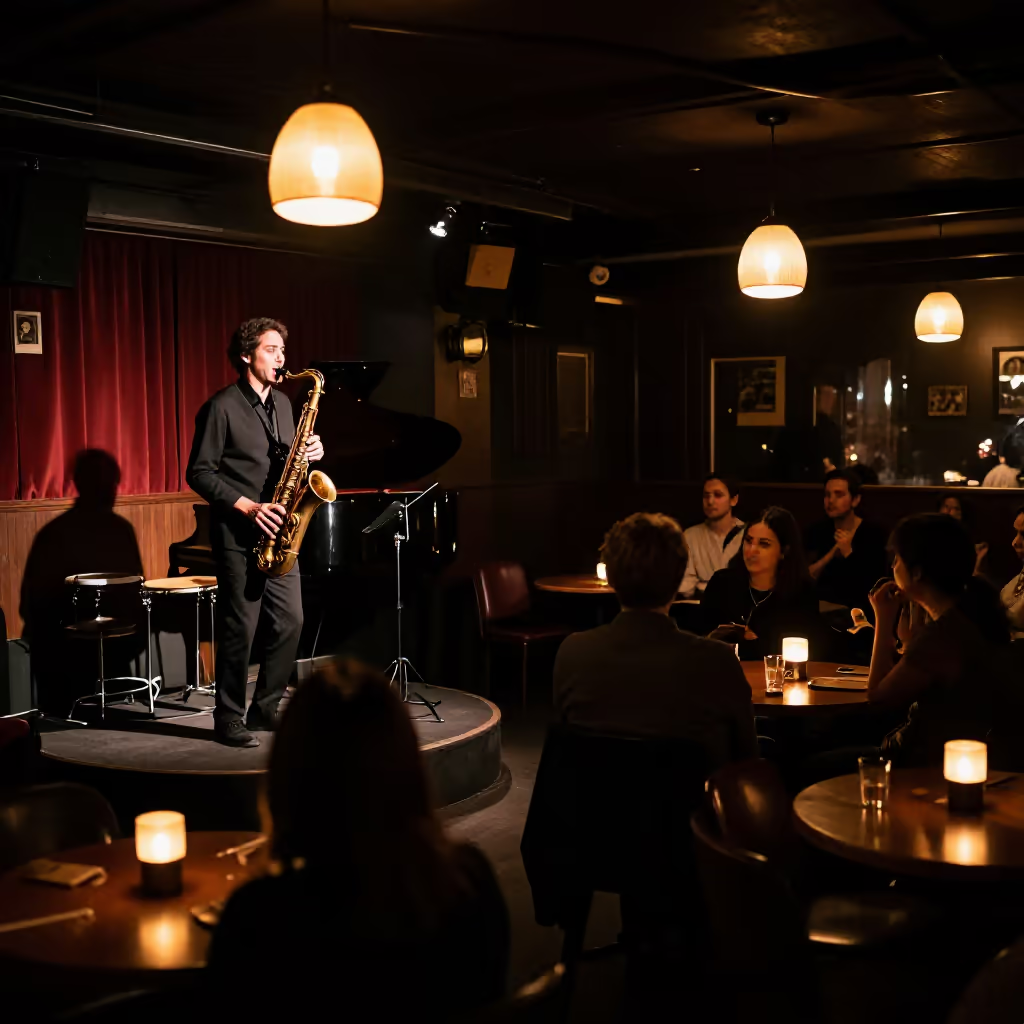
Der Regisseur erzeugt durch die Musik eine spannungsgeladene Grundstimmung.
The director creates a tense atmosphere through the music.
Compare with
near_synonym · confusable
Grundstimmung vs Stimmung
mood / atmosphere
'die Stimmung' and 'die Grundstimmung' both describe how a person, a group, or a place feels emotionally. 'Stimmung' is more general and can change quickly: someone is in a good mood today, or the atmosphere at a party suddenly turns bad. 'Grundstimmung' means more of the lasting underlying mood that remains in the background. It is less a brief moment and more the basis on which individual moods arise. Learners may confuse the words because both describe feelings and atmosphere. In practice: for the current moment, 'Stimmung' usually fits; for a longer-lasting emotional undertone, 'Grundstimmung' is more likely.
Grundstimmung
Trotz kleiner Probleme bleibt die Grundstimmung in der Gruppe positiv.
Despite small problems, the underlying mood in the group remains positive.
Stimmung
Nach der Pause war die Stimmung im Team deutlich entspannter.
After the break, the mood in the team was noticeably more relaxed.