

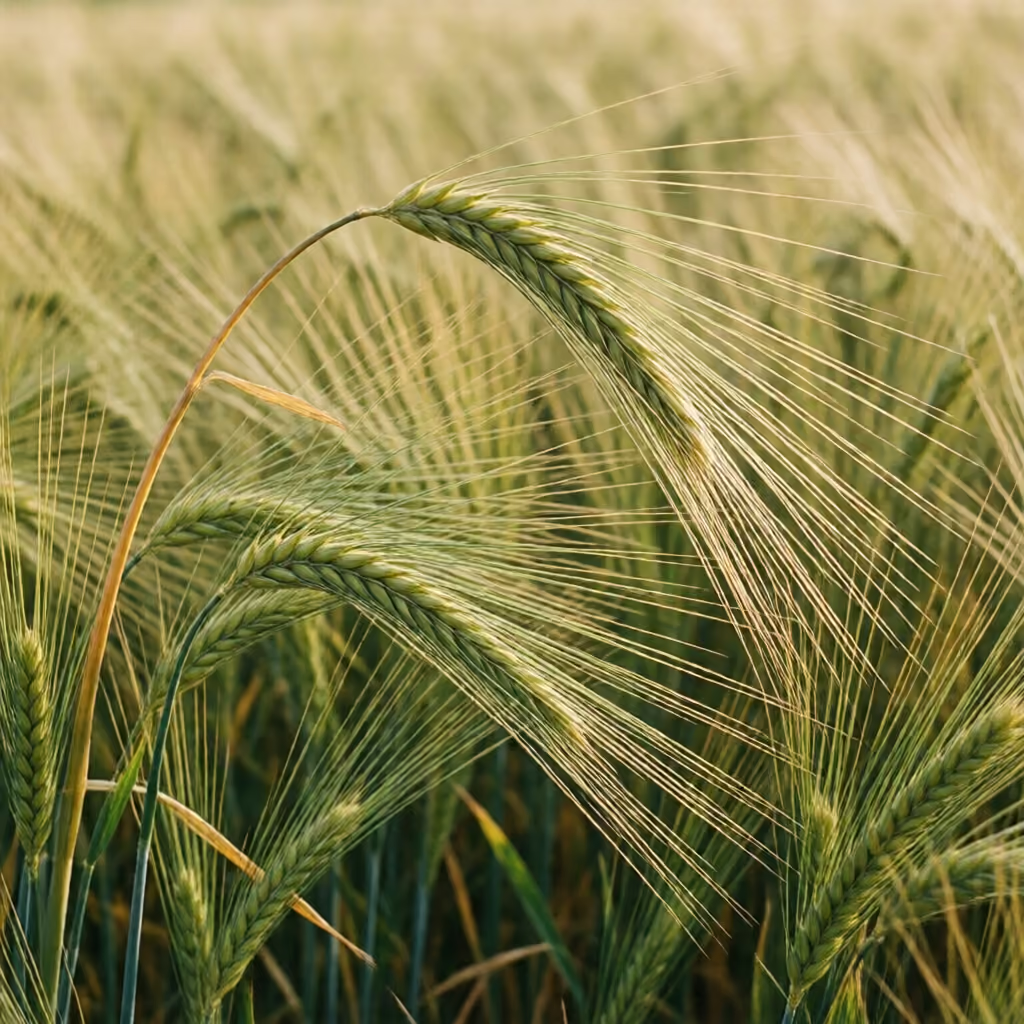
der Halm
stalk
A usually hollow, thin stem of grasses or grain.
EXAMPLE
Der Halm des reifen Weizens wurde vom Wind hin und her bewegt.
The stalk of the ripe wheat was moved back and forth by the wind.
stalk
der Halm, die Halme
Loading your saved state.
stalk
A usually hollow, thin stem of grasses or grain.
Der Halm des reifen Weizens wurde vom Wind hin und her bewegt.
The stalk of the ripe wheat was moved back and forth by the wind.
| gender | masculine der |
|---|---|
| plural | die Halme |
| genitive | des Halmes |
| singular | plural | |
|---|---|---|
| nominative | der Halm | die Halme |
| accusative | den Halm | die Halme |
| dative | dem Halm | den Halmen |
| genitive | des Halmes des Halms | der Halme |
The article changes with the case; it is shown in colour.
'Halm' (stalk) is a productive base word in compounds. Common examples include 'Grashalm' (blade of grass), 'Getreidehalm' (grain stalk), and 'Weizenhalm' (wheat stalk); the first component usually names the type of plant.
Ein einzelner Grashalm ragte aus dem frisch gemähten Feld heraus.
A single blade of grass stood out from the freshly mowed field.
'Halm' (stalk) is often used with verbs that describe movement or damage, such as 'sich im Wind biegen' (to bend in the wind), 'knicken' (to bend or snap), and 'brechen' (to break). Adjectives such as 'dünn' (thin), 'trocken' (dry), and 'lang' (long) are also common.
Die trockenen Halme knickten unter dem Gewicht des Regens um.
The dry stalks bent under the weight of the rain.
'Halm' (stalk) is especially common in contexts involving meadows, fields, and grain. Words such as 'Weizen' (wheat), 'Roggen' (rye), 'Gerste' (barley), and 'Gras' (grass) usually indicate from the context what type of stalk is meant.
Nach dem Sturm lagen viele Gerstenhalme quer auf dem Feld.
After the storm, many barley stalks were lying across the field.