

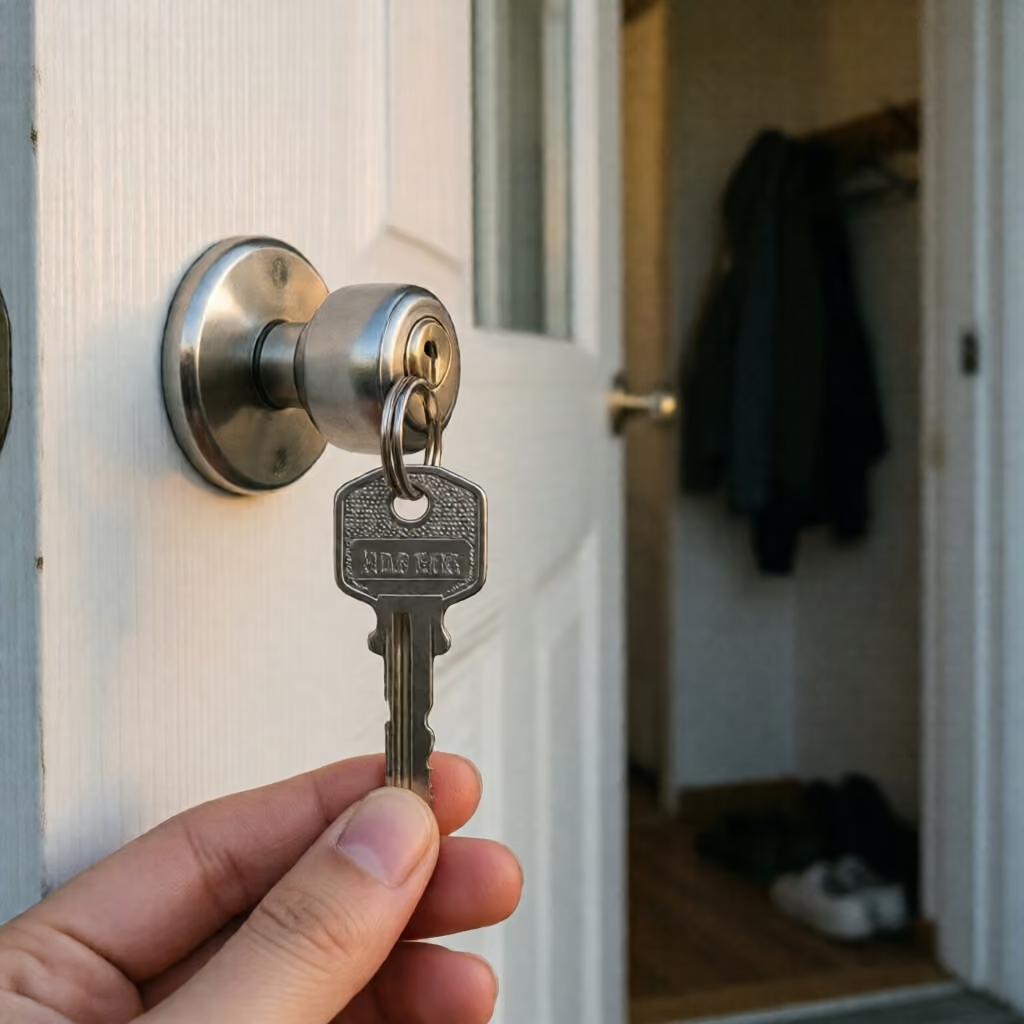
der Haustürschlüssel
front door key
A key used to unlock the front door of a house or apartment.
EXAMPLE
Ich habe meinen Haustürschlüssel auf dem Küchentisch liegen lassen.
I left my front door key on the kitchen table.
front door key
der Haustürschlüssel, die Haustürschlüssel
Loading your saved state.
front door key
A key used to unlock the front door of a house or apartment.
Ich habe meinen Haustürschlüssel auf dem Küchentisch liegen lassen.
I left my front door key on the kitchen table.
| gender | masculine der |
|---|---|
| plural | die Haustürschlüssel |
| genitive | des Haustürschlüssels |
| singular | plural | |
|---|---|---|
| nominative | der Haustürschlüssel | die Haustürschlüssel |
| accusative | den Haustürschlüssel | die Haustürschlüssel |
| dative | dem Haustürschlüssel | den Haustürschlüsseln |
| genitive | des Haustürschlüssels | der Haustürschlüssel |
The article changes with the case; it is shown in colour.
'Haustürschlüssel' is made up of 'Haus' (house), 'Tür' (door), and 'Schlüssel' (key). You can understand the word in two steps: 'Haustür' means the door of a house, and 'Schlüssel' names the corresponding object.
An meinem Schlüsselbund hängt auch der Haustürschlüssel.
My key ring also has the front door key on it.
When you describe what you use to unlock the door, the pattern 'mit dem Haustürschlüssel aufschließen' (to unlock with the front door key) is appropriate. After 'mit', the key is in the dative case.
Sie schloss die Tür mit ihrem Haustürschlüssel auf.
She unlocked the door with her front door key.
Common collocations include 'den Haustürschlüssel verlieren' (to lose the front door key), 'den Haustürschlüssel vergessen' (to forget the front door key), and 'einen Haustürschlüssel nachmachen lassen' (to have a front door key duplicated). 'Nachmachen lassen' expresses that you have someone make another copy of the key for you.
Für unsere Tochter haben wir einen Haustürschlüssel nachmachen lassen.
We had a front door key duplicated for our daughter.