


helfen
to help
To support someone with an activity or in solving a problem.
EXAMPLE
Kannst du mir bitte beim Tragen der Kisten helfen?
Can you please help me carry the boxes?
to help
Loading your saved state.
to help
To support someone with an activity or in solving a problem.
Kannst du mir bitte beim Tragen der Kisten helfen?
Can you please help me carry the boxes?
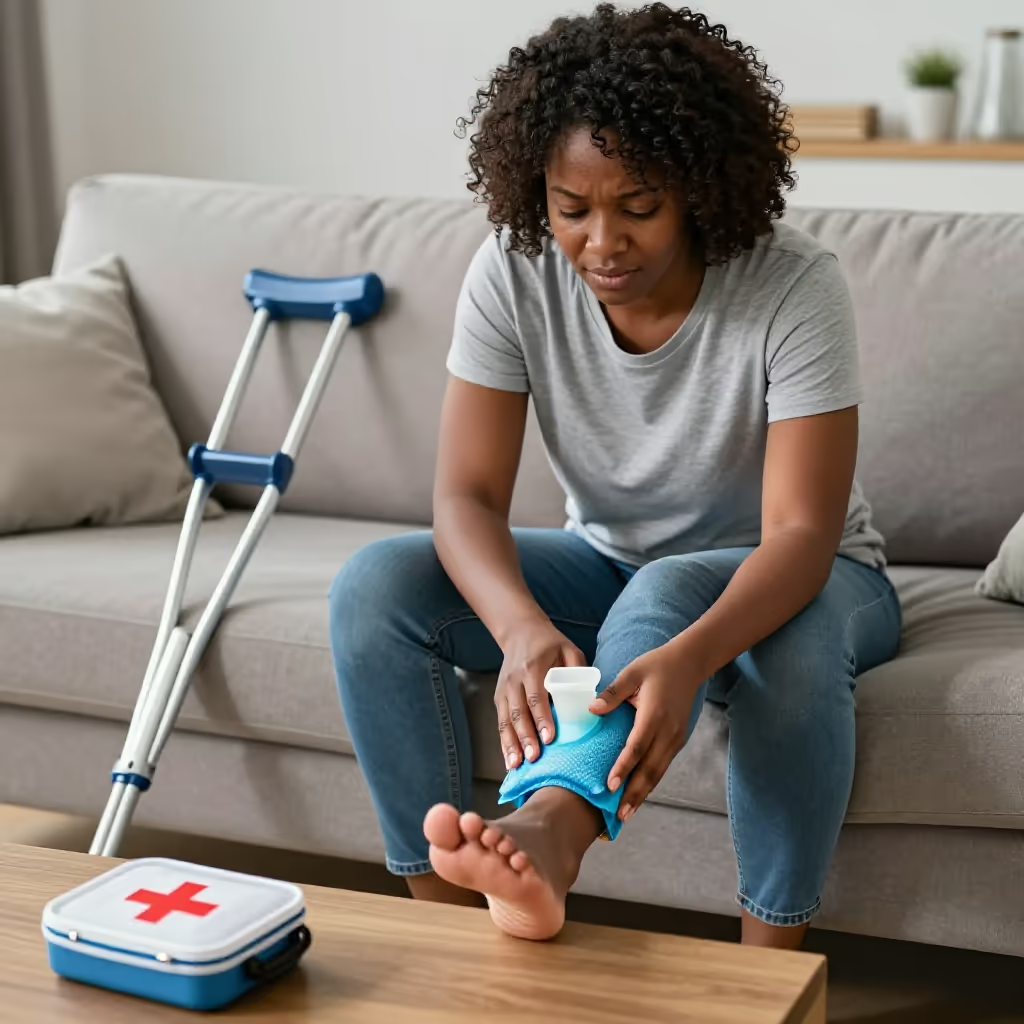
to help
To be effective against an illness, pain, or problem.
Diese Tabletten helfen gut gegen Kopfschmerzen.
These tablets help well against headaches.

nothing can be done
An idiom that expresses that a situation is unavoidable and that you have to accept it.
Es hilft nichts, wir müssen die Prüfung morgen schreiben.
Nothing can be done; we have to take the exam tomorrow.

to help oneself
To serve oneself, especially food and drink, without asking.
Helft euch einfach, der Kuchen ist für alle da!
Just help yourselves, the cake is for everyone!
'Helfen' (to help) is a verb that always requires the dative. You help 'einer Person' (a person; dative), not 'eine Person' (a person; accusative). This is a very common mistake among German learners.
Der Sanitäter half dem verletzten Radfahrer.
The paramedic helped the injured cyclist.
To name the activity with which help is given, German uses the preposition 'bei' (with/at) followed by the dative. The structure is: Person 1 helps Person 2 with thing X.
Er hat mir gestern bei der Reparatur meines Fahrrads geholfen.
He helped me repair my bicycle yesterday.
When 'helfen' (to help) means that something is effective, the preposition 'gegen' (against) with the accusative is used to name the problem, such as an illness.
Dieser Tee hilft gut gegen Halsschmerzen.
This tea helps well against sore throats.
The expression 'Es hilft nichts' (nothing can be done/it can't be helped) is a fixed idiom. It is used to express that you have to accept an unpleasant but unchangeable situation.
Es hilft nichts, wir müssen bei diesem Regen nach draußen gehen.
Nothing can be done; we have to go outside in this rain.
In the meaning 'sich bedienen' (to help oneself), 'helfen' (to help) is used reflexively. The reflexive pronoun changes according to the person. It is especially common in the imperative to express hospitality.
Bitte, hilf dir! Nimm dir ruhig noch ein Stück Kuchen.
Please, help yourself! Go ahead and take another piece of cake.
to use / benefit
Helfen and nutzen can both say that a measure is good for someone. Helfen emphasizes support with a problem, while nutzen focuses more on assessing the benefit or success for the person. Use helfen when the specific support is important, and nutzen when its benefit is the focus.

Der neue Fahrplan hilft den Pendlern bei der täglichen Fahrt.
The new timetable helps commuters with their daily journey.
Der neue Fahrplan nutzt den Pendlern durch kürzere Wartezeiten.
The new timetable benefits commuters by reducing wait times.