

herum
around
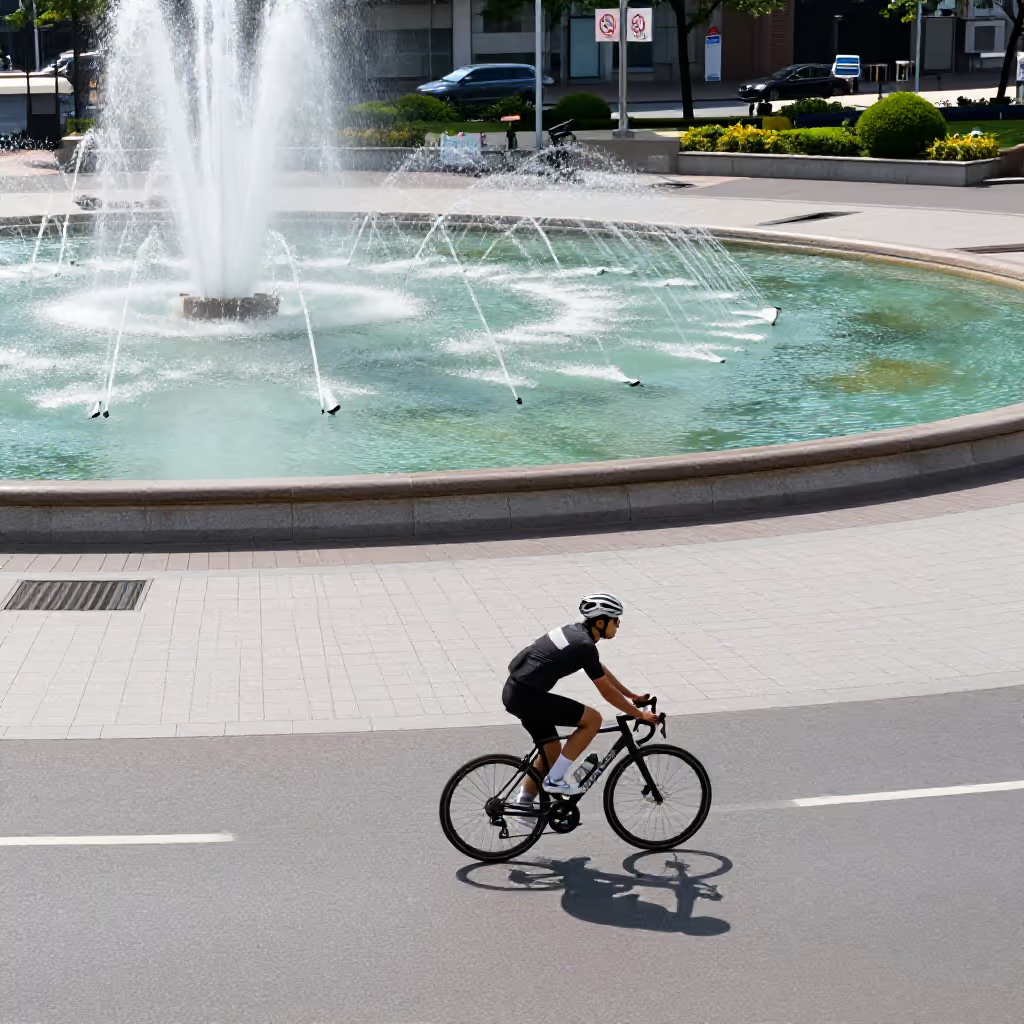
Indicates movement or position in a circle around something or along a boundary.
EXAMPLE
Die Katze schleicht um den heißen Brei herum.
The cat is beating around the bush.
around / about
Loading your saved state.
around
Indicates movement or position in a circle around something or along a boundary.
Die Katze schleicht um den heißen Brei herum.
The cat is beating around the bush.

about / around
Expresses an approximate indication of time, quantity, or place; in the sense of 'approximately' or 'about'.
Wir treffen uns so um 18 Uhr herum.
We'll meet at around 6 p.m.

to be over
In the expression 'herum sein' (to be over), it means that something is over or finished in terms of time.
Wenn die Woche endlich herum ist, fahre ich in den Urlaub.
When the week is finally over, I'm going on vacation.

to get around something
To inevitably have to do or deal with a task or situation.
Um eine Steuererklärung kommen wir dieses Jahr leider nicht herum.
Unfortunately, we won't get around filing a tax return this year.

around
Indicates indefinite movement or staying in a place without a clear purpose.
Hör auf, nur faul herumzuliegen und hilf mir!
Stop just lying around lazily and help me!
'Herum' (around/about) is made up of the directional particles 'her' (movement toward the speaker) and 'um' (around/in a circle). It often describes circular or undirected movement.
Komm mal schnell herum, ich will dir etwas zeigen.
Come around quickly; I want to show you something.
'Herum' is a very common separable prefix. In verbs like 'herumlaufen' (to run/walk around), 'herumstehen' (to stand around), or 'herumliegen' (to lie around), it often gives the meaning of aimlessness or inactivity.
Die Kinder laufen den ganzen Tag im Garten herum.
The children run around in the garden all day.
When 'herum' means 'ungefähr' (approximately/about), it always comes after the time or quantity it refers to. The expression itself is often introduced with 'um' or 'so'.
Ich bin so gegen 10 Uhr herum bei dir.
I'll be at your place around 10 o'clock or so.
The expression 'herum sein' (to be over) means that a period of time has come to an end. The subject is the period of time itself.
Endlich ist die anstrengende Woche herum!
Finally, the exhausting week is over!
The idiom 'um etwas herumkommen' (to get around something) means that you cannot avoid something unpleasant. It is usually used in the negative.
Um die Prüfung wirst du nicht herumkommen.
You won't get around the exam.
at / around / in order to
Um and herum can both describe movement in a circle around something. Um is a preposition placed before an accusative phrase, while herum places greater emphasis on the movement all the way around and usually comes after that phrase. Use um for the basic construction and um ... herum for clearer emphasis on circling movement.

Die Kinder laufen um den Baum herum.
The children are running all the way around the tree.
Die Kinder laufen um den Baum.
The children are running around the tree.