

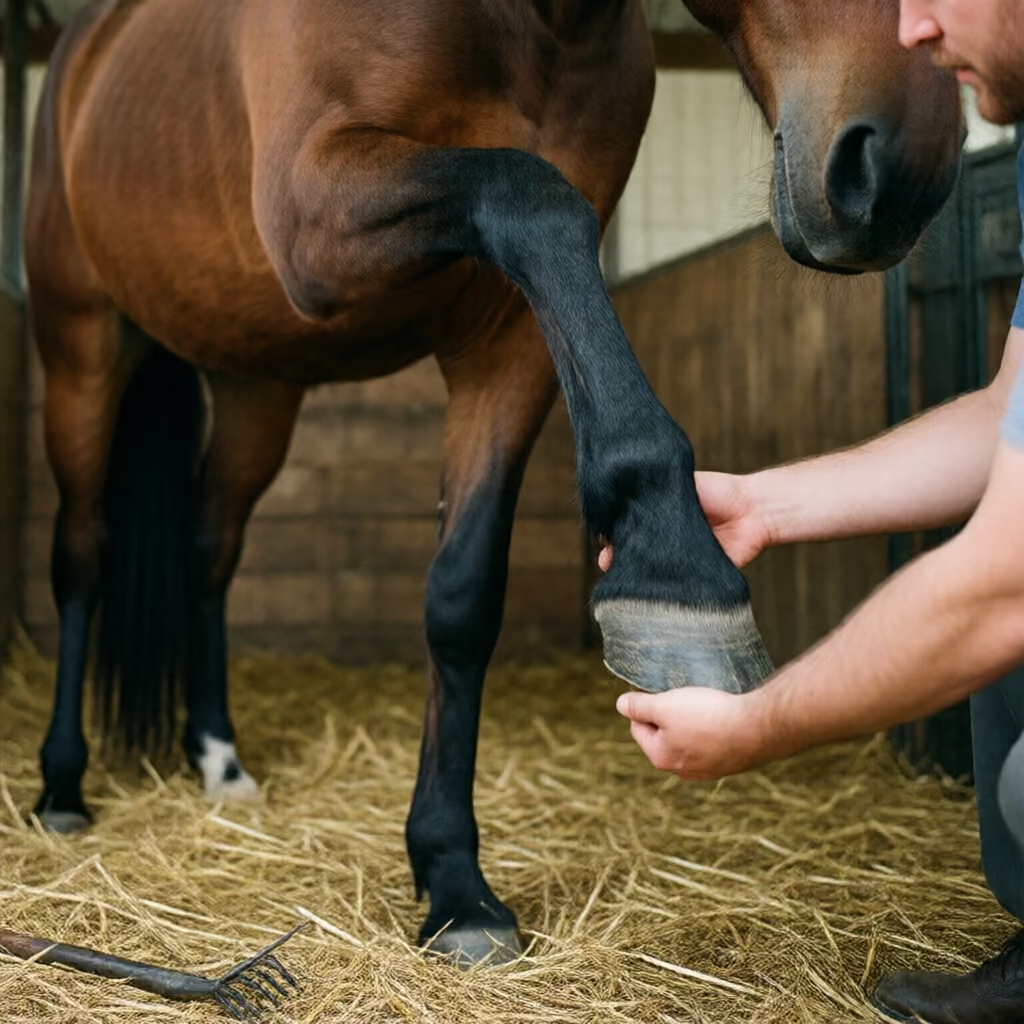
der Huf
hoof
The hard, horn-based part at the end of the foot of horses and some other hoofed animals.
EXAMPLE
Der Tierarzt untersuchte den verletzten Huf des Pferdes.
The veterinarian examined the injured hoof of the horse.
hoof
der Huf, die Hufe
Loading your saved state.
hoof
The hard, horn-based part at the end of the foot of horses and some other hoofed animals.
Der Tierarzt untersuchte den verletzten Huf des Pferdes.
The veterinarian examined the injured hoof of the horse.

foot
Informally, a foot, especially a person's foot.
Nach der langen Wanderung tun mir die Hufe weh.
My feet hurt after the long hike.

to get a move on
Informally, to hurry and set off briskly.
Wir sollten die Hufe schwingen, sonst verpassen wir den Zug.
We should get a move on, or we'll miss the train.
| gender | masculine der |
|---|---|
| plural | die Hufe |
| genitive | des Hufes |
| singular | plural | |
|---|---|---|
| nominative | der Huf | die Hufe |
| accusative | den Huf | die Hufe |
| dative | dem Huf | den Hufen |
| genitive | des Hufes des Hufs | der Hufe |
The article changes with the case; it is shown in colour.
In connection with animals, 'Huf' (hoof) is often used when talking about hoof care. A hoof can be cared for, trimmed, or shod. 'Hufschmied' (farrier) and 'Hufverletzung' (hoof injury) are also important collocations.
Der Hufschmied beschlug den Huf des jungen Pferdes.
The farrier shod the young horse's hoof.
For human feet, 'Huf' (hoof) is almost always used in a casual, often humorous context. The word frequently appears in the plural, especially in combinations with verbs such as 'wehtun' (to hurt) or 'bewegen' (to move).
Nach dem Stadtbummel musste ich erst einmal meine Hufe hochlegen.
After walking around town, I had to put my feet up for a while.
'Die Hufe schwingen' (to get a move on) is a fixed informal expression used without an object. It is often used as a command or with a modal verb when someone needs to leave quickly.
Schwingt die Hufe, der Bus fährt gleich ab!
Get a move on, the bus is leaving soon!