

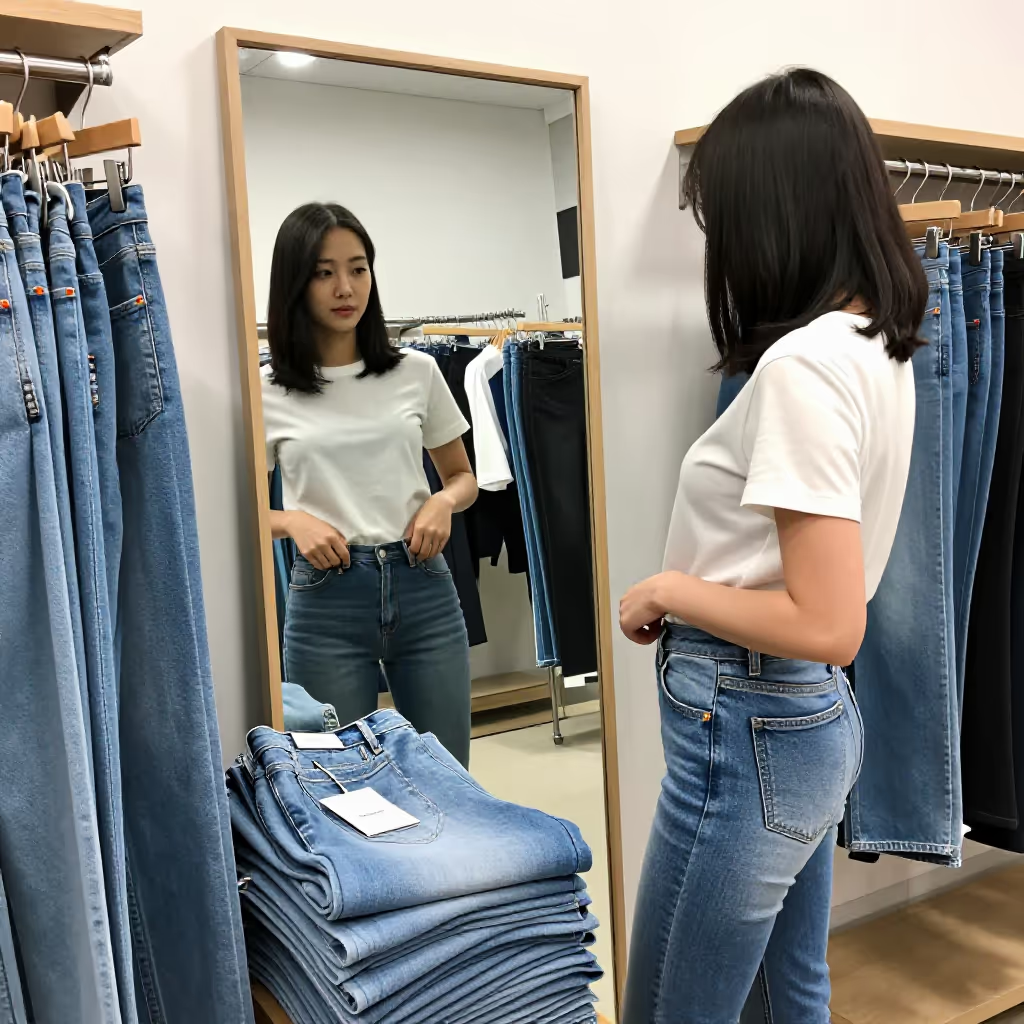
die Jeans
jeans
A pair of pants made from a sturdy cotton fabric called denim. They are a very common and popular item of clothing.
EXAMPLE
Am liebsten trage ich eine bequeme Jeans und ein T-Shirt.
I prefer to wear comfortable jeans and a T-shirt.
jeans
die Jeans, die Jeans
Loading your saved state.
jeans
A pair of pants made from a sturdy cotton fabric called denim. They are a very common and popular item of clothing.
Am liebsten trage ich eine bequeme Jeans und ein T-Shirt.
I prefer to wear comfortable jeans and a T-shirt.
| gender | feminine die |
|---|---|
| plural | die Jeans |
| genitive | der Jeans |
| singular | plural | |
|---|---|---|
| nominative | die Jeans | die Jeans |
| accusative | die Jeans | die Jeans |
| dative | der Jeans | den Jeans |
| genitive | der Jeans | der Jeans |
The article changes with the case; it is shown in colour.
| gender | neuter das |
|---|---|
| genitive | des Jeans |
| singular | plural | |
|---|---|---|
| nominative | das Jeans | – |
| accusative | das Jeans | – |
| dative | dem Jeans | – |
| genitive | des Jeans | – |
The article changes with the case; it is shown in colour.
Although the word ends in '-s' and comes from English, 'die Jeans' (jeans) is used in German as a singular word for one pair of pants. The verb is therefore also singular.
Meine neue Jeans ist blau und sehr bequem.
My new jeans are blue and very comfortable.
The word stem 'Jeans-' is very productive and forms many compound nouns for items of clothing made from the typical fabric.
Im Sommer trage ich gerne eine Jeansjacke über dem T-Shirt.
In summer, I like wearing a denim jacket over my T-shirt.
Er hat sich ein neues Jeanshemd gekauft.
He bought himself a new denim shirt.
Common adjectives used with 'Jeans' (jeans) are 'eng' (tight), 'weit' (loose), 'zerrissen' (ripped), or 'ausgewaschen' (faded). Typical verbs are 'eine Jeans tragen' (to wear jeans) or 'eine Jeans anziehen' (to put on jeans).
Für die Party hat sie eine enge, schwarze Jeans angezogen.
For the party, she put on tight black jeans.