


jeweils
each
Refers to each individual element of a group and means 'for each one individually' or 'per item'.
EXAMPLE
Die Teilnehmer erhalten jeweils eine Urkunde und eine Medaille.
The participants each receive a certificate and a medal.
respectively / each
Loading your saved state.
each
Refers to each individual element of a group and means 'for each one individually' or 'per item'.
Die Teilnehmer erhalten jeweils eine Urkunde und eine Medaille.
The participants each receive a certificate and a medal.

respectively
Refers to a particular recurring time or situation and means 'at the relevant time' or 'in each respective case'.
Die Treffen finden jeweils am ersten Montag des Monats statt.
The meetings take place respectively on the first Monday of the month.
The adverb 'jeweils' (each/respectively) is made up of 'je' (each) and 'Weile' (time/while). It expresses that something applies to each individual unit or at each individual point in time.
Die Teams bestehen aus jeweils fünf Spielern.
The teams each consist of five players.
As an adverb, 'jeweils' (each/respectively) can stand flexibly in the sentence. In position 1, it introduces the sentence, and the verb follows directly after it. But it can also stand in the middle of the sentence.
Jeweils am Monatsende wird das Gehalt gezahlt.
At the end of each month, the salary is paid.
Make sure that 'jeweils' (each/respectively) is an adverb and never changes its form. It is not declined like an adjective before a noun.
Die beiden Kandidaten bekamen jeweils gleich viele Stimmen.
The two candidates each received the same number of votes.
In the meaning of 'per item' or 'for each one individually', 'jeweils' (each) is often used with numbers, prices, or quantities. It distributes a characteristic across the individual elements of a group.
Die Äpfel kosten 50 Cent, die Birnen jeweils 60 Cent.
The apples cost 50 cents, and the pears 60 cents each.
always
Immer and jeweils can refer to recurring appointments. Immer emphasizes that something happens at every appointment without exception; jeweils assigns the action to each individual appointment. Choose immer for repetition without exceptions and jeweils for distribution across the individual cases.
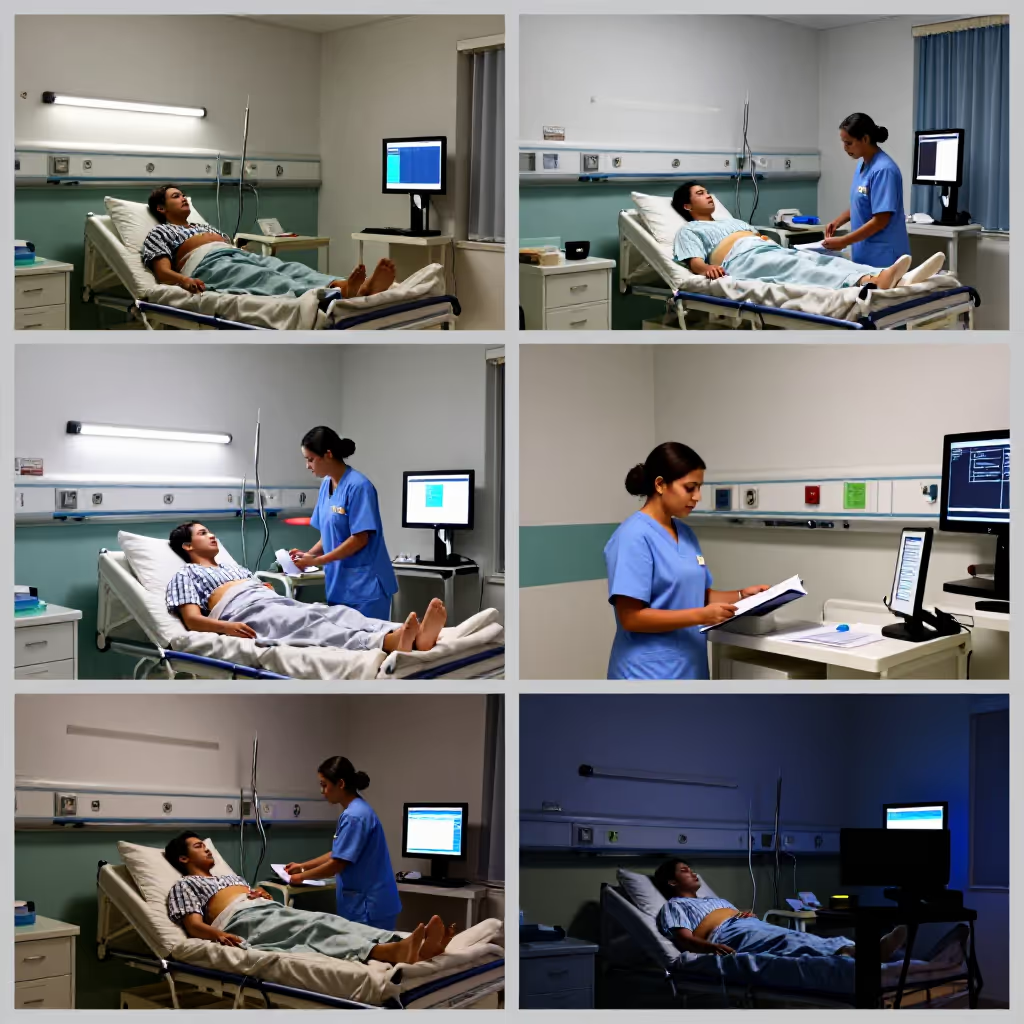
Bei den Kontrollterminen misst die Ärztin jeweils zuerst den Blutdruck.
At the follow-up appointments, the doctor measures the patient's blood pressure first each time.
Bei den Kontrollterminen misst die Ärztin immer zuerst den Blutdruck.
At the follow-up appointments, the doctor always measures the patient's blood pressure first.