


steigen
to rise
To increase in quantity, value, intensity, or level.
EXAMPLE
Die Arbeitslosigkeit ist im letzten Quartal leicht gestiegen.
Unemployment rose slightly in the last quarter.
to rise / climb
Loading your saved state.
to rise
To increase in quantity, value, intensity, or level.
Die Arbeitslosigkeit ist im letzten Quartal leicht gestiegen.
Unemployment rose slightly in the last quarter.

to climb
To move upward; to go up onto something or climb.
Vorsichtig stieg er auf die Leiter, um das Dach zu reparieren.
He carefully climbed onto the ladder to repair the roof.
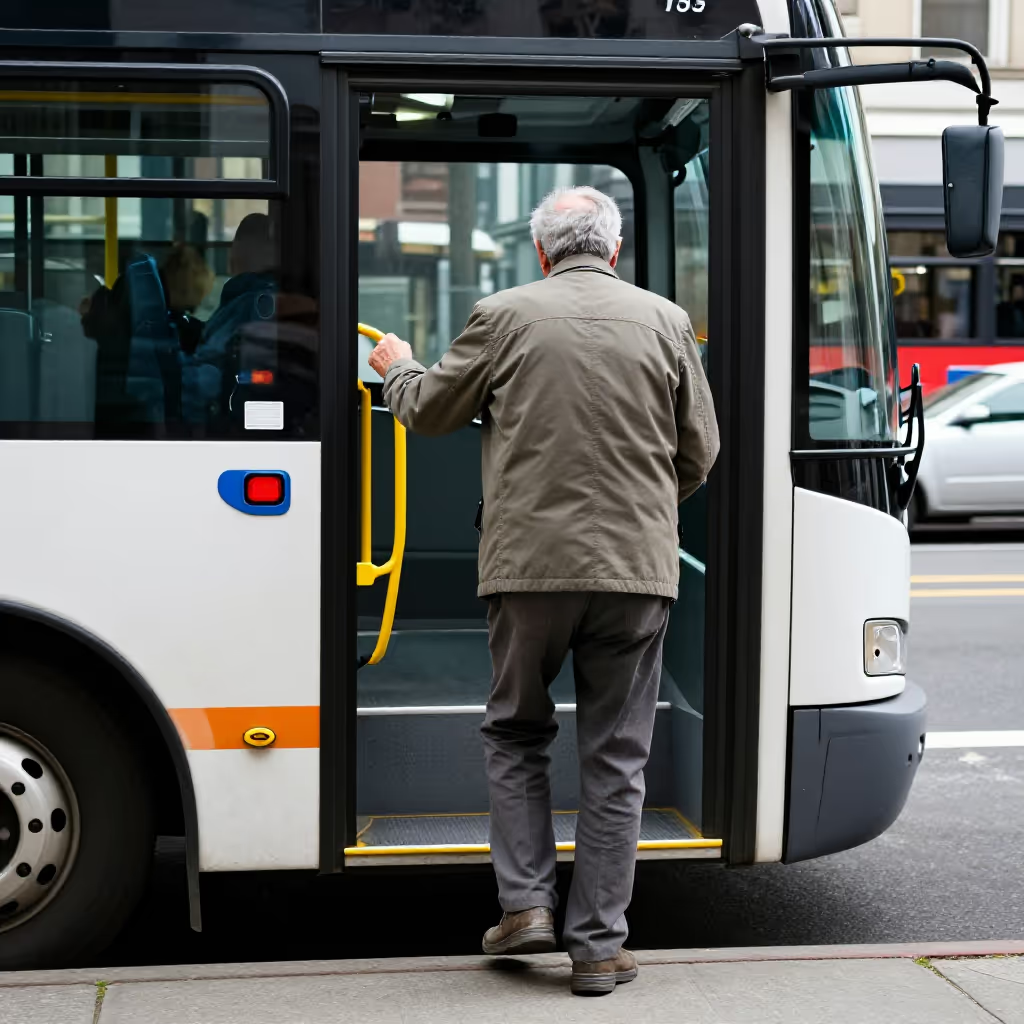
to get into/onto
To enter a vehicle, means of transport, or an elevated position.
Der Reiter stieg auf sein Pferd und ritt davon.
The rider got onto his horse and rode away.

to take place
To take place, to be held (usually used colloquially for celebrations or parties).
Nächstes Wochenende steigt bei uns im Garten eine große Grillparty.
Next weekend, a big barbecue party is taking place in our garden.

to rise
To move upward as gas, smoke, steam, or something similar.
Aus dem Schornstein stieg weißer Rauch in den blauen Himmel.
White smoke rose from the chimney into the blue sky.
'Steigen' (to rise/climb) describes movement or a change of state. Therefore, the perfect tense is always formed with the auxiliary verb 'sein' (to be).
Die Benzinpreise sind schon wieder gestiegen.
Petrol prices have risen again.
'Steigen' (to climb/get) is the base verb for many important verbs related to means of transport: 'einsteigen' (to get in), 'aussteigen' (to get out), and 'umsteigen' (to change vehicles/trains).
Wir müssen an der nächsten Haltestelle aussteigen.
We have to get off at the next stop.
In the meaning 'zunehmen' (to increase), 'steigen' (to rise) is usually used for abstract things that can be measured, such as prices, temperatures, numbers, or fever.
Die Nachfrage nach Elektroautos steigt kontinuierlich.
Demand for electric cars is rising continuously.
When entering vehicles, the preposition is important: you get 'in' closed vehicles ('in den Bus' — into the bus, 'ins Auto' — into the car), but 'auf' for open vehicles or animals ('auf das Fahrrad' — onto the bicycle, 'aufs Motorrad' — onto the motorcycle).
Er stieg schnell in den Zug, bevor die Türen sich schlossen.
He quickly got into the train before the doors closed.
The meaning 'stattfinden' (to take place) is colloquial and is used almost only for parties, festivals, or similar events.
Wo steigt heute Abend die Party?
Where's the party happening tonight?
to grow / to wax
“Steigen” neutrally describes a measurable value or level becoming higher. “Wachsen” more often describes a gradual increase in quantity, importance, or scope, but it can also be used with numbers. “Steigen” often fits a single measurable change, while “wachsen” is more suitable for an increase that develops over time.

Die Zahl der Besucher steigt in diesem Monat auf 10 000.
The number of visitors is rising to 10,000 this month.
Die Zahl der Besucher wächst seit dem Start des Festivals stetig.
The number of visitors has been growing steadily since the festival began.