

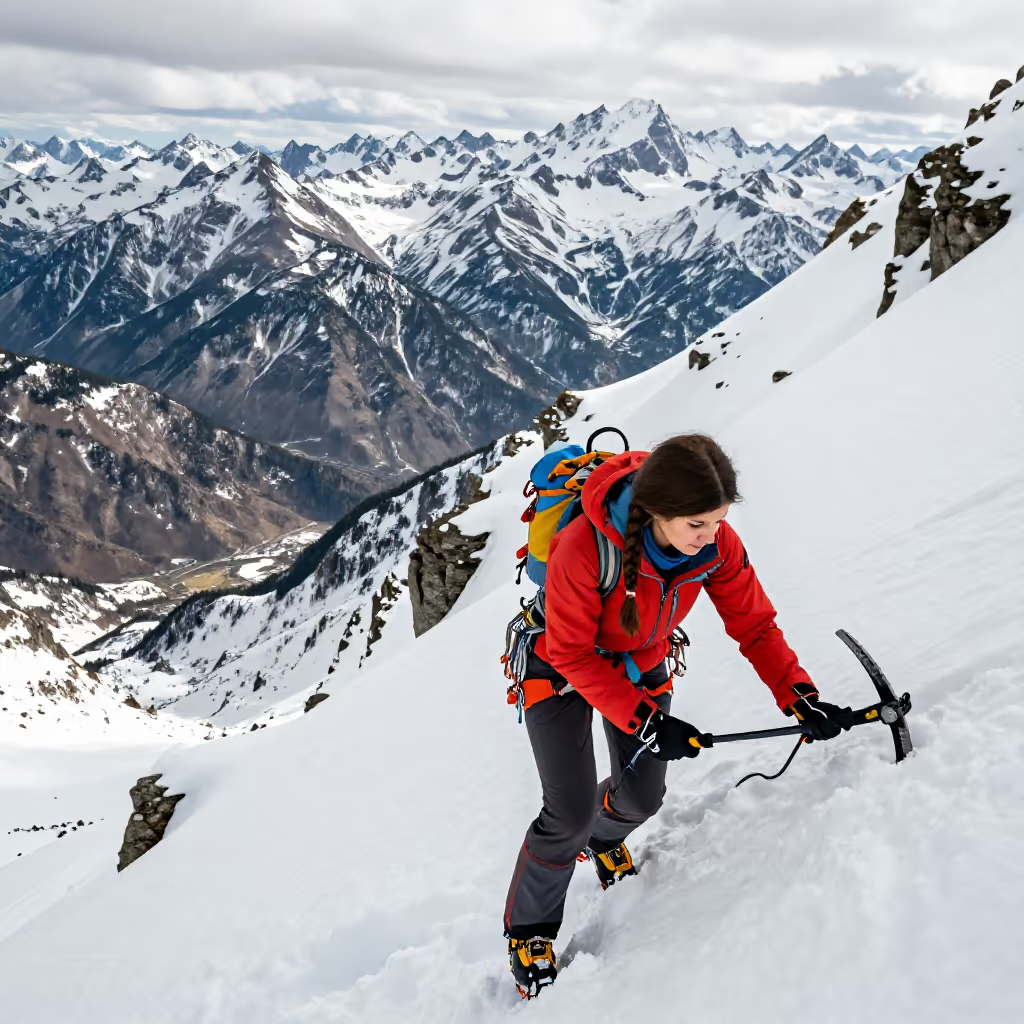
aufsteigen
to rise
To move physically upward; to gain height.
EXAMPLE
Heisse Luft steigt nach oben auf.
Hot air rises upward.
to rise / mount
Loading your saved state.
to rise
To move physically upward; to gain height.
Heisse Luft steigt nach oben auf.
Hot air rises upward.

to mount
To climb onto a vehicle, such as a bicycle or motorcycle, or onto a mount, such as a horse.
Der Reiter stieg elegant auf sein Pferd auf.
The rider mounted his horse elegantly.

to rise
To reach a higher position in a hierarchy, at work, or in society.
Sie hofft, bald zur Teamleiterin aufzusteigen.
She hopes to rise to team leader soon.

to be promoted
In sports, to achieve promotion to a higher division or league.
Nach einer grandiosen Saison ist der Verein in die erste Liga aufgestiegen.
After a fantastic season, the club was promoted to the first division.

to rise up
For feelings, thoughts, or physical sensations: to suddenly become noticeable or enter consciousness.
Beim Geruch des Kuchens stiegen sofort Kindheitserinnerungen in ihr auf.
At the smell of the cake, childhood memories immediately rose up in her.
'Aufsteigen' (to rise / mount) is a separable verb. The prefix 'auf-' separates from the verb in a main clause and stands at the end of the sentence.
Der Heißluftballon steigt langsam auf.
The hot-air balloon rises slowly.
Since 'aufsteigen' (to rise / mount) describes movement or a change of state, the perfect tense is always formed with the auxiliary verb 'sein' (to be).
Der Nebel ist am Morgen aufgestiegen.
The fog rose in the morning.
When climbing onto a vehicle or mount, you use the preposition 'auf' with the accusative.
Vorsichtig stieg sie auf das unruhige Pferd auf.
Carefully, she mounted the restless horse.
To express a promotion at work, the preposition 'zu' with the dative is used to name the new position.
Nach nur zwei Jahren ist er zum Abteilungsleiter aufgestiegen.
After only two years, he rose to department head.
In a sports context, the preposition 'in' with the accusative is used to indicate the higher league that is reached.
Der Verein ist letztes Jahr in die zweite Liga aufgestiegen.
The club was promoted to the second division last year.
When feelings, thoughts, or sensations 'aufsteigen' (rise up), the subject is the feeling itself. The person who feels it is often named with the preposition 'in' and dative.
Bei seinen Worten stieg Wut in mir auf.
At his words, anger rose up in me.
to rise / climb
With smoke, both “steigen” and “aufsteigen” can express upward movement. “Steigen” neutrally describes gaining height, while “aufsteigen” places more emphasis on the beginning of the movement from a lower starting point. The difference is a nuance, not a fixed distinction.

Der Rauch steigt langsam aus dem Schornstein auf.
The smoke is slowly rising from the chimney.
Der Rauch steigt langsam über die Dächer.
The smoke is slowly rising above the rooftops.