

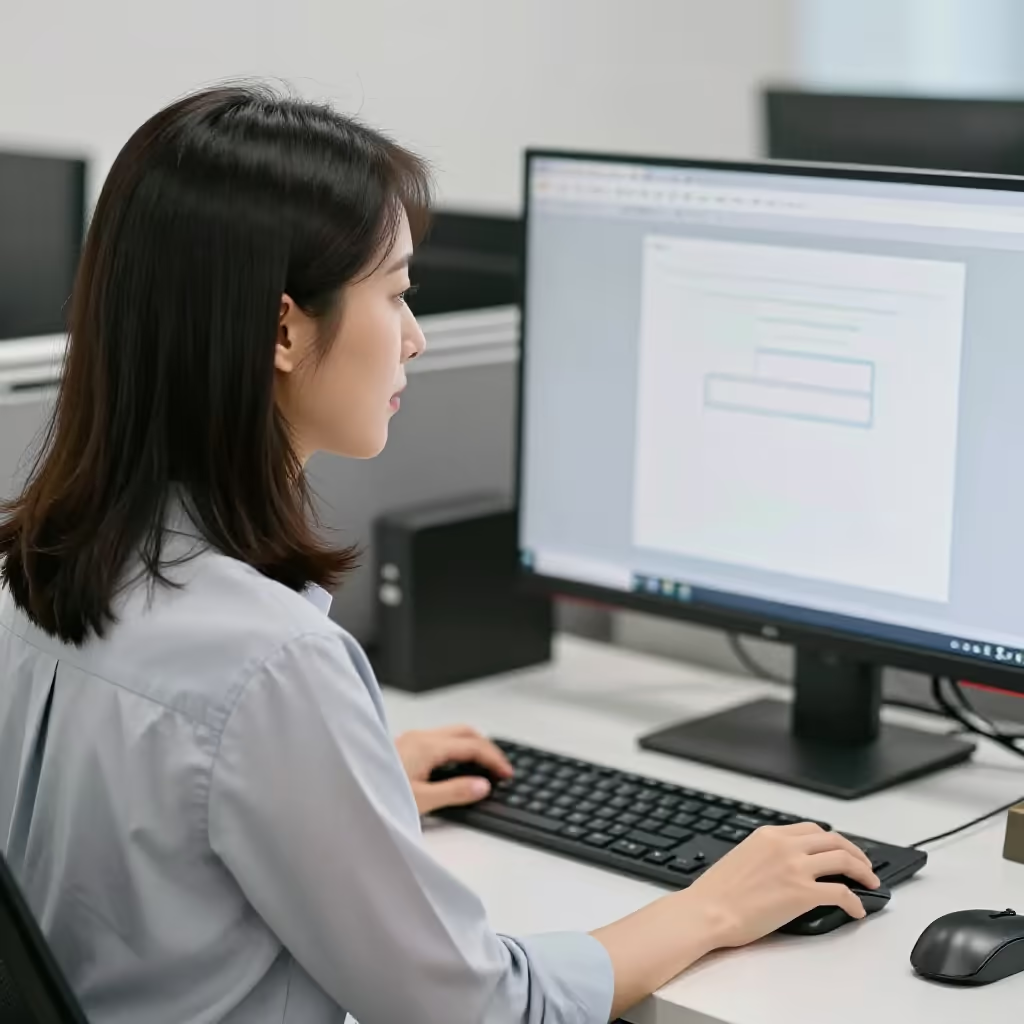
klicken
to click
To briefly press a button on a computer mouse or touchpad in order to trigger an action on the screen.
EXAMPLE
Klicken Sie auf den Link, um die Webseite zu öffnen.
Click on the link to open the website.
to click
Loading your saved state.
to click
To briefly press a button on a computer mouse or touchpad in order to trigger an action on the screen.
Klicken Sie auf den Link, um die Webseite zu öffnen.
Click on the link to open the website.
to click
To produce a short, hard sound, like when two hard objects hit each other.
Das Schloss klickte, als ich den Schlüssel umdrehte.
The lock clicked when I turned the key.

to click
(Colloquial) To suddenly understand or grasp something; to have a realization. Often used in the expression 'es hat geklickt' (it clicked).
Nach seiner Erklärung hat es bei mir endlich geklickt.
After his explanation, it finally clicked for me.

to click
(Colloquial) To get along well with someone right away; to feel an immediate connection.
Wir haben uns auf der Party kennengelernt und es hat sofort zwischen uns geklickt.
We met at the party and it clicked between us right away.
When you want to say what you are clicking on, always use the preposition 'auf' followed by the accusative.
Um fortzufahren, müssen Sie auf den „Weiter“-Button klicken.
To continue, you must click on the 'Weiter' button.
In this meaning, the subject of the sentence is usually a mechanical object that makes a short, hard sound. Typical subjects are 'das Schloss' (the lock), 'die Tür' (the door), or 'die Kamera' (the camera).
Die Autotür klickte leise, als sie ins Schloss fiel.
The car door clicked softly as it shut.
The colloquial expression 'es hat bei jemandem geklickt' means that someone suddenly understands something. The person who has the realization is in the dative.
Zuerst verstand ich die Aufgabe nicht, aber dann hat es bei mir geklickt.
At first I didn't understand the task, but then it clicked for me.
When you want to say that two or more people immediately like each other, you use the colloquial expression 'es hat zwischen ihnen geklickt' (it clicked between them).
Schon beim ersten Treffen hat es zwischen den beiden geklickt.
It clicked between the two of them at their very first meeting.
to press / hug
Drücken refers more to the physical movement of pressing the mouse button. Klicken describes briefly pressing it to trigger an action on the screen. If you mean the button itself, drücken is appropriate; if you mean a link or an on-screen action, people usually say klicken.
Klicken Sie auf den Link, damit das Menü erscheint.
Click the link to make the menu appear.
Drücken Sie die linke Maustaste, bis das Menü erscheint.
Press the left mouse button until the menu appears.