

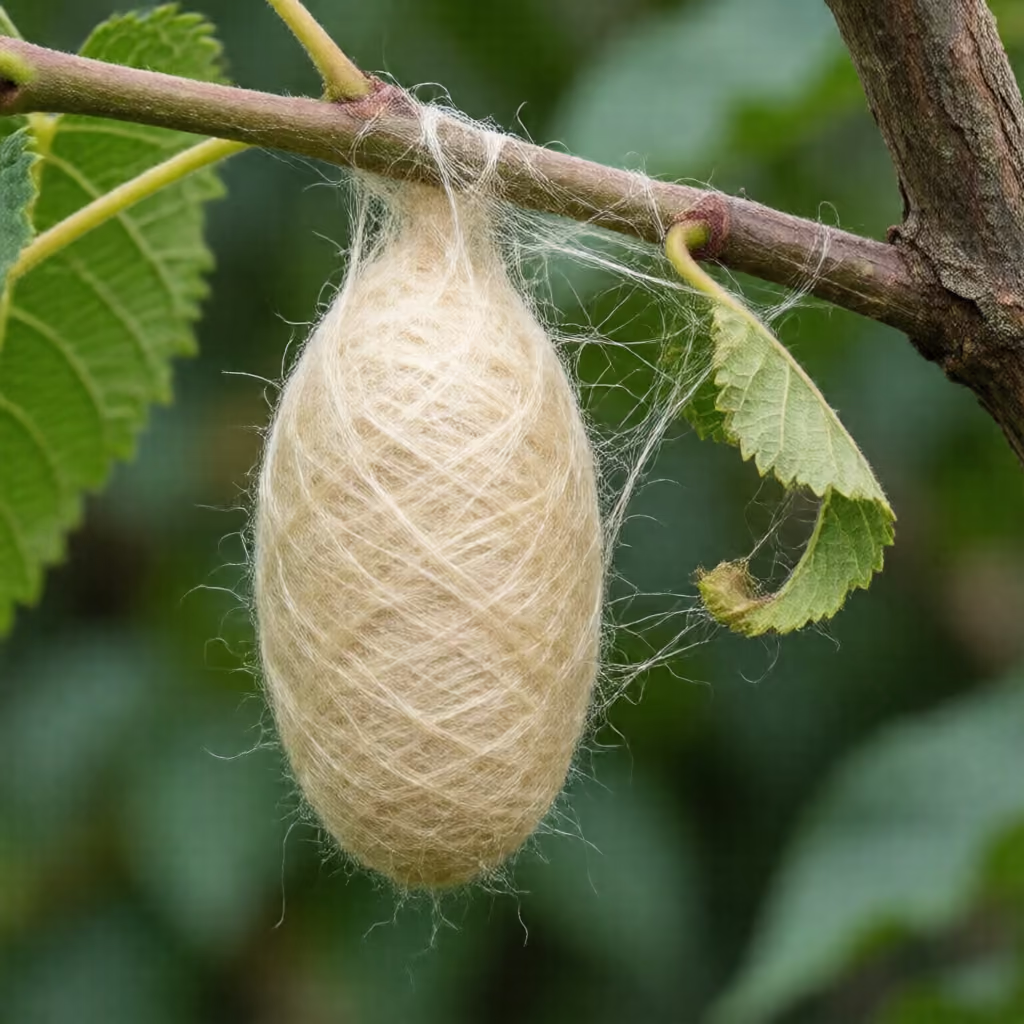
der Kokon
cocoon
A protective covering that certain insect larvae or other animals make from their own threads and in which they develop into adults.
Aus dem Kokon schlüpfte schließlich ein Schmetterling.
A butterfly finally emerged from the cocoon.

cocoon
der Kokon, die Kokons
Loading your saved state.

cocoon
A protective covering that certain insect larvae or other animals make from their own threads and in which they develop into adults.
Aus dem Kokon schlüpfte schließlich ein Schmetterling.
A butterfly finally emerged from the cocoon.

cocoon
A protective, enclosed environment that a person retreats into or in which they are shielded from the outside world.
In ihrer kleinen Wohnung schuf sie sich einen gemütlichen Kokon.
She created a cozy cocoon for herself in her small apartment.
| gender | masculine der |
|---|---|
| plural | die Kokons |
| genitive | des Kokons |
| singular | plural | |
|---|---|---|
| nominative | der Kokon | die Kokons |
| accusative | den Kokon | die Kokons |
| dative | dem Kokon | den Kokons |
| genitive | des Kokons | der Kokons |
The article changes with the case; it is shown in colour.
The words surrounding 'Kokon' (cocoon) usually indicate its meaning: words like 'Larve' (larva), 'Raupe' (caterpillar), 'Fäden' (threads), or 'schlüpfen' (to emerge) point to the animal's protective covering. With words like 'Wohnung' (apartment), 'Rückzug' (retreat), or 'Außenwelt' (outside world), 'Kokon' (cocoon) is usually used figuratively.
Die Raupe blieb mehrere Wochen in ihrem Kokon.
The caterpillar stayed in its cocoon for several weeks.
Nach dem Umzug wurde die Wohnung für ihn zu einem schützenden Kokon.
After the move, the apartment became a protective cocoon for him.
In its biological sense, 'Kokon' (cocoon) often occurs with verbs like 'spinnen' (to spin), 'bilden' (to form), 'schlüpfen' (to emerge), and 'verlassen' (to leave). The phrase 'aus dem Kokon schlüpfen' (to emerge from the cocoon) is particularly common.
Die Seidenraupe spinnt einen Kokon aus feinen Fäden.
The silkworm spins a cocoon from fine threads.
Nach einigen Tagen verließ der Falter seinen Kokon.
After a few days, the moth left its cocoon.
When referring to people, 'Kokon' (cocoon) is almost always used figuratively and often describes a voluntary retreat from the outside world. Typical phrases are 'sich in einen Kokon zurückziehen' (to retreat into a cocoon) and 'sich einen Kokon schaffen' (to create a cocoon for oneself).
Nach den stressigen Arbeitstagen zog sie sich in ihren Kokon zurück.
After stressful days at work, she retreated into her cocoon.
Mit Musik und Büchern schuf er sich einen persönlichen Kokon.
With music and books, he created a personal cocoon for himself.