

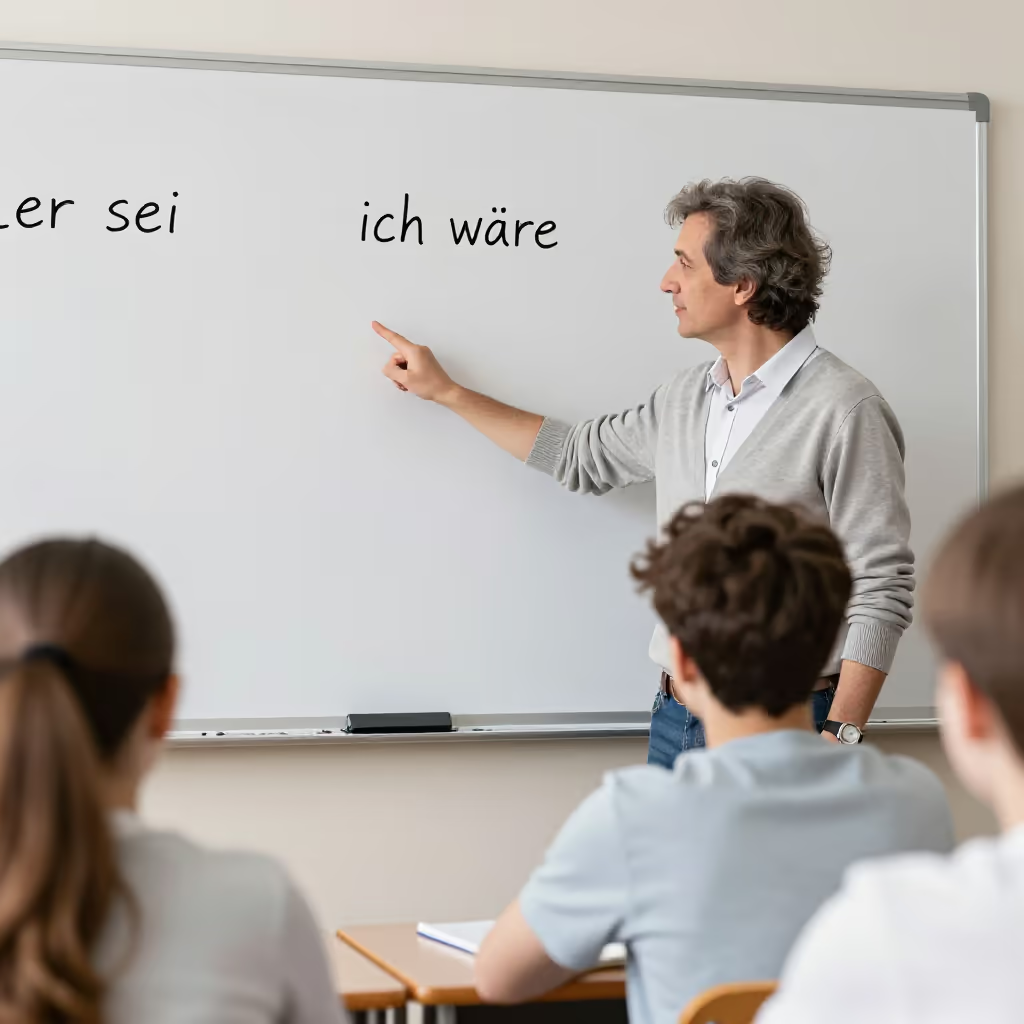
A mood of the verb in German grammar that marks a statement as possible, desired, or not real. A distinction is made between Konjunktiv I (often used for indirect speech) and Konjunktiv II (often used for unreal conditions).
example
Im Satz „Er sagte, er sei krank“ steht das Verb „sei“ im Konjunktiv I.
In the sentence 'Er sagte, er sei krank' (He said he was ill), the verb 'sei' is in Konjunktiv I.

Usage tips
Typical verbs
When talking about this verb form, people often use the phrase 'im Konjunktiv stehen' (to be in the subjunctive). Alternatively, you can also use the verbs 'benutzen' (to use) or 'verwenden' (to use).
EXAMPLE
Der Satz „Ich wünschte, ich hätte mehr Zeit“ steht im Konjunktiv II.
The sentence 'Ich wünschte, ich hätte mehr Zeit' (I wish I had more time) is in Konjunktiv II.
Typical collocations
The word 'Konjunktiv' (subjunctive) is almost always used with the additions 'I' (one) or 'II' (two) to specify the exact form.
EXAMPLE
Der Konjunktiv I klingt oft sehr formell.
Konjunktiv I often sounds very formal.
Register
'Konjunktiv' (subjunctive) is a technical term from grammar. You use it when talking about language or learning it.
EXAMPLE
Im Deutschkurs haben wir heute den Konjunktiv gelernt.
In German class today, we learned the subjunctive.
Compare with
confusable
Konjunktiv vs Imperativ
imperative
'der Imperativ' and 'der Konjunktiv' are both grammatical forms of the verb. They can be confused because neither is simply a normal statement in the indicative. 'Imperativ' is used for requests, commands, or prohibitions, for example when someone is supposed to do something. 'Konjunktiv' is used for possibilities, wishes, unreal situations, or indirect speech. In grammar class, the difference is important: the imperative says 'Tu das!' (Do that!), while the subjunctive is more about 'es wäre' (it would be), 'er sagte, er sei' (he said he was), or 'wenn es möglich wäre' (if it were possible).
Konjunktiv
In der indirekten Rede verwendet die Lehrerin heute den Konjunktiv.
In indirect speech, the teacher is using the subjunctive today.
Imperativ
Im Satz „Komm bitte pünktlich“ steht das Verb im Imperativ.
In the sentence 'Komm bitte pünktlich' (Please come on time), the verb is in the imperative.