


kontinuierlich
continuous
Describes a process or development that proceeds without interruption, evenly, and steadily.
Die Firma ist in den letzten zehn Jahren kontinuierlich gewachsen.
The company has grown continuously over the last ten years.
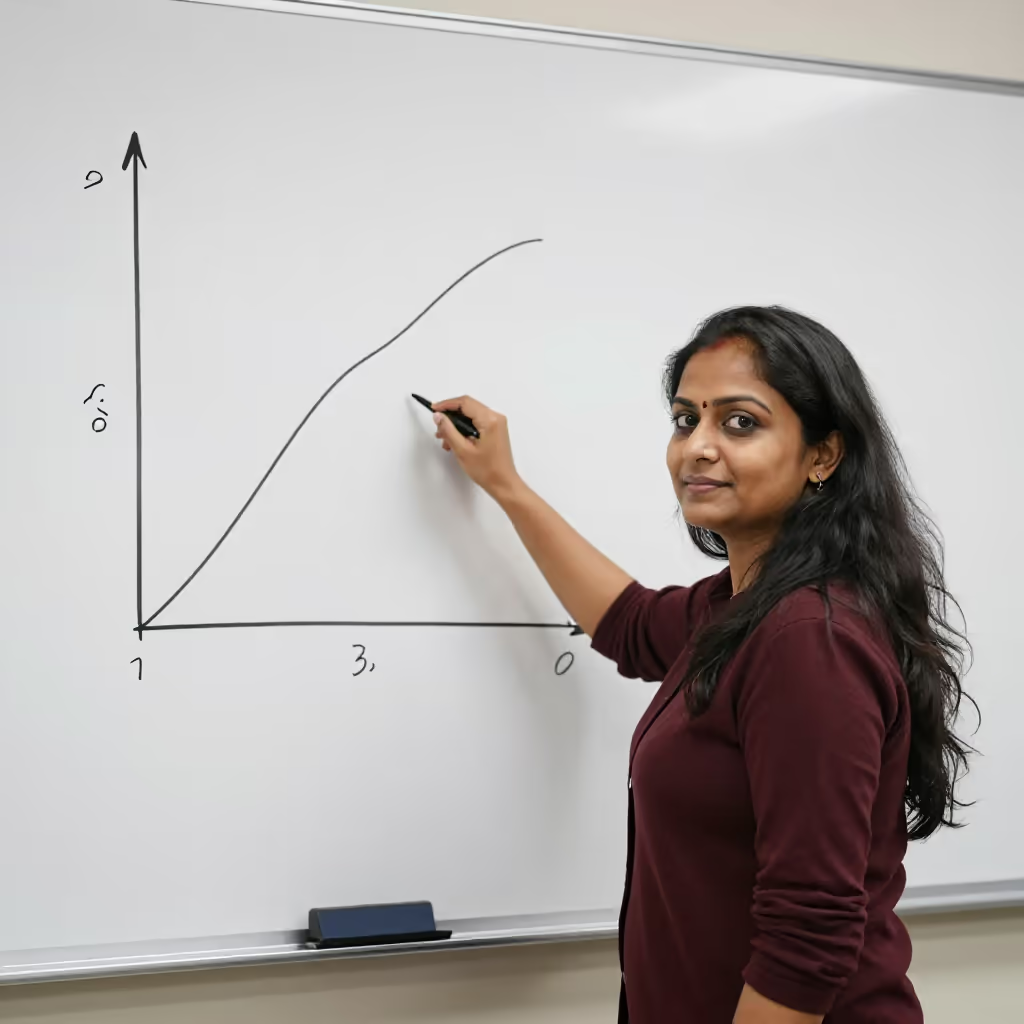

continuous
Loading your saved state.
continuous
Describes a process or development that proceeds without interruption, evenly, and steadily.
Die Firma ist in den letzten zehn Jahren kontinuierlich gewachsen.
The company has grown continuously over the last ten years.

'Kontinuierlich' (continuously) is very often used like an adverb to describe a verb. It answers the question 'How does something happen?' and then usually stands directly with the verb.
Wir arbeiten kontinuierlich an der Verbesserung unserer Dienstleistungen.
We are continuously working to improve our services.
The word 'kontinuierlich' (continuous / continuously) belongs more to written language or formal contexts, such as business, science, or reports. It often sounds more formal and precise.
Die Daten werden kontinuierlich erfasst und ausgewertet.
The data is continuously recorded and analyzed.
In its general meaning, 'kontinuierlich' (continuously) is often combined with verbs of change or development. Typical phrases are: 'sich kontinuierlich verbessern' (to improve continuously), 'kontinuierlich steigen/sinken' (to rise/fall continuously), or 'etwas kontinuierlich fortsetzen' (to continue something continuously).
Die Preise für Rohstoffe sind kontinuierlich gestiegen.
Raw material prices have risen continuously.
You can recognize the technical meaning from the context. When 'Funktion' (function), 'Kurve' (curve), 'Signal' (signal), or other terms from mathematics and physics are mentioned, the gapless property is meant.
Ein kontinuierliches Signal kann zu jedem Zeitpunkt einen Wert annehmen.
A continuous signal can take on a value at any point in time.
constant
'ständig' and 'kontinuierlich' both have to do with duration. 'ständig' often means that something happens very frequently or again and again. This can also be irregular. 'kontinuierlich' is used more when a process continues evenly and without interruption, for example a development, training, or improvement. The words can be confused because neither describes just a single moment. The practical difference is: 'ständig' emphasizes frequency, while 'kontinuierlich' emphasizes a steady progression.

Durch das tägliche Üben hat sich ihr Deutsch kontinuierlich verbessert.
Through daily practice, her German has improved continuously.
Im Bus schaut Emma ständig auf ihr Handy.
On the bus, Emma is constantly looking at her phone.