

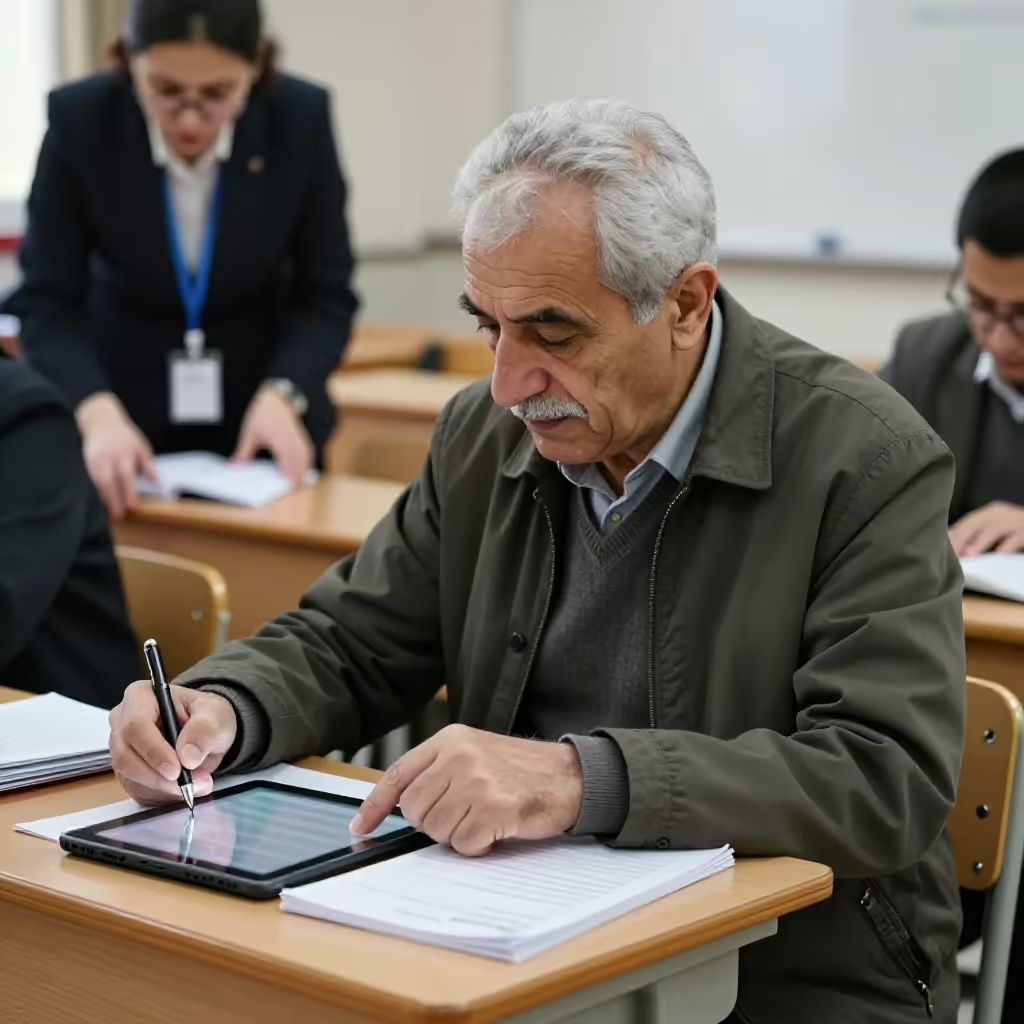
A person who is acquiring knowledge or skills. The term is more general than pupil or student and is often used in pedagogical or formal contexts.
example
Der Kurs richtet sich an fortgeschrittene Lernende der deutschen Sprache.
The course is aimed at advanced learners of the German language.

Usage tips
Word formation
The word 'Lernende(r)' (learner) is a nominalized participle of the verb 'lernen' (to learn). It describes a person who is in the process of learning.
EXAMPLE
Die Lernenden arbeiten in kleinen Gruppen zusammen.
The learners work together in small groups.
Adjective declension
Since this is a nominalized adjective, it is declined like an adjective. The ending changes depending on the article and case.
EXAMPLE
Der Lernende stellt eine Frage.
The learner asks a question.
Register and usage
The term is often used in pedagogical and formal contexts. In the plural, 'die Lernenden' (the learners), it is a common and gender-inclusive term for a group of people who are learning.
EXAMPLE
Diese App wurde speziell für Lernende entwickelt.
This app was developed especially for learners.
Compare with
near_synonym
Lernende vs Schüler
student / pupil
'der Schüler' and 'der Lernende' both refer to people who are learning something. 'Schüler' is especially suitable for school or for a person who learns from a master or a doctrine. 'Lernende' is more general: it can be a child, an adult, a university student, or someone in a course. The word often sounds somewhat more formal and is used in texts about teaching or education. When you are specifically talking about a school, 'Schüler' is more natural. When the type of learning should remain open, 'Lernende' fits better.
Lernende
In dem Onlinekurs können die Lernenden ihr Tempo selbst wählen.
In the online course, learners can choose their own pace.