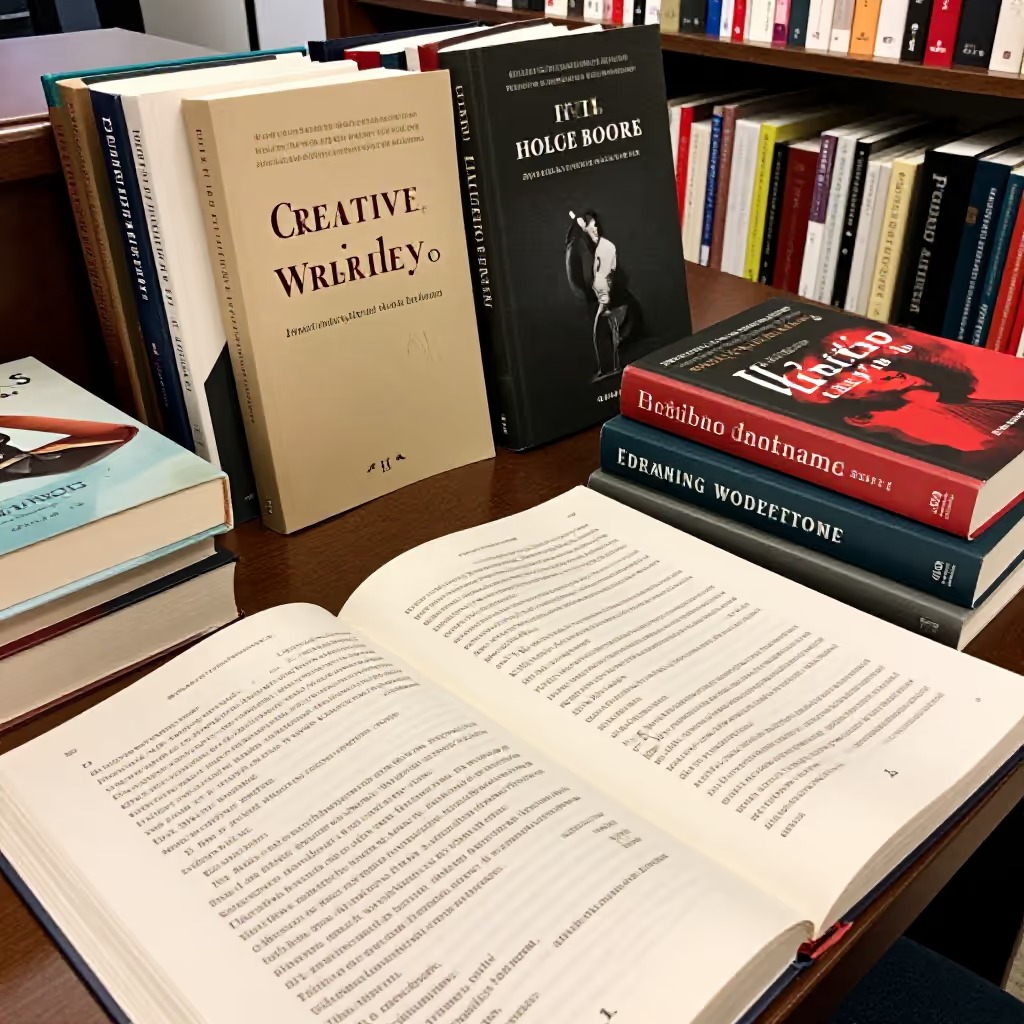
The entirety of written and published works, especially those with artistic value such as novels, poems, and dramas.
example
Im Deutschunterricht lesen wir klassische deutsche Literatur.
In German class, we read classic German literature.

Usage tips
Context clue
To distinguish the meanings, pay attention to the context. If the sentence is about art, novels, or poems, the artistic meaning is intended. If it is about science, research, or a specialized topic, it refers to the body of specialist texts.
EXAMPLE
Sie liest in ihrer Freizeit gerne moderne Literatur.
She likes reading modern literature in her free time.
Use in the singular
The word 'Literatur' (literature) is almost always used in the singular, even when it refers to many works. When speaking generally about the art form, it is often used without an article.
EXAMPLE
Literatur ist ein wichtiger Teil der Kultur.
Literature is an important part of culture.
Typical collocations
In the artistic sense, 'Literatur' (literature) is often combined with adjectives such as 'klassisch' (classic), 'modern' (modern), or 'zeitgenössisch' (contemporary). Nationalities are also common, e.g. 'deutsche Literatur' (German literature) or 'französische Literatur' (French literature).
EXAMPLE
Ich interessiere mich sehr für die klassische Literatur des 19. Jahrhunderts.
I am very interested in the classic literature of the 19th century.
Academic context
In this meaning, people often speak of 'Fachliteratur' (specialist literature) or 'wissenschaftlicher Literatur' (academic literature). Typical verbs are 'recherchieren' (to research), 'zitieren' (to cite), or 'sichten' (to review).
EXAMPLE
Bitte geben Sie alle Quellen im Literaturverzeichnis an.
Please list all sources in the bibliography.
Compare with
confusable
Literatur vs Quelle
source
'die Quelle' and 'die Literatur' can both be important when writing or studying. A 'Quelle' is a specific place where you find information, for example a book, an article, a website, or a person. 'Literatur', on the other hand, means the texts on a topic as a whole, especially in school, university, or academic contexts. Learners may confuse the words because information is often found in the literature. In practical terms: you read 'Literatur', but you name individual texts or people as 'Quellen'.
Literatur
Im Seminar lesen wir viel Literatur über moderne Geschichte.
In the seminar, we read a lot of literature on modern history.
Quelle
Für die Präsentation nennt Lisa am Ende jede Quelle.
For the presentation, Lisa lists every source at the end.