

lose
loose
Not firmly in place, attached, or connected; loose.
EXAMPLE
Der Knopf an meiner Jacke ist lose und muss angenäht werden.
The button on my jacket is loose and needs to be sewn on.
loose
Loading your saved state.
loose
Not firmly in place, attached, or connected; loose.
Der Knopf an meiner Jacke ist lose und muss angenäht werden.
The button on my jacket is loose and needs to be sewn on.

loose
A loose, not strictly ordered or connected sequence or collection of things.
Das Buch ist eine lose Sammlung von Essays zu verschiedenen Themen.
The book is a loose collection of essays on various topics.

loose
Not firm or compact, but loose and crumbly, as with soil or powder, for example.
Die Pflanzen wachsen am besten in loser, gut durchlüfteter Erde.
The plants grow best in loose, well-aerated soil.
Careful: 'lose' does not mean 'verlieren' (to lose), but rather 'locker' or 'nicht fest' (loose/not firm). The German verb for 'to lose' is 'verlieren'.
Die Schraube ist lose, du könntest sie verlieren.
The screw is loose; you could lose it.
The adjective 'lose' (loose) is related to the verb 'lösen' (to loosen/undo). When something comes loose, such as a screw or a knot, it becomes 'lose' (loose).
Wenn du den Knoten löst, wird das Seil lose.
If you undo the knot, the rope becomes loose.
In the meaning 'not firm', 'lose' (loose) is often combined with things that should actually be attached. Typical examples are: 'ein loser Zahn' (a loose tooth), 'eine lose Schraube' (a loose screw), or 'ein loses Kabel' (a loose cable).
Der Wackelkontakt kommt von einem losen Kabel.
The loose connection is caused by a loose cable.
With materials such as soil, tea, or snow, 'lose' (loose) means that they are not pressed or individually packaged. You then buy them by weight or volume.
Möchtest du Teebeutel oder losen Tee kaufen?
Would you like to buy tea bags or loose tea?
go / loose
“Los” and “lose” can describe something that is no longer firmly connected. “Los” more often describes something that has come loose or become detached, while “lose” expresses a loose or unsecured condition. Use “los” when something has already come off and “lose” when it is still sitting loosely.

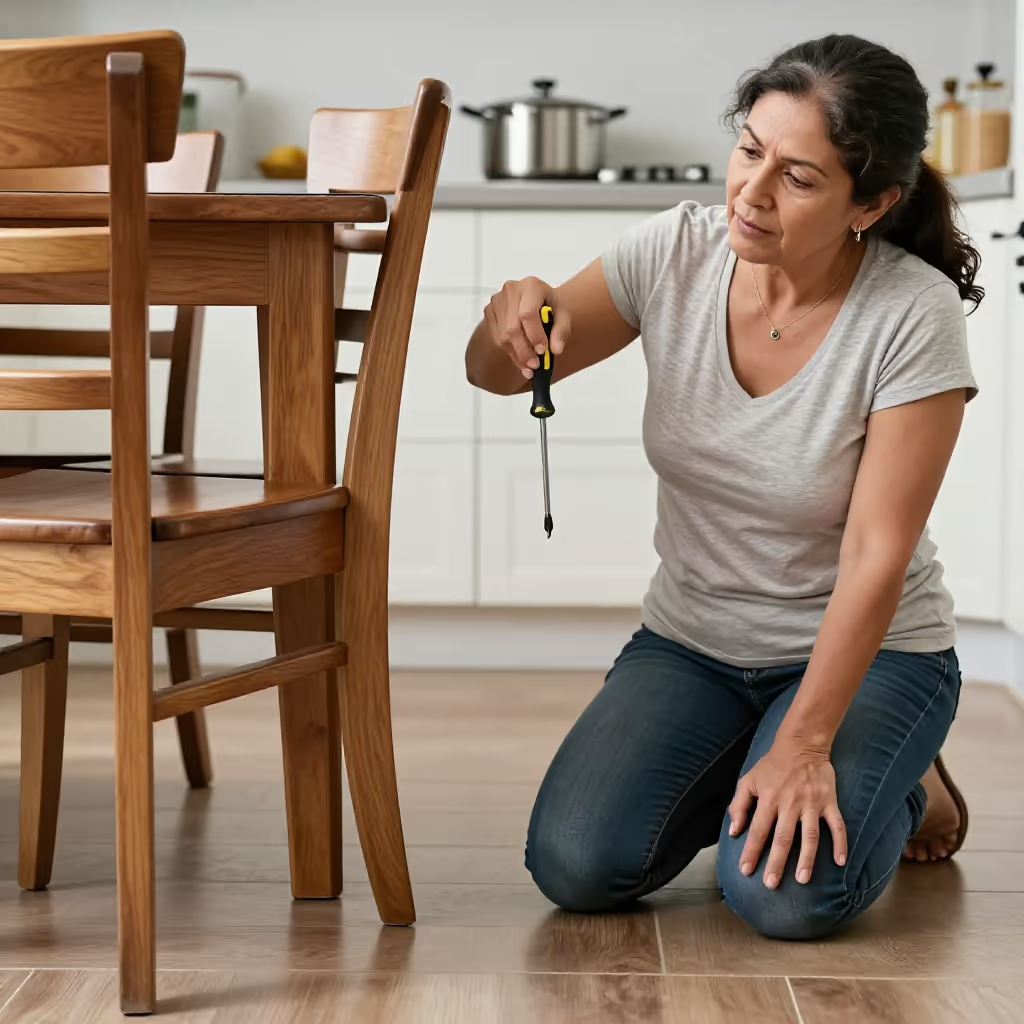
Die Schraube sitzt lose im Tischbein und wackelt.
The screw is loose in the table leg and is wobbling.
Die Schraube ist los und liegt neben dem Tischbein.
The screw has come loose and is lying next to the table leg.