


niederschlagen
to knock down
To violently hit someone or something to the ground, often until they lose consciousness.
EXAMPLE
Der Boxer schlug seinen Gegner in der dritten Runde nieder.
The boxer knocked down his opponent in the third round.
to knock down / suppress / be reflected
Loading your saved state.
to knock down
To violently hit someone or something to the ground, often until they lose consciousness.
Der Boxer schlug seinen Gegner in der dritten Runde nieder.
The boxer knocked down his opponent in the third round.

to suppress
To end an uprising, protest, or rebellion through force or authority.
Das Militär wurde eingesetzt, um den Aufstand schnell niederzuschlagen.
The military was deployed to quickly suppress the uprising.

to be reflected in
To show itself in something, have an effect, or manifest as a result.
Die gestiegenen Rohstoffkosten schlagen sich in den Preisen für die Endkunden nieder.
The increased raw material costs are reflected in the prices for end customers.
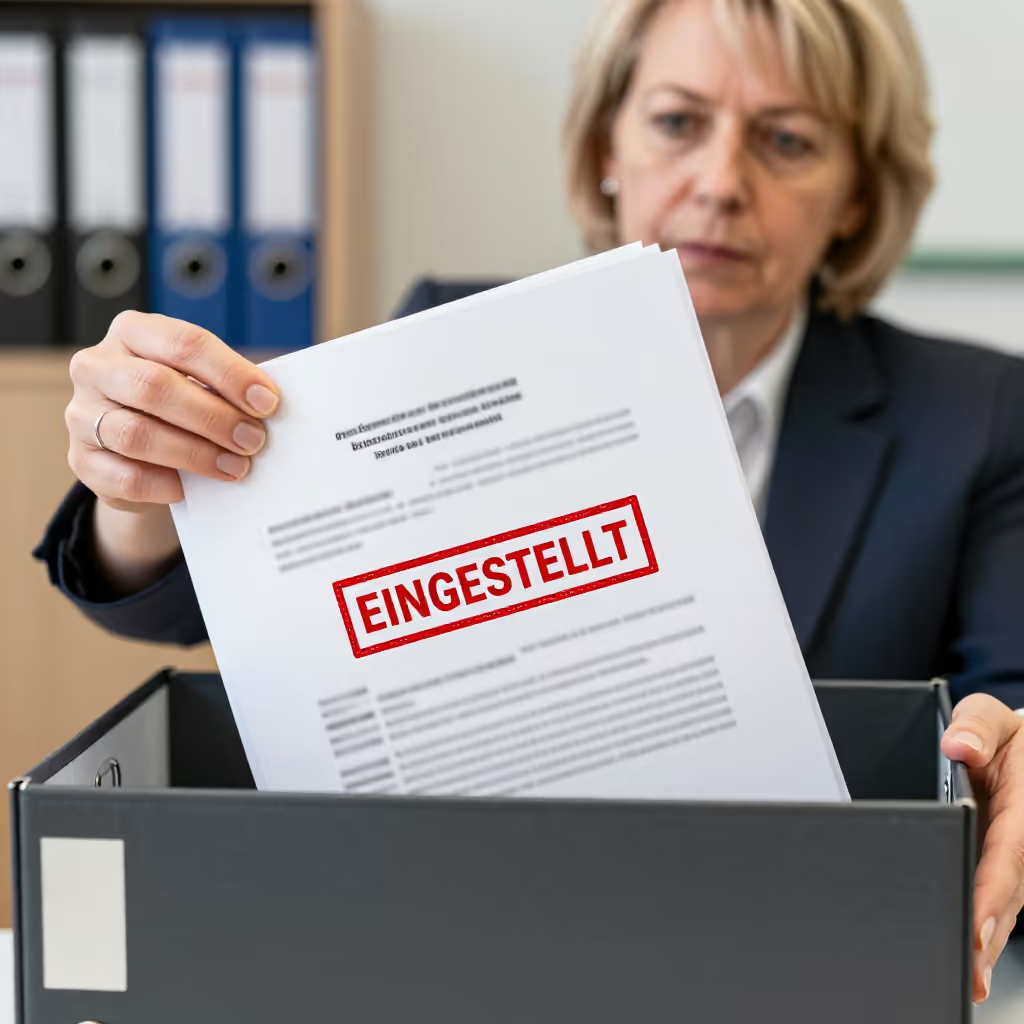
to drop
To discontinue and end a legal proceeding or investigation without a judgment or result.
Die Staatsanwaltschaft hat das Verfahren mangels Beweisen niedergeschlagen.
The public prosecutor's office dropped the case for lack of evidence.

to precipitate
In chemistry, the separation of a solid substance from a liquid (solution) or a gas.
Wenn man die Lösung abkühlt, schlägt sich das Salz am Boden des Gefäßes nieder.
If you cool the solution, the salt precipitates at the bottom of the vessel.
'Niederschlagen' is a separable verb. The prefix 'nieder-' comes at the end in a main clause. In subordinate clauses and in the infinitive with 'zu', the verb stays together.
Die Regierung schlug den Aufstand nieder.
The government suppressed the uprising.
The verb consists of 'nieder' (down) and 'schlagen' (to hit/strike). The literal meaning 'to knock to the ground' is often used metaphorically to mean ending or suppressing something by force.
Die vernichtende Kritik schlug ihn emotional völlig nieder.
The devastating criticism completely knocked him down emotionally.
In the meaning 'sich auswirken' (to have an effect), the verb is always reflexive and is used with the preposition 'in' and the dative. The structure is: something (nominative) 'schlägt sich in' something (dative) 'nieder'.
Die positive Stimmung schlägt sich in den Verkaufszahlen nieder.
The positive mood is reflected in the sales figures.
In political or social contexts, 'niederschlagen' (to suppress) is often combined with abstract nouns such as 'Aufstand' (uprising), 'Protest' (protest), 'Rebellion' (rebellion), or 'Demonstration' (demonstration).
Die Armee hatte den Befehl, die Rebellion niederzuschlagen.
The army had orders to suppress the rebellion.
In legal usage, 'niederschlagen' means to discontinue proceedings. Typical objects are 'das Verfahren' (the proceedings/case), 'die Anklage' (the charge/indictment), or 'die Ermittlungen' (the investigations).
Die Staatsanwaltschaft schlug das Verfahren gegen ihn nieder.
The public prosecutor's office dropped the case against him.
The meaning 'sich absetzen' (to settle/precipitate) is a technical term from chemistry. Here the verb is often used reflexively when a solid substance separates out of a liquid.
Beim Abkühlen der Flüssigkeit schlug sich ein weißer Feststoff nieder.
As the liquid cooled, a white solid precipitated.
to hire / adjust / stop
Both verbs can refer to ending a procedure or investigation. „Einstellen“ is general and can involve various reasons for ending it, while „niederschlagen“ specifically refers to ending it without a judgment or result. When there is insufficient evidence, „niederschlagen“ is therefore the more specific choice.

Die Staatsanwaltschaft schlug das Verfahren mangels ausreichender Beweise nieder.
The prosecutor dropped the case for lack of sufficient evidence.
Die Behörde stellte die Ermittlung aus organisatorischen Gründen ein.
The authorities discontinued the investigation for organizational reasons.