

unterdrücken
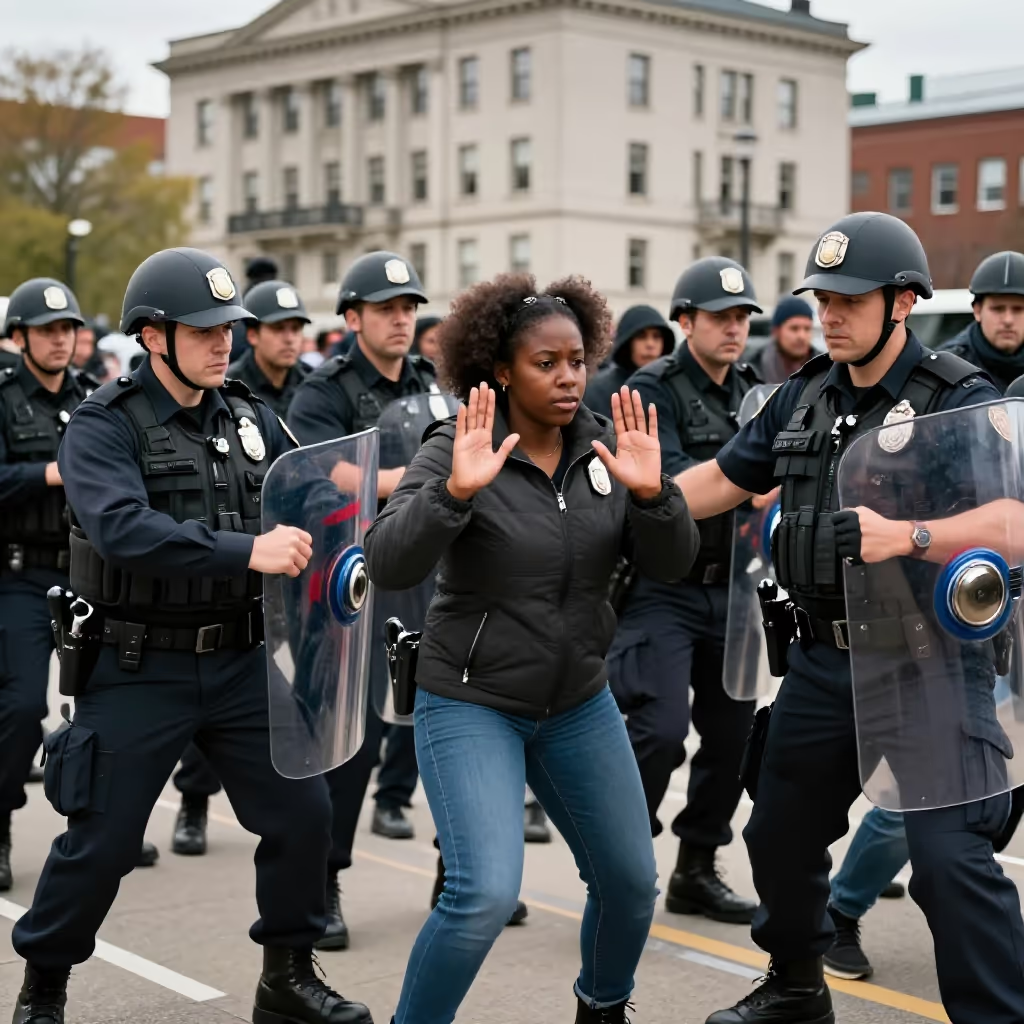
to oppress
To use violence or power to prevent people or groups from being free and exercising their rights.
EXAMPLE
Das Regime versuchte, jede Form von Opposition zu unterdrücken.
The regime tried to oppress every form of opposition.
to suppress
Loading your saved state.
to oppress
To use violence or power to prevent people or groups from being free and exercising their rights.
Das Regime versuchte, jede Form von Opposition zu unterdrücken.
The regime tried to oppress every form of opposition.

to suppress
To consciously or unconsciously prevent feelings, thoughts, or impulses from being expressed.
Er musste ein Gähnen unterdrücken, um nicht unhöflich zu wirken.
He had to suppress a yawn so as not to seem rude.

to suppress
To stop or prevent a physical reaction or process.
Diese Medikamente unterdrücken die allergische Reaktion des Körpers.
These medications suppress the body's allergic reaction.

to suppress
To deliberately withhold information, evidence, or news and not publish it.
Die Zeitung wurde beschuldigt, wichtige Fakten in dem Bericht zu unterdrücken.
The newspaper was accused of suppressing important facts in the report.
'Unterdrücken' (to suppress) is an inseparable verb. The prefix 'unter-' remains firmly attached to the verb 'drücken' (to press) in all tenses and sentence constructions.
Er unterdrückt seine wahren Gefühle.
He suppresses his true feelings.
The word consists of 'unter-' (under) and 'drücken' (to press). The meaning here is metaphorical: you 'press' something downward so that it does not become visible or cannot develop freely.
Es ist nicht gesund, seine Wut immer zu unterdrücken.
It is not healthy to always suppress your anger.
'Unterdrücken' (to suppress) is a transitive verb and always requires an accusative object. You always suppress 'jemanden' (someone) or 'etwas' (something).
Der Diktator unterdrückte sein Volk.
The dictator oppressed his people.
In a political context, 'unterdrücken' (to oppress) is often used with groups or movements. Typical combinations are: 'ein Volk unterdrücken' (to oppress a people), 'eine Minderheit unterdrücken' (to oppress a minority), or 'eine Revolution unterdrücken' (to suppress a revolution).
Die Besatzer unterdrückten die lokale Bevölkerung.
The occupiers oppressed the local population.
When it comes to feelings or impulses, the verb is used frequently. Typical expressions are: 'Gefühle unterdrücken' (to suppress feelings), 'Tränen unterdrücken' (to hold back tears), 'Wut unterdrücken' (to suppress anger), or 'ein Gähnen unterdrücken' (to suppress a yawn).
Während der Rede musste sie ihre Tränen unterdrücken.
During the speech, she had to hold back her tears.
You can recognize this meaning from the object of the sentence. When it is about information, typical objects are 'die Wahrheit' (the truth), 'Beweise' (evidence), 'Fakten' (facts), or 'ein Gerücht' (a rumor).
Die Firma versuchte, die Wahrheit über den Unfall zu unterdrücken.
The company tried to suppress the truth about the accident.
to repress / displace
Both words can describe how someone deals with a distressing feeling. Verdrängen generally means unconsciously keeping the feeling out of awareness; unterdrücken primarily means consciously or unconsciously inhibiting its expression or effect. Use verdrängen for keeping something away internally and unterdrücken for holding it back outwardly.

Nach dem Streit unterdrückte sie ihre Wut und blieb nach außen ruhig.
After the argument, she suppressed her anger and remained calm on the outside.
Nach dem Streit verdrängte sie ihre Wut und dachte nicht mehr bewusst darüber nach.
After the argument, she repressed her anger and no longer thought about it consciously.