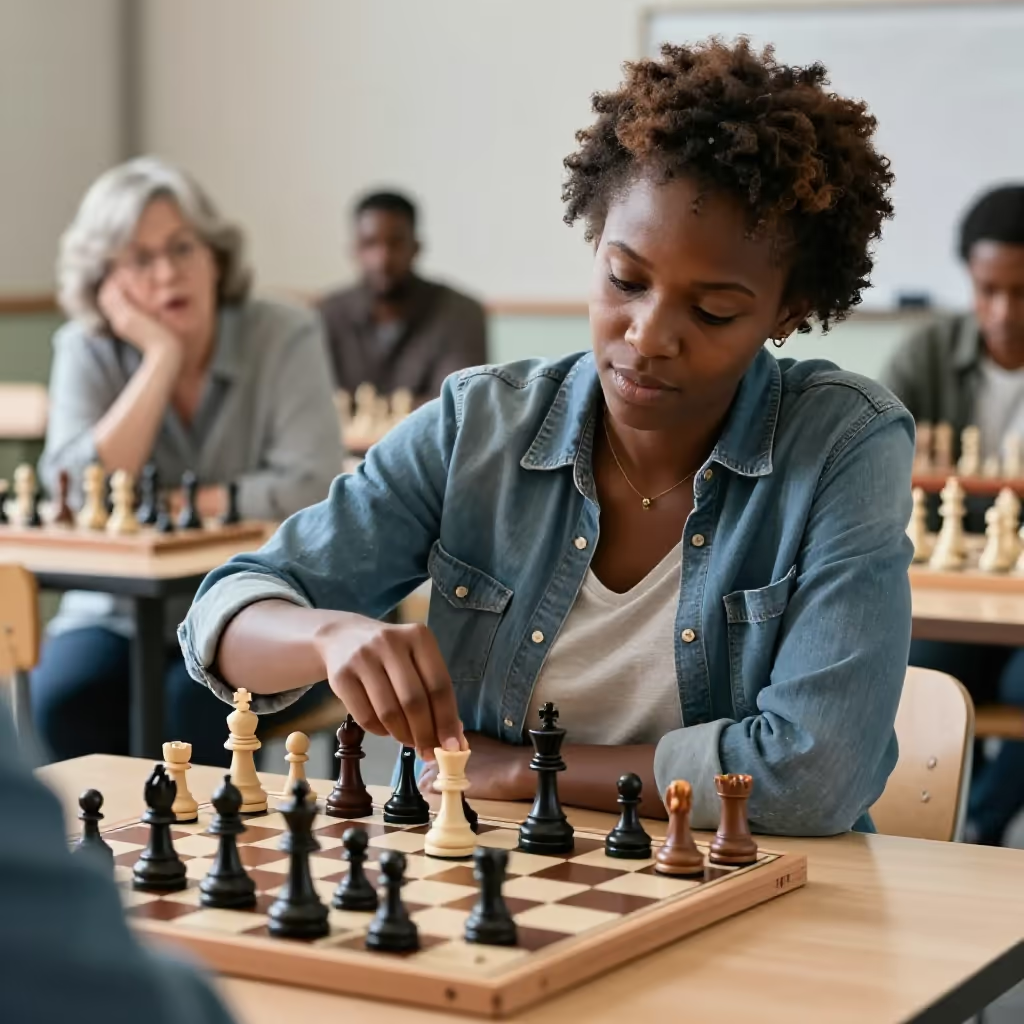
To gain control, superiority, or the decisive advantage in a conflict, competition, or difficult situation.
example
Nach einem langen Kampf gewann die Feuerwehr die Oberhand über das Feuer.
After a long fight, the fire department gained the upper hand over the fire.

Usage tips
Word composition
The word consists of 'ober' (superior, upper) and 'Hand' (hand). Figuratively speaking, the person has the 'obere Hand' (upper hand) if they have control or the advantage in a conflict.
EXAMPLE
In der Diskussion gewann sie schnell die Oberhand.
In the discussion, she quickly gained the upper hand.
Fixed expressions
'Die Oberhand' (the upper hand) is used almost exclusively in fixed combinations with verbs. The most common are 'gewinnen' (to gain), 'bekommen' (to get), 'haben' (to have), and 'behalten' (to keep).
EXAMPLE
Es ist wichtig, in schwierigen Situationen die Oberhand zu behalten.
It is important to keep the upper hand in difficult situations.
Preposition 'über'
If you want to say what someone gains control over, you use the preposition 'über' (over) followed by the accusative. You gain the upper hand over a person or a thing.
EXAMPLE
Die Mannschaft gewann die Oberhand über den Gegner.
The team gained the upper hand over the opponent.
Meaning of the verbs
The choice of verb changes the meaning. 'Die Oberhand gewinnen' or 'bekommen' describes the process of gaining control. 'Die Oberhand haben' or 'behalten' describes the state of already having control.
EXAMPLE
Zuerst führte der Gegner, aber dann bekam unser Team die Oberhand.
At first the opponent was ahead, but then our team gained the upper hand.
Compare with
near_synonym · confusable
Oberhand vs Kontrolle
control / check
'die Kontrolle' and 'die Oberhand' can both express that someone has command of a situation. 'Kontrolle' is more general and can be used in many situations, even without conflict or competition. 'Die Oberhand' fits especially when there is a fight, a problem, a competition, or a difficult situation. People often say 'die Oberhand gewinnen' (to gain the upper hand) or 'die Oberhand behalten' (to keep the upper hand). The words can be confused because both refer to power over a situation. However, 'Oberhand' sounds more dynamic and shows that someone is asserting themselves against something or someone.
Oberhand
Nach einer schwierigen ersten Halbzeit gewinnt die Mannschaft wieder die Oberhand.
After a difficult first half, the team regains the upper hand.
Kontrolle
Im Zug verlor der Vater kurz die Kontrolle über die lauten Kinder.
On the train, the father briefly lost control of the noisy children.