

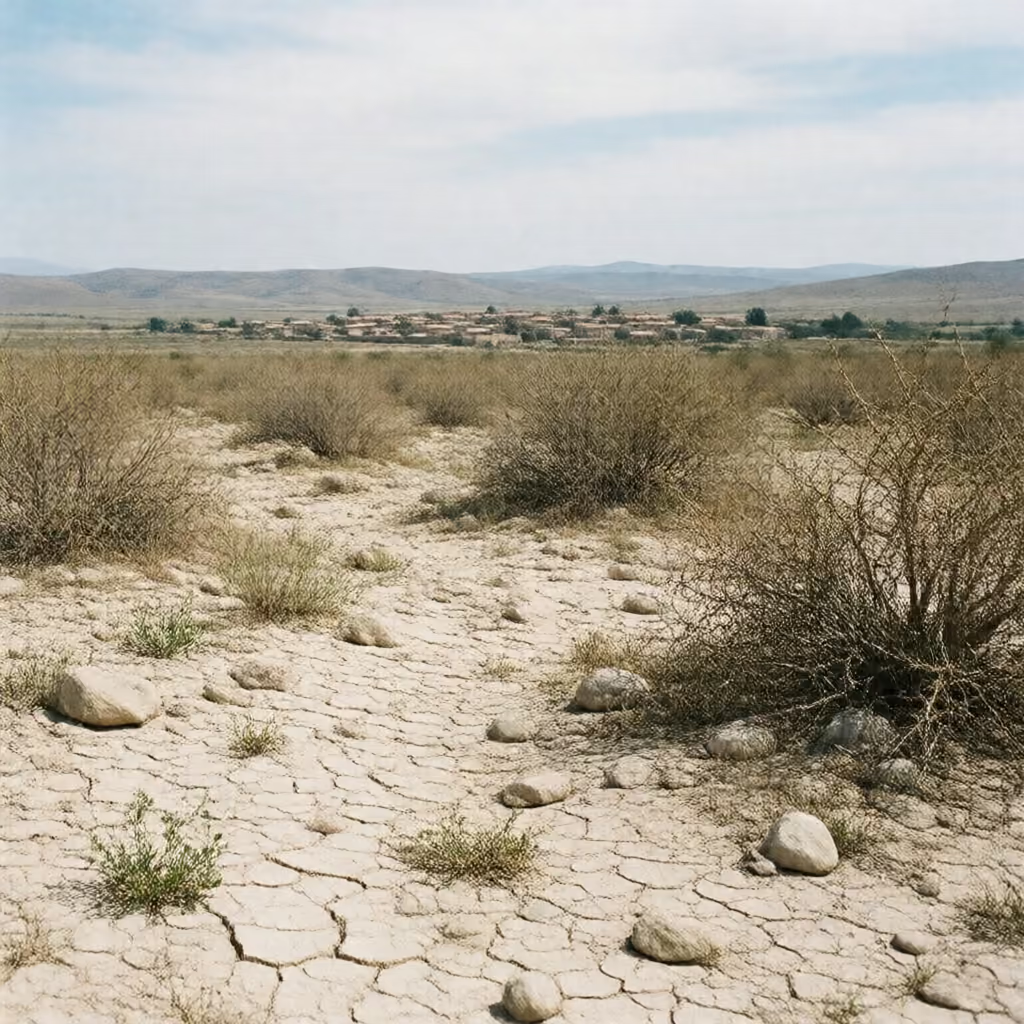
das Ödland
wasteland
Barren, largely or entirely uncultivated land on which only a few plants grow.
EXAMPLE
Hinter dem Dorf beginnt weites Ödland.
The vast wasteland begins just beyond the village.
wasteland
das Ödland
Loading your saved state.
wasteland
Barren, largely or entirely uncultivated land on which only a few plants grow.
Hinter dem Dorf beginnt weites Ödland.
The vast wasteland begins just beyond the village.
| gender | neuter das |
|---|---|
| genitive | des Ödlands |
| singular | plural | |
|---|---|---|
| nominative | das Ödland | – |
| accusative | das Ödland | – |
| dative | dem Ödland | – |
| genitive | des Ödlands des Ödlandes | – |
The article changes with the case; it is shown in colour.
'Ödland' is made up of 'öd' (desolate, barren) and 'Land' (land). The first component describes the character of the land as empty, barren, or sparsely populated.
Am Rand der ehemaligen Industriestadt erstreckt sich ein großes Ödland.
A large wasteland stretches along the edge of the former industrial city.
'Ödland' (wasteland) frequently appears with words such as 'karg' (barren), 'weit' (vast), or 'unfruchtbar' (infertile). Typical verbs include 'urbar machen' (to cultivate), 'bewirtschaften' (to farm), and 'begrünen' (to make green).
Die Gemeinde möchte das Ödland langsam begrünen.
The municipality wants to gradually turn the wasteland green.
'Ödland' (wasteland) is particularly common in geographical, historical, and literary descriptions. It is often preceded in a sentence by a location phrase with 'auf' (on) or 'in' (in).
Auf dem Ödland wachsen nur wenige niedrige Sträucher.
Only a few low shrubs grow on the wasteland.