

ölig
oily
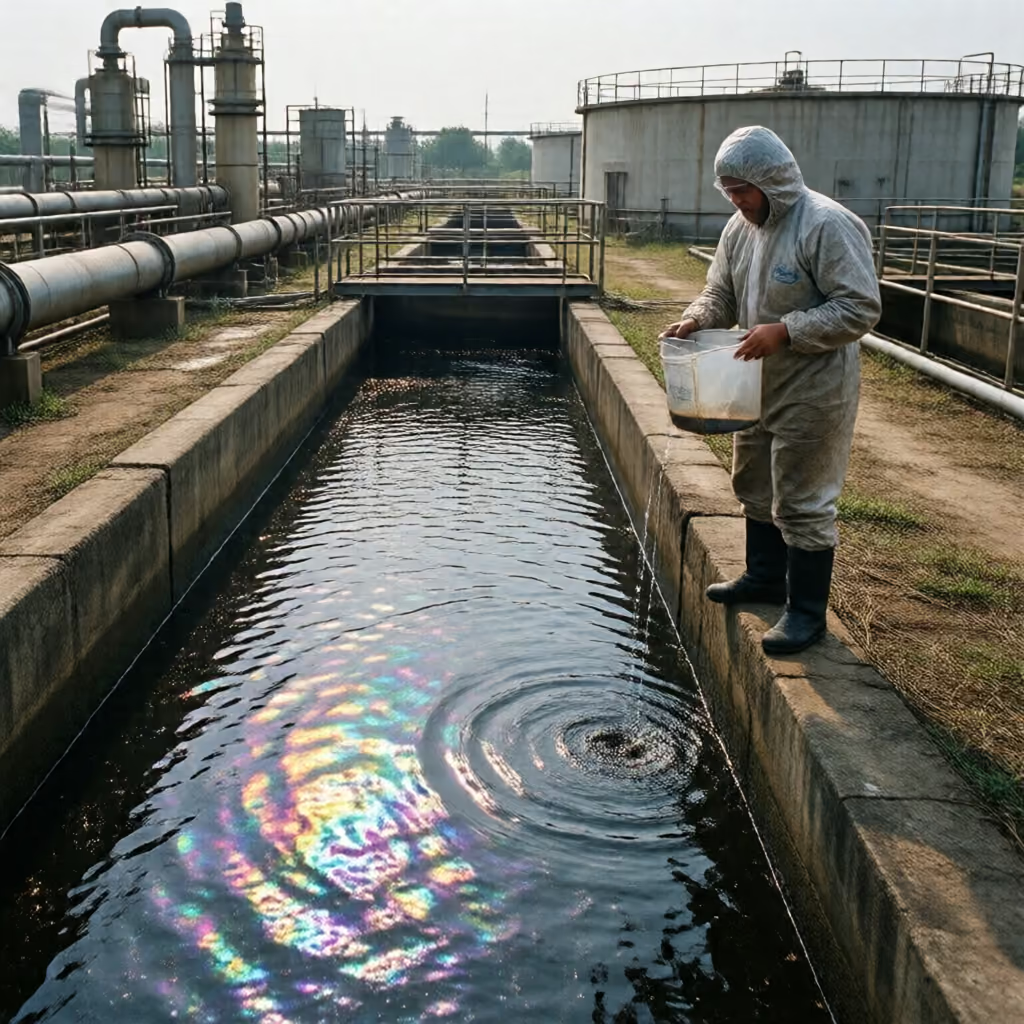
Containing oil or saturated with oil.
EXAMPLE
Das ölige Abwasser darf nicht in den Fluss gelangen.
The oily wastewater must not be allowed to enter the river.
oily
ölig – öliger – am öligsten
Loading your saved state.
oily
Containing oil or saturated with oil.
Das ölige Abwasser darf nicht in den Fluss gelangen.
The oily wastewater must not be allowed to enter the river.

oily
Covered with oil or contaminated by oil.
Nach der Reparatur des Motors waren seine Hände ölig.
After repairing the engine, his hands were oily.

oily
Resembling oil in its consistency, especially because of a viscous texture or greasy sheen.
Die Flüssigkeit war dick und ölig und floss nur langsam aus der Flasche.
The liquid was thick and oily and flowed slowly out of the bottle.

oily
Disapprovingly describing an excessively friendly, ingratiating manner that seems insincere.
Mit öliger Stimme versicherte er seinem Vorgesetzten, wie sehr er ihn bewundere.
In an oily voice, he assured his supervisor how much he admired him.
| basic form | ölig |
|---|---|
| comparative | öliger |
| superlative | am öligsten |
| masc. | fem. | neut. | plural | |
|---|---|---|---|---|
| nom. | -e | -e | -e | -en |
| acc. | -en | -e | -e | -en |
| dat. | -en | -en | -en | -en |
| gen. | -en | -en | -en | -en |
Add the ending to ölig.
| masc. | fem. | neut. | plural | |
|---|---|---|---|---|
| nom. | -er | -e | -es | -en |
| acc. | -en | -e | -es | -en |
| dat. | -en | -en | -en | -en |
| gen. | -en | -en | -en | -en |
Add the ending to ölig.
| masc. | fem. | neut. | plural | |
|---|---|---|---|---|
| nom. | -er | -e | -es | -e |
| acc. | -en | -e | -es | -e |
| dat. | -em | -er | -em | -en |
| gen. | -en | -er | -en | -er |
Add the ending to ölig.
“Ölig” is made up of the noun “Öl” (oil) and the ending “-ig.” The ending forms an adjective and here indicates a characteristic or a connection with oil.
Der Boden war nach dem Unfall ölig und rutschig.
The ground was oily and slippery after the accident.
In technical and environmental texts, “ölig” is often used with substances or residues that contain oil. Typical collocations are “öliges Abwasser” (oily wastewater), “ölige Rückstände” (oily residues), and “öliger Schlamm” (oily sludge).
Die Anlage filtert öliges Abwasser, bevor es weitergeleitet wird.
The facility filters oily wastewater before it is discharged.
When used with body parts, tools, or clothing, “ölig” often describes an outer layer caused by contact with oil. The adjective then refers to the surface of the object.
Nach dem Wechseln des Filters fühlten sich seine Finger ölig an.
After changing the filter, his fingers felt oily.
When used with liquids, creams, or substances, “ölig” describes the consistency or sheen of the thing itself. Common collocations are “ölig glänzen” (to have an oily sheen), “sich ölig anfühlen” (to feel oily), and “ölig auf der Haut liegen” (to sit on the skin with an oily feel).
Die Creme fühlt sich zunächst ölig an, zieht aber schnell ein.
The cream initially feels oily, but it absorbs quickly.
The figurative meaning is especially common with words such as “Stimme” (voice), “Lächeln” (smile), or “Kompliment” (compliment). “Ölig” signals that the friendliness is perceived as excessive and insincere.
Sein öliges Lächeln überzeugte die Kundin überhaupt nicht.
His oily smile did not convince the customer at all.