

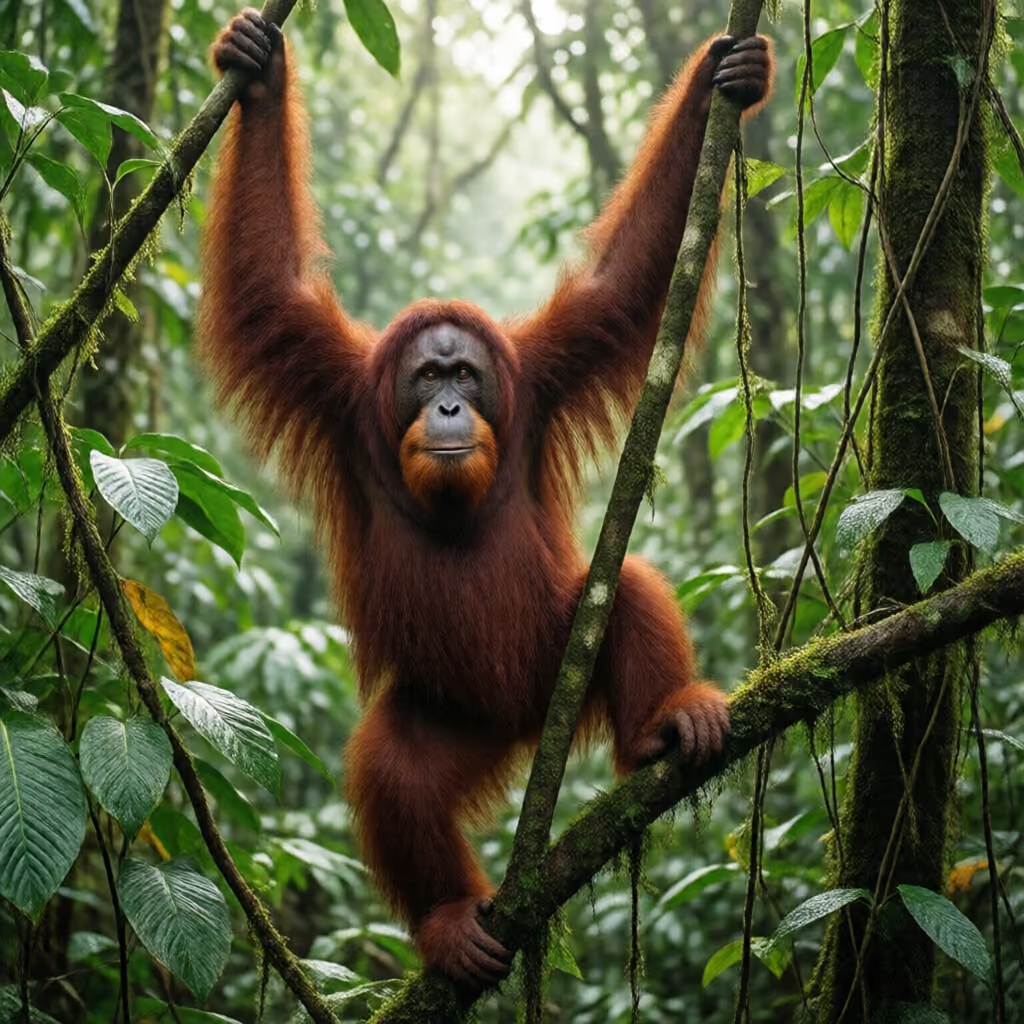
der Orang-Utan
orangutan
A great ape with reddish-brown fur that lives in the forests of Southeast Asia.
EXAMPLE
Der Orang-Utan kletterte langsam auf einen hohen Baum.
The orangutan slowly climbed up a tall tree.
orangutan
der Orang-Utan, die Orang-Utans
Loading your saved state.
orangutan
A great ape with reddish-brown fur that lives in the forests of Southeast Asia.
Der Orang-Utan kletterte langsam auf einen hohen Baum.
The orangutan slowly climbed up a tall tree.
| gender | masculine der |
|---|---|
| plural | die Orang-Utans |
| genitive | des Orang-Utans |
| singular | plural | |
|---|---|---|
| nominative | der Orang-Utan | die Orang-Utans |
| accusative | den Orang-Utan | die Orang-Utans |
| dative | dem Orang-Utan | den Orang-Utans |
| genitive | des Orang-Utans | der Orang-Utans |
The article changes with the case; it is shown in colour.
'der Orang-Utan' (the orangutan) is often used with verbs related to behavior and movement: 'klettern' (to climb), 'sich ernähren' (to feed), 'in Bäumen leben' (to live in trees), and 'bedroht sein' (to be threatened).
Der Orang-Utan ernährt sich vor allem von Früchten.
The orangutan mainly feeds on fruit.
The word often appears in texts about species conservation. Typical collocations include 'den Lebensraum des Orang-Utans schützen' (to protect the orangutan's habitat) and 'der Orang-Utan ist vom Aussterben bedroht' (the orangutan is threatened with extinction).
Viele Organisationen wollen den Lebensraum des Orang-Utans schützen.
Many organizations want to protect the orangutan's habitat.
When describing habitat, 'der Orang-Utan' (the orangutan) is often used with locations or the preposition 'in': this describes where the animals live or can be observed.
In einem Nationalpark kann man den Orang-Utan mit etwas Glück beobachten.
In a national park, you may be able to observe an orangutan if you're lucky.