

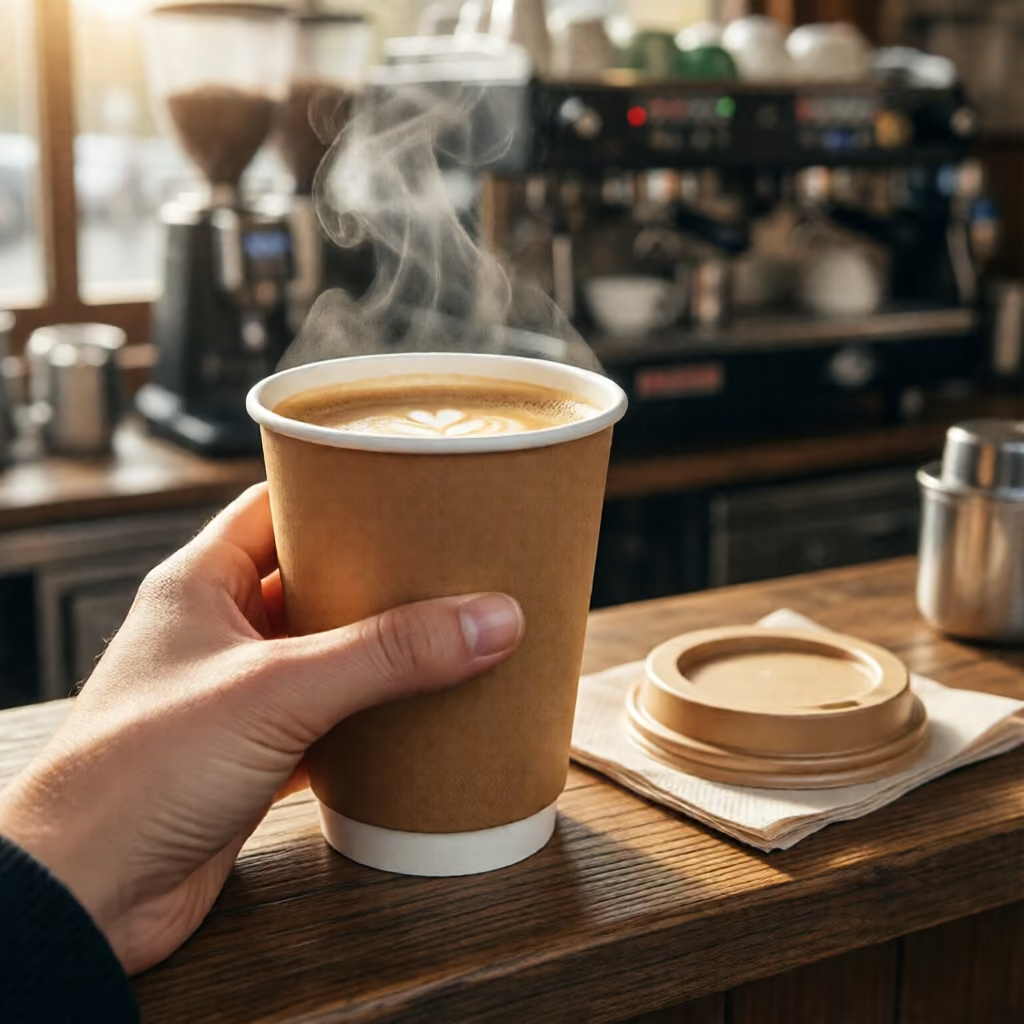
der Pappbecher
paper cup
A cup made of cardboard, usually used for drinks and thrown away after one use.
EXAMPLE
Am Kiosk bekam sie ihren Kaffee in einem Pappbecher.
At the kiosk, she got her coffee in a paper cup.
paper cup
der Pappbecher, die Pappbecher
Loading your saved state.
paper cup
A cup made of cardboard, usually used for drinks and thrown away after one use.
Am Kiosk bekam sie ihren Kaffee in einem Pappbecher.
At the kiosk, she got her coffee in a paper cup.
| gender | masculine der |
|---|---|
| plural | die Pappbecher |
| genitive | des Pappbechers |
| singular | plural | |
|---|---|---|
| nominative | der Pappbecher | die Pappbecher |
| accusative | den Pappbecher | die Pappbecher |
| dative | dem Pappbecher | den Pappbechern |
| genitive | des Pappbechers | der Pappbecher |
The article changes with the case; it is shown in colour.
'Pappbecher' consists of 'Papp-' (cardboard) and 'Becher' (cup). The first part refers to the material cardboard, while the second part refers to the container.
Für die Veranstaltung bestellte der Organisator mehrere Pappbecher.
For the event, the organizer ordered several paper cups.
Common collocations are 'einen Pappbecher nehmen' (to take a paper cup), 'einen Pappbecher wegwerfen' (to throw away a paper cup), and 'ein Getränk im Pappbecher' (a drink in a paper cup). The word is especially often used in connection with coffee or other hot drinks.
Nach dem kurzen Spaziergang warf er den leeren Pappbecher in den Mülleimer.
After the short walk, he threw the empty paper cup into the trash can.
For use with drinks, 'in einem Pappbecher' (in a paper cup) and 'aus einem Pappbecher' (from a paper cup) are typical phrases. 'In' describes the container in which the drink is located, while 'aus' describes drinking from the container.
Sie trinkt ihren Tee morgens aus einem Pappbecher.
She drinks her tea from a paper cup in the morning.