

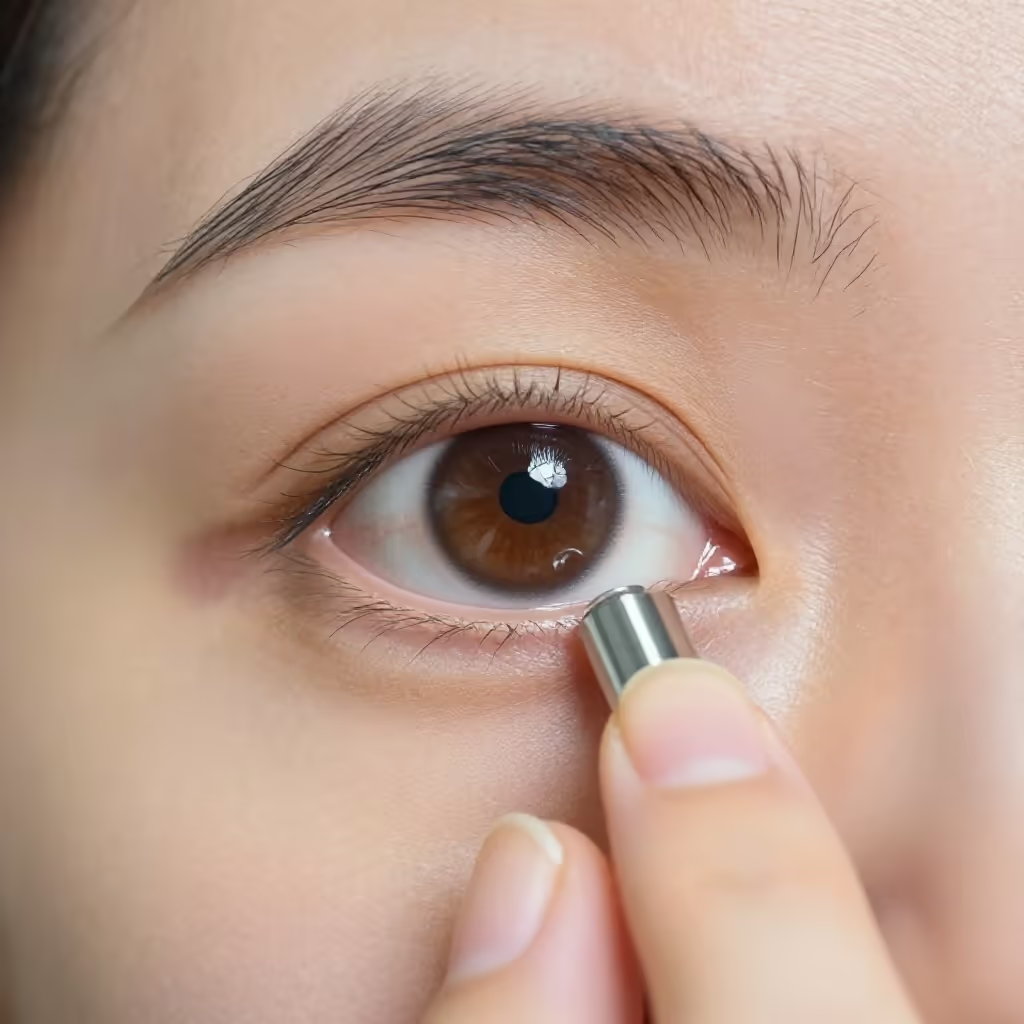
The round, black opening in the center of the iris of the eye. It regulates the amount of light that reaches the retina by constricting in brightness and dilating in darkness.
example
Bei dem hellen Licht verengten sich ihre Pupillen sofort.
In the bright light, her pupils constricted immediately.
Usage tips
Typical verbs
'Pupille' (pupil) is often used with the reflexive verbs 'sich erweitern' (to dilate, become larger) and 'sich verengen' (to constrict, become smaller). These describe its natural reaction to light.
EXAMPLE
Im Dunkeln erweitern sich die Pupillen, um mehr Licht einzufangen.
In the dark, the pupils dilate to take in more light.
Typical adjectives
To describe the condition of the pupil, the adjectives 'weit' (dilated/wide) or 'eng' (constricted/narrow) are often used. The participle forms 'erweitert' (dilated) and 'verengt' (constricted) are also very common.
EXAMPLE
Der Patient hatte nach dem Unfall weite Pupillen.
After the accident, the patient had dilated pupils.
Medical context
The word 'Pupille' (pupil) is mainly used in a medical, biological, or scientific context. In everyday language, people talk less often about this specific part of the eye.
EXAMPLE
Bei der Augenuntersuchung wird die Reaktion der Pupillen getestet.
During the eye examination, the reaction of the pupils is tested.
Compare with
confusable
Pupille vs Linse
lentil / lens
'die Linse' and 'die Pupille' are both parts of the eye and have to do with light and vision. But they are not the same thing. The pupil is the black opening in the center of the eye. Light enters the eye through it. The lens is inside the eye and helps focus the light sharply. Learners may confuse the words because both are parts of the eye. A simple guide is: you can see the pupil from the outside as a black dot; the lens is behind it.
Pupille
Bei hellem Licht wird die Pupille kleiner.
In bright light, the pupil gets smaller.
Linse
Die Linse im Auge verändert ihre Form, damit wir nah und fern scharf sehen.
The lens in the eye changes its shape so that we can see clearly both near and far.