


das Register
register
An official directory, list, or book in which specific data is systematically recorded.
EXAMPLE
Jeder Verein muss in das Vereinsregister eingetragen werden.
Every association must be entered in the register of associations.
register
Loading your saved state.
register
An official directory, list, or book in which specific data is systematically recorded.
Jeder Verein muss in das Vereinsregister eingetragen werden.
Every association must be entered in the register of associations.

register
A specific pitch range of a human voice or a musical instrument.
Die Sopranistin singt mühelos im höchsten Register.
The soprano sings effortlessly in the highest register.

register
A particular style level of language used in a specific situation or context, e.g. formal, informal, or technical.
In einem Bewerbungsschreiben sollte man ein formelles Register wählen.
In a job application letter, you should choose a formal register.

to pull out all the stops
To use all available means and possibilities to achieve a goal.
Um den Kunden zu überzeugen, hat der Verkäufer alle Register gezogen.
To convince the customer, the salesperson pulled out all the stops.
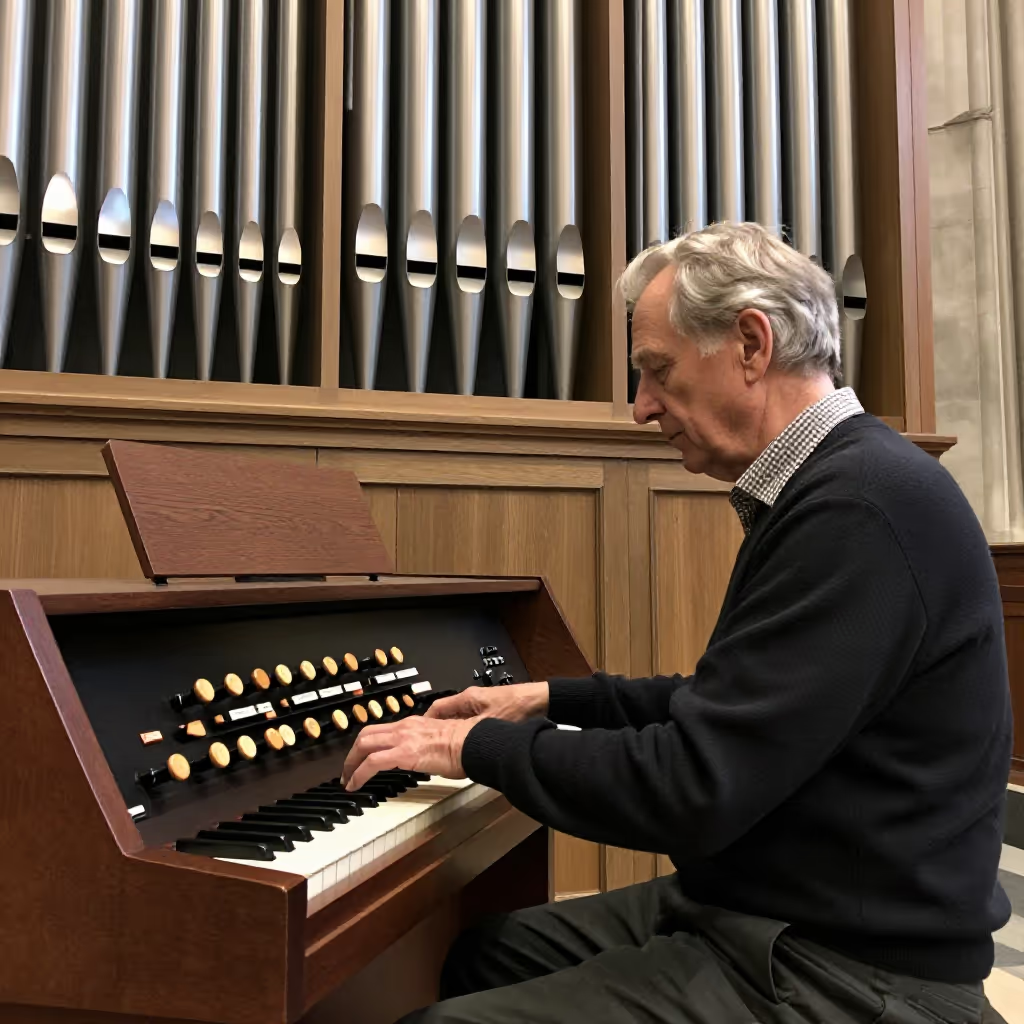
organ stop
A set of organ pipes with the same timbre or construction type that can be switched on or off.
Für das laute Stück wählte der Organist das Trompeten-Register.
For the loud piece, the organist chose the trumpet stop.

register
A small, extremely fast storage area inside a computer processor.
Die CPU speichert Zwischenergebnisse der Berechnungen direkt in ihren Registern.
The CPU stores intermediate results of the calculations directly in its registers.
'Register' (register) is closely related to the verb 'registrieren' (to register, to record) and the noun 'die Registrierung' (registration). The basic idea of systematic recording and organizing appears in many of its meanings.
Haben Sie sich schon für den Newsletter registriert?
Have you already registered for the newsletter?
Since 'Register' (register) has many meanings, context is crucial. Is it about offices and lists, music and voice, language, or computer technology? The accompanying words reveal the meaning.
Der Techniker prüfte die Werte in den Registern des Prozessors.
The technician checked the values in the processor's registers.
The idiom 'alle Register ziehen' (to pull out all the stops) means to use all available means and abilities to achieve a goal. It originally comes from organ playing, where pulling out all the stops produces the fullest sound.
Im Wahlkampf hat die Partei noch einmal alle Register gezogen.
In the election campaign, the party pulled out all the stops one more time.
In the meaning 'official directory', 'Register' (register) is often used with verbs like 'führen' (to keep/maintain), 'eintragen' (to enter/register), or 'einsehen' (to inspect/view). Common compounds are 'Handelsregister' (commercial register), 'Vereinsregister' (register of associations), or 'Strafregister' (criminal record).
Jede Geburt wird im Geburtenregister vermerkt.
Every birth is recorded in the birth register.
In a musical context, 'Register' (register) can refer to the range of a voice, e.g. head voice or chest voice, or to the timbres of an organ. Words like 'Stimme' (voice), 'singen' (to sing), 'hoch' (high), 'tief' (low), or 'Orgel' (organ) point to this.
Die Sängerin wechselte mühelos zwischen den Registern ihrer Stimme.
The singer switched effortlessly between the registers of her voice.
When it comes to language, 'Register' (register) refers to the style level that fits a particular situation. Typical verbs in this context are 'wählen' (to choose), 'verwenden' (to use), or 'wechseln' (to switch).
In einem Gespräch mit Freunden verwendet man ein informelles Register.
In a conversation with friends, you use an informal register.
The meaning of 'Register' (register) as part of a computer processor is purely technical language from computer science. Without this technical context, this meaning is very unlikely.
Der Prozessor führt arithmetische Operationen direkt in seinen Registern aus.
The processor performs arithmetic operations directly in its registers.
list
A Liste can compile names or data for a one-time purpose. A Register, by contrast, systematically records specific data in an official directory. Liste fits a temporary compilation; Register fits permanent official record-keeping.

Die Behörde erfasste die gemeldeten Personen dauerhaft in einem amtlichen Register.
The authorities permanently recorded the registered individuals in an official register.
Die Mitarbeiterin schrieb für den heutigen Termin eine Liste der Besucher.
The employee wrote a list of the visitors for today's appointment.