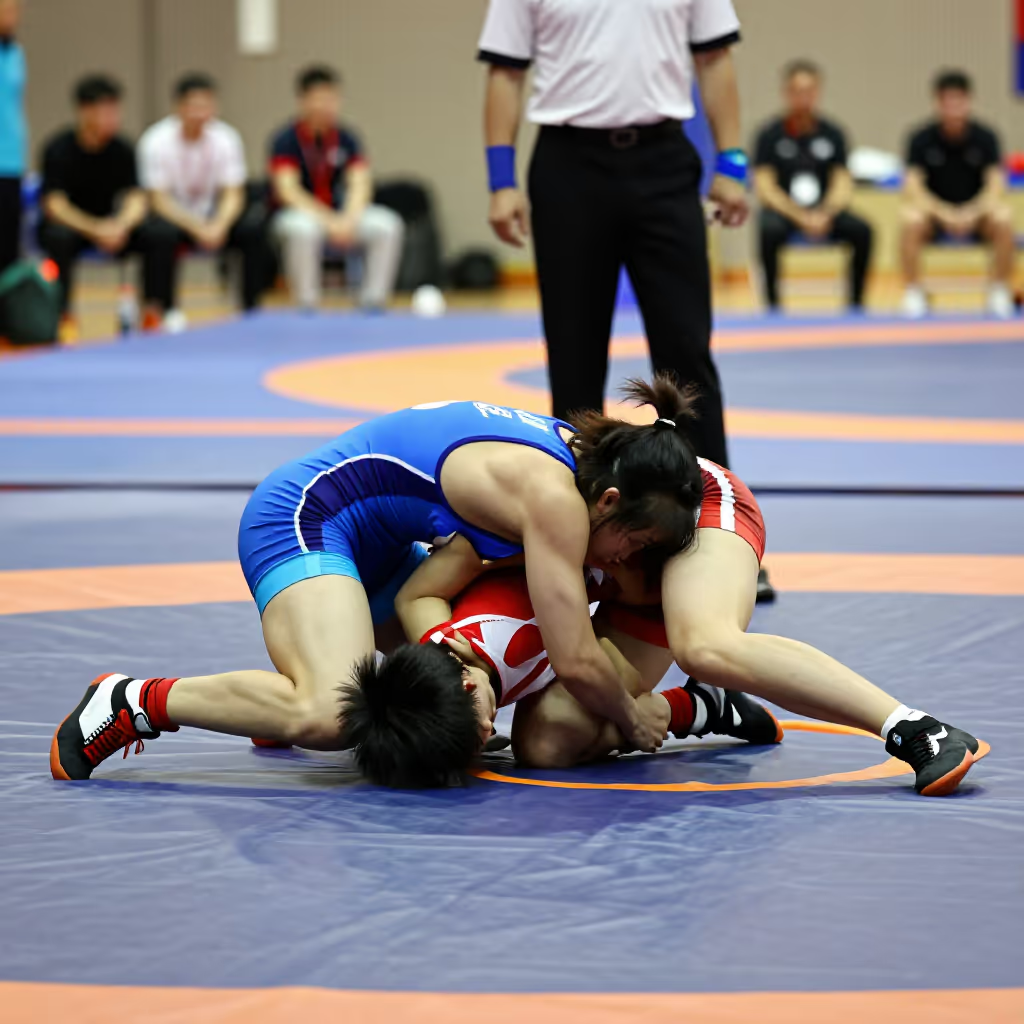
ringen
to wrestle
To practice a combat sport in which two opponents try to force each other to the ground using strength and technique.
Die beiden Athleten rangen fair um den Meistertitel.
The two athletes wrestled fairly for the championship title.

to wrestle / struggle
Loading your saved state.

to wrestle
To practice a combat sport in which two opponents try to force each other to the ground using strength and technique.
Die beiden Athleten rangen fair um den Meistertitel.
The two athletes wrestled fairly for the championship title.


to fight for
To make an intense and strenuous effort for something or fight for something.
Nach dem Unfall rangen die Ärzte stundenlang um das Leben des Patienten.
After the accident, the doctors fought for hours for the patient's life.

to wrestle with
To have an inner struggle with oneself, a difficult decision, or a strong feeling.
Er rang lange mit sich, bevor er sich zu dem Geständnis durchringen konnte.
He wrestled with himself for a long time before he could bring himself to confess.

to struggle for
To make a difficult effort to find or obtain something, especially words, composure, or breath.
Nach dem Schock rang sie sichtlich nach Worten.
After the shock, she was visibly struggling for words.
The meaning of 'ringen' (to wrestle / struggle) changes completely depending on the preposition used. Pay close attention to whether the verb stands alone or is combined with 'um' (for), 'mit' (with), or 'nach' (for/after).
Die Kinder rangen zum Spaß auf der Wiese.
The children wrestled for fun in the meadow.
Without a preposition or with a direct opponent ('ringen gegen jemanden' — to wrestle against someone), 'ringen' almost always describes the combat sport of the same name. The context here is usually athletic.
Schon als Kind hat er im Verein gerungen.
He already wrestled in a club as a child.
The expression 'ringen um' (to fight for) expresses an intense struggle for a goal. Typical goals are 'das Leben' (life), 'eine Lösung' (a solution), 'Anerkennung' (recognition), or 'die Macht' (power).
Die Firma ringt um ihr wirtschaftliches Überleben.
The company is fighting for its economic survival.
With the preposition 'mit' (with), 'ringen' describes an inner or difficult struggle. You can wrestle with 'mit sich selbst' (with oneself), 'mit einer Entscheidung' (with a decision), 'mit den Tränen' (with tears), or 'mit dem Schlaf' (with sleep).
Sie rang sichtlich mit den Tränen, als sie die traurige Nachricht hörte.
She was visibly fighting back tears when she heard the sad news.
The construction 'ringen nach' (to struggle for) describes a desperate, often physical search. It is almost always used in the fixed expressions 'nach Luft ringen' (to gasp for air), 'nach Worten ringen' (to struggle for words), or 'nach Fassung ringen' (to struggle to regain one's composure).
Nach dem langen Sprint rang der Läufer nach Luft.
After the long sprint, the runner gasped for air.
to search / look for
Both words work when someone is trying to find the right words. „Suchen“ describes the general attempt to find the right words, while „ringen“ shows a strong inner or situational block and great effort. Use „suchen“ for normal reflection and „ringen“ when formulating something is particularly difficult.

Ich ringe nach den richtigen Worten für meine Antwort.
I am struggling to find the right words for my answer.
Ich suche nach den richtigen Worten für meine Antwort.
I am looking for the right words for my answer.