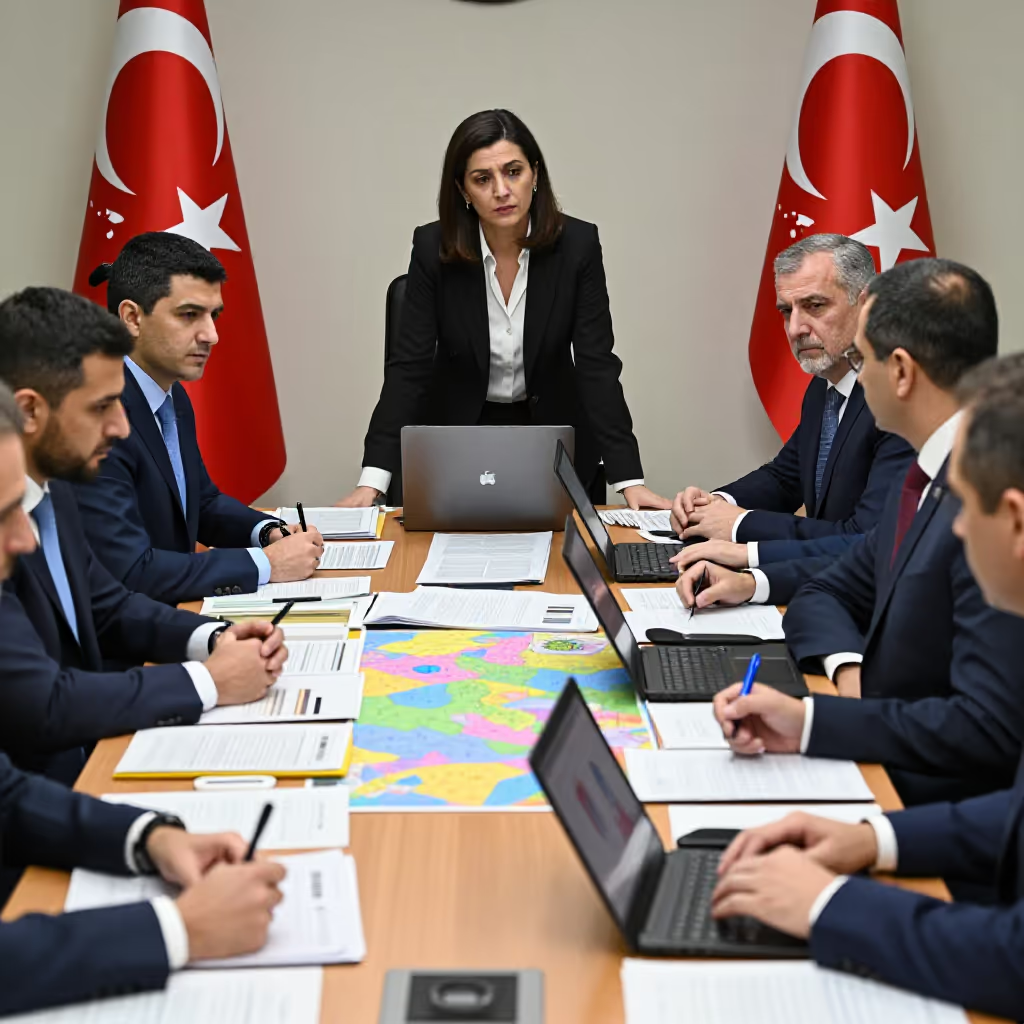
A difficult, problematic, or unstable situation, especially in financial or economic terms.
example
Durch die Krise ist das Unternehmen in eine ernste Schieflage geraten.
Because of the crisis, the company has fallen into a serious difficult situation.

Usage tips
Word composition
The word is made up of 'schief' (crooked/slanted) and 'Lage' (position/situation). The literal meaning of a slanted position (as with a picture on the wall) is transferred to a problematic, unstable situation.
EXAMPLE
Die finanzielle Schieflage des Vereins wurde offen diskutiert.
The club's financial difficulties were openly discussed.
Context clue
The literal meaning refers to physical objects (e.g., a tower, a shelf). The figurative, more common meaning refers to abstract systems such as companies, finances, or the economy.
EXAMPLE
Die Schieflage des Regals ist gefährlich, wir müssen es befestigen.
The tilt of the shelf is dangerous; we need to secure it.
Typical collocations
In the economic or financial meaning, the expression 'in eine Schieflage geraten' (to get into financial/economic difficulty) is often used. Other typical verbs are 'sich befinden' (to be located/to be) or 'bringen' (to bring someone/something into).
EXAMPLE
Viele kleine Betriebe sind durch die Pandemie in eine Schieflage geraten.
Many small businesses got into difficulty because of the pandemic.
Compare with
near_synonym · confusable
Schieflage vs Krise
crisis
'die Krise' and 'die Schieflage' can both mean an unstable and problematic situation. 'Die Krise' is more general and often more serious: it can be political, economic, or personal, and usually requires a clear decision. 'Die Schieflage' is used especially when something has become unbalanced, often with money, companies, or economic problems. It can be the beginning of a crisis, but it does not always sound as dramatic. The words are easy to confuse because both describe problems and uncertainty. If you mean the whole serious situation, 'Krise' fits better; if you want to emphasize an imbalance or financial problems, 'Schieflage' is more precise.
Schieflage
Durch die hohen Kosten ist der kleine Verein in eine finanzielle Schieflage geraten.
Because of the high costs, the small association has got into financial difficulties.
Krise
Die Krise im Team wurde größer, weil niemand offen über die Probleme sprach.
The crisis in the team got worse because no one spoke openly about the problems.